When evaluating a new apartment, villa, or commercial space, property buyers often look for a single numerical metric to gauge architectural harmony. A generic online checklist might tell you that having an east-facing door gives you a passing grade, but experienced spatial energy consultants know that real-world environments are far more complex. Evaluating a layout requires understanding how different areas of a structure influence specific life outcomes, which is why a scientific vastu score calculator relies on weighted directional zones rather than simple yes-or-no questions.
Every square foot of a building carries a specific energetic function based on elemental alignments like Fire, Earth, Water, Air, and Space. A flaw in a non-critical zone might cause minor inconveniences, whereas a defect in a primary power center can severely disrupt financial stability, physical vitality, or relationship clarity. Learning how weighted algorithms determine an accurate property Vastu score gives homeowners, investors, and architects the objective clarity needed to make sound real estate decisions without falling prey to fear-based myths or oversimplified ratings.
Understanding How a Vastu Score Calculator Evaluates Living Spaces
A true spatial energy assessment does not treat all directions equally. Traditional architectural principles recognize that certain cardinal and intercardinal orientations govern foundational life energies. An automated Vastu rating calculator that assigns equal points to every room fails to reflect how residents actually experience a building over time.
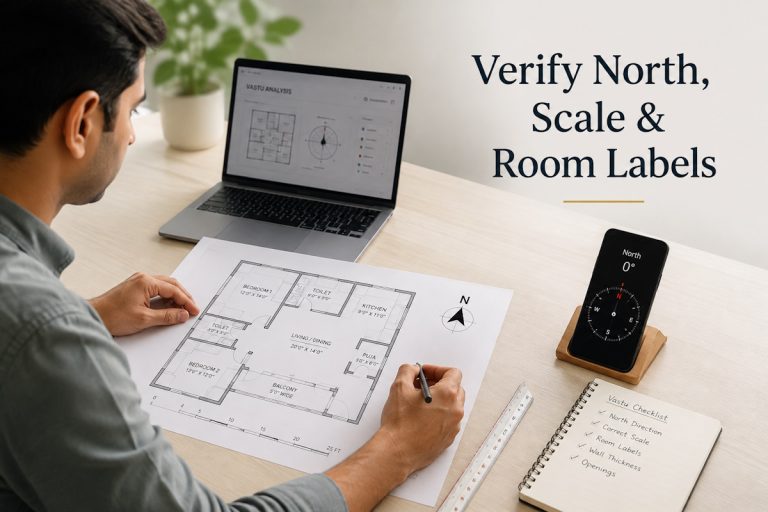
When you assess a floor plan, you must establish an energetic baseline. This begins by mapping the precise geographical degrees of the property rather than relying on assumed street directions. Once the orientation is clear, the layout is broken down into functional sectors to determine how spatial distributions affect daily life, mental peace, and long-term prosperity. To see how these ratings are structured across modern properties, you can Understand Your Property Vastu Score with detailed analytical metrics.
The Problem With Basic Percentage-Based Checklists
Most free online tools use a flat calculation model. If a floor plan contains ten rooms and eight of them align with standard guidelines, the tool displays an eighty percent compliance rate. However, if the two non-compliant zones happen to be the primary entrance and the master bedroom located over a sensitive water zone, the property will feel chaotic despite the seemingly high score.
A flat percentage creates a false sense of security. It treats a misplaced storage shelf with the same mathematical weight as a misplaced kitchen stove or underground septic tank. To establish a realistic assessment, advanced tools utilize weighted evaluation models that reflect true spatial mechanics.
The Role of Mathematical Weightage in Spatial Energy
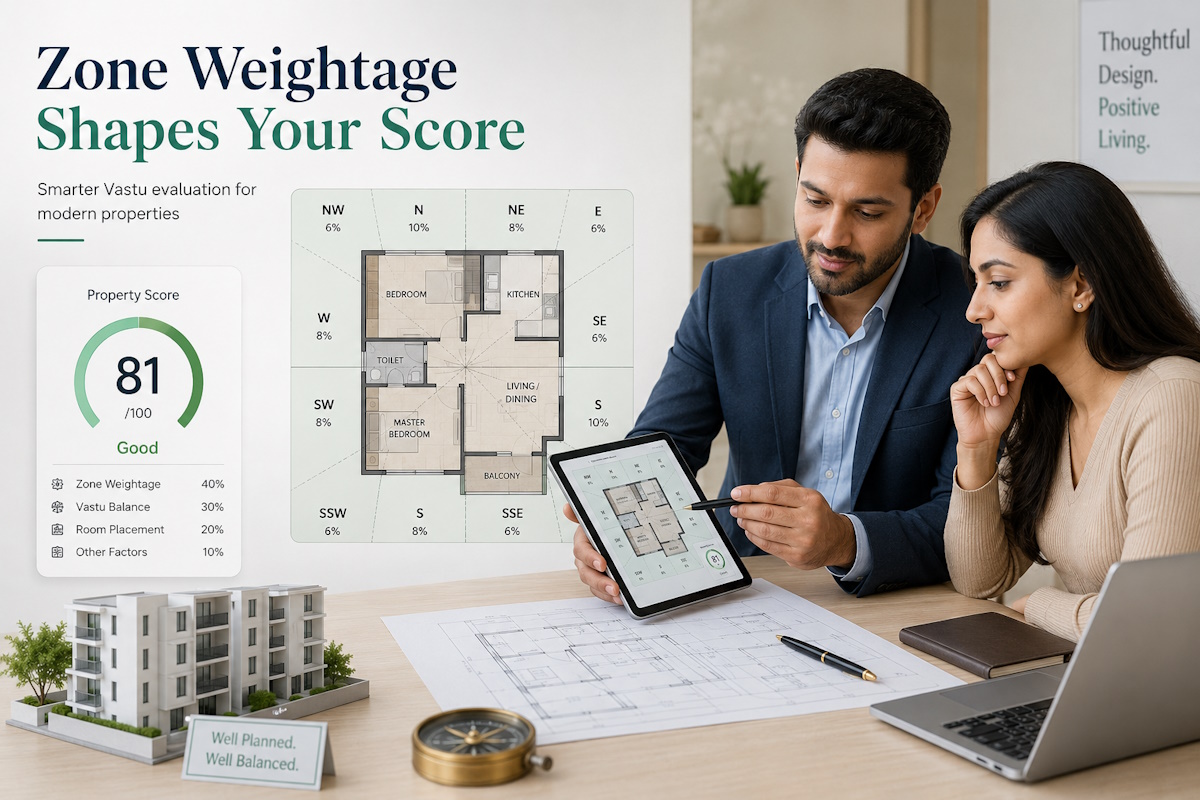
Zone weightage assigns distinct mathematical multipliers to different sectors of a home based on their elemental vulnerability and functional usage. The Northeast, Southwest, Southeast, and Northwest hold the highest impact coefficients because they govern foundational health, stability, financial cash flow, and mental support systems.
When a house Vastu calculator applies weighted formulas, minor imbalances in secondary zones like the West-Northwest or East-Southeast do not drastically reduce your rating. Conversely, severe imbalances in the core energy centers immediately adjust the score downward, alerting the occupant to areas that require non-invasive corrective remedies.
The 16-Zone Energy Framework and Weight Distribution
Classical architecture divides the cardinal and intercardinal spectrum into sixteen distinct energetic divisions, each spanning exactly 22.5 degrees. A dependable 16 zone Vastu score calculates the balance of elements across each of these slices, ensuring no energetic sector is overlooked.
Understanding these sixteen zones allows property owners to identify where specific friction originates. Instead of broadly stating that a home has negative energy, precise zonal mapping pinpoints whether a financial bottleneck stems from an overburdened North zone or if sleep disturbances arise from an imbalanced South-Southwest sector. Modern structural assessments benefit immensely from a Personalized 16-Zone Vastu Analysis designed for contemporary architectural layouts.
High-Impact Primary Zones
Certain zones possess high sensitivity due to their primary elemental associations. When these areas are compromised, the entire property experiences energetic turbulence.
Northeast (Ishanya) and North Zones
Governed by the Water element and expansive Space energy, the Northeast represents cognitive clarity, spiritual peace, and overall well-being. The North sector governs financial opportunities and career growth. Heavy structural loads, blocked openings, or incorrect toilet placements in these areas carry the highest negative weight in any reliable calculation model.
Southwest (Nairutya) and South Zones
The Southwest sector embodies the Earth element, providing grounding, relationship stability, and life longevity. Placing water tanks, cuts, or main entrances in the Southwest heavily penalizes the overall rating because an unstable foundation compromises every other functional zone in the house.
Moderate and Low-Impact Supporting Zones
Not every sector carries existential weight. Secondary zones regulate routine aspects of lifestyle and social behavior, allowing for greater architectural flexibility.
East and Northwest Zones
The East governs social connectivity and vitality, while the Northwest controls support systems, banking relationships, and temporary movement. While imbalances here can cause friction in networking or delays in support, they rarely lead to structural collapse in health or finances.
West and transitional sectors
The West represents gains and profitability, acting as an outcome zone rather than an initiating energy center. Minor adjustments in transitional sectors like West-Southwest or East-Northeast carry moderate multipliers in a Vastu compliance calculator, making them easier to manage through non-demolition remedies like color therapy, metal strips, or directional realignment.
How Zone Conflicts Alter Your Overall Vastu Score
When evaluating a property layout, zone conflicts arise when opposing elemental activities occupy a delicate sector. A comprehensive vastu score calculator evaluates not just room placement, but also how elements interact within specific degrees.
For instance, water elements located inside a fire zone create an immediate elemental clash. Fire represents liquidity, motivation, and digestive health. Introducing blue hues, mirrors, or water storage into the Southeast dampens that fire, reducing the overall property rating significantly more than a simple aesthetic mismatch would.
Elemental Contradictions and Score Penalties
Every element in nature follows a cycle of creation and destruction. When calculating property scores, algorithms penalize layouts where destructive elemental cycles are present.
- Water in Fire Zones: Placing sinks, water filters, or blue interior finishes in the Southeast or South dampens financial vitality and physical energy.
- Fire in Water Zones: Locating kitchens, heating equipment, or vibrant red elements in the North or Northeast causes mental agitation and depletes liquidity.
- Earth in Air Zones: Introducing excessive heavy storage in the East or North suppresses spontaneous opportunities and fresh air circulation.
- Space Reductions: Cutting off the central Brahmasthan or creating structural cuts in corners limits the expansive potential of the property.
Distinguishing between superficial room assessments and deep elemental calculations is critical when choosing between a Free vs Detailed Vastu Assessment for long-term family peace and investments.
Structural Cuts, Extensions, and Geometric Irregularities
Modern urban apartments frequently feature L-shaped, T-shaped, or irregular geometric footprints. When a sector is missing entirely from a layout, that specific life attribute experiences an energetic deficit.
A missing Northeast corner heavily drags down the composite score of an apartment because it deprives the layout of solar and cosmic energy. Conversely, a minor extension in the North or East can add positive mathematical weight to the score, enhancing overall balance even if secondary rooms have minor flaws.
Practical Application: Making Decisions Using a Property Vastu Score
Obtaining a spatial energy rating is not about achieving absolute perfection. In modern civil construction, finding a home with one hundred percent alignment is virtually impossible. The objective of using a vastu score calculator is risk assessment, strategic prioritization, and informed decision-making.
When evaluating a potential purchase, a score between seventy-five and eighty-five percent indicates a solid, supportive baseline where any existing defects can be neutralized through non-invasive remedies. A score below fifty percent, driven by critical flaws in the Southwest, Northeast, or Brahmasthan, signals that rectifying the property may require substantial structural modifications or ongoing corrective efforts.
Evaluating Prospective Real Estate Purchases
Before signing a lease or finalizing a property purchase, run the architectural blueprint through a weighted assessment model. Look closely at which specific zones are lowering the score.
If the lower score is caused by an improperly positioned study room or a guest bedroom in a neutral zone, it should not deter your purchase. However, if the penalty stems from an underground drainage chamber directly in the center of the home or an entrance in an unfavorable energy field, you can use this data to negotiate or seek alternative layouts.
Prioritizing Non-Invasive Remedies
Once you understand your property’s weighted rating, focus your corrective efforts solely on the high-impact areas that carry the greatest mathematical weight.
- Neutralize Elemental Clashes: Use appropriate element balancers like brass, copper, or stainless steel strips to demarcate zones without breaking floors.
- Optimize Color Frequencies: Repaint imbalanced sectors with neutral, balancing tones to calm aggravated energies.
- Redistribute Weight: Shift heavy furniture and storage wardrobes toward the South and West sectors to naturally reinforce stability.
- Clear Energy Pathways: Keep the central Brahmasthan, North, and Northeast sectors clutter-free to allow smooth circulation of vital life force.
Frequently Asked Questions
1. What is an acceptable score on a vastu score calculator?
A score between 70% and 85% is considered healthy and supportive for modern residential properties. Minor defects within this range are common and can usually be balanced using simple, non-invasive remedies without structural demolition.
2. Why do different calculators give different scores for the same floor plan?
Variations occur because basic tools use flat checklists where every room has equal value, while advanced calculators apply weighted scoring based on the 16-zone elemental framework and critical cardinal directions.
3. Can a low property Vastu score be improved without breaking walls?
Yes. Most spatial imbalances can be corrected using elemental balancing techniques, color adjustments, strategic metal installations, shifting room functions, and redistributing heavy furniture across stable zones.
4. Which zone carries the highest weight in a house Vastu calculation?
The Northeast (Ishanya), Southwest (Nairutya), and the central core (Brahmasthan) carry the highest weight because they govern foundational health, mental clarity, relationship stability, and life balance.
5. Does a vastu score calculator work for modern commercial offices and apartments?
Yes. The principles of directional degrees, elemental distribution, and weighted zonal impacts apply equally to apartments, individual houses, corporate offices, and industrial layouts.