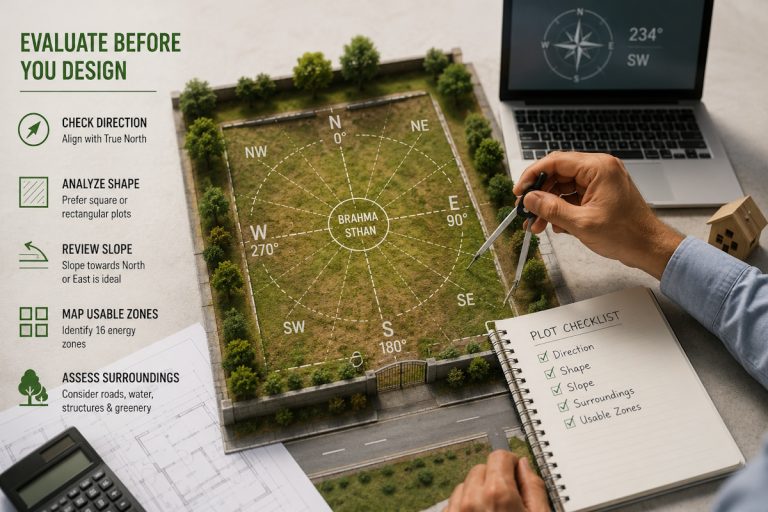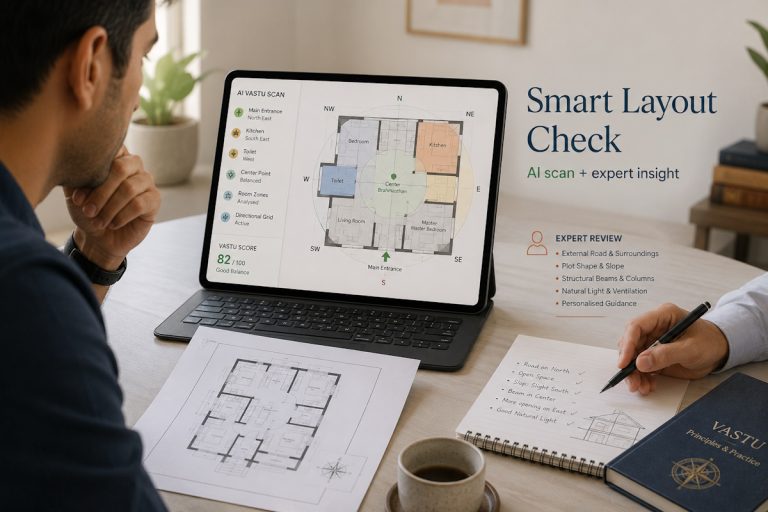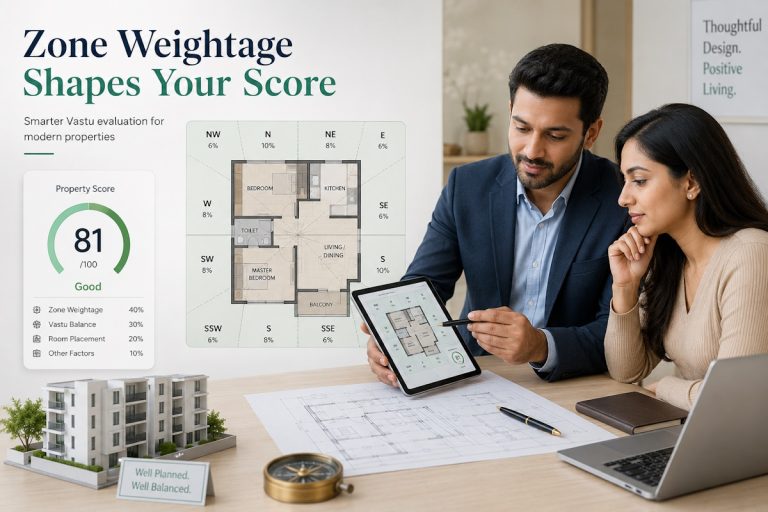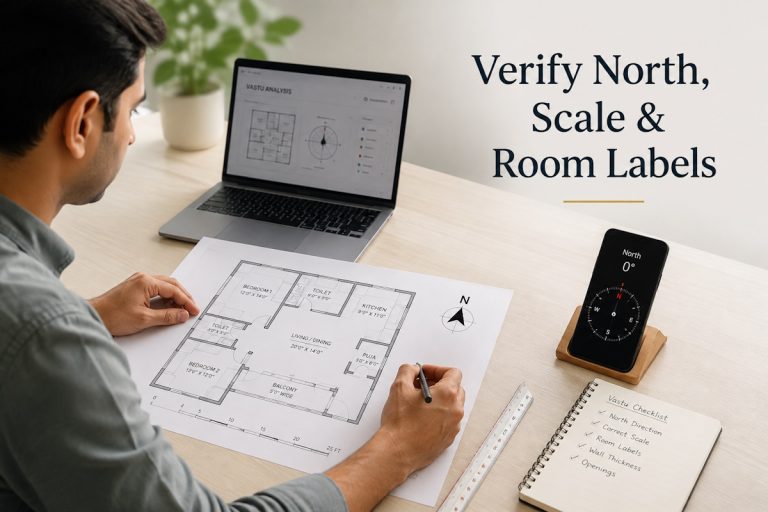
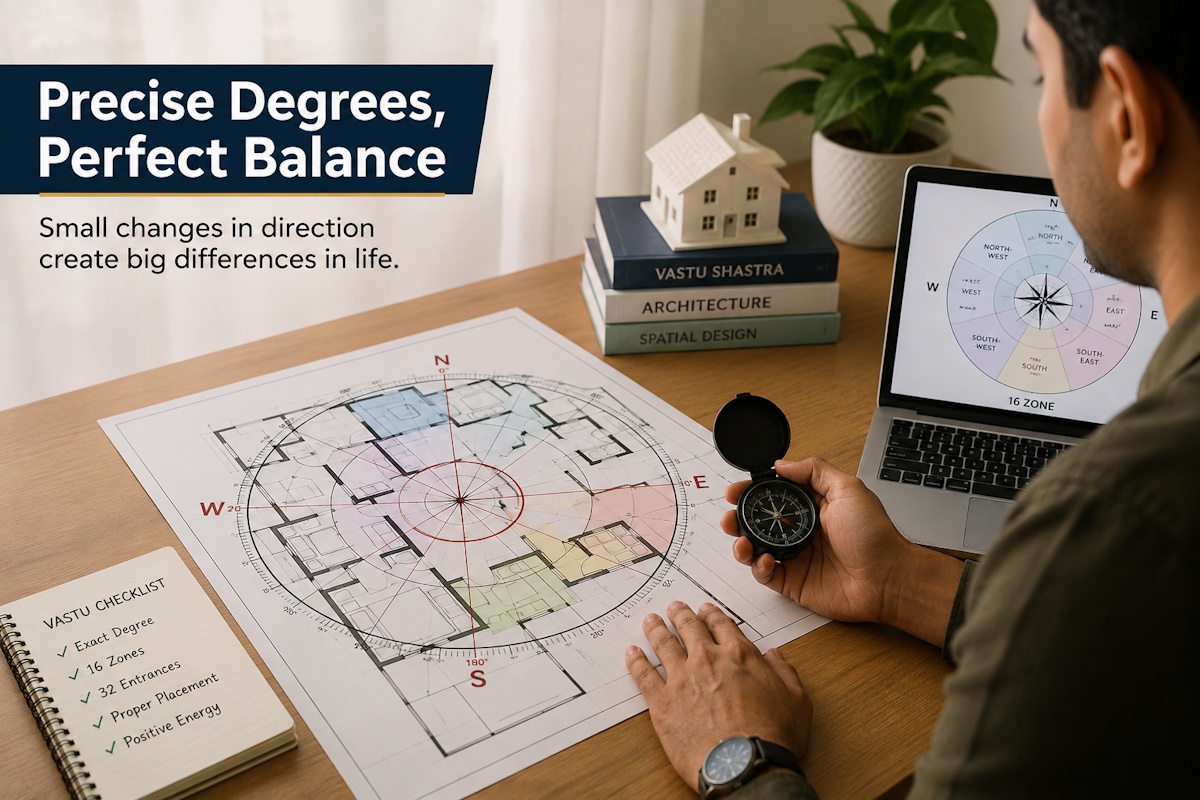
When evaluating a home, office, or apartment, most property buyers and homeowners start with a basic assumption. They look at where the sun rises or check a simple smartphone compass and declare the property to be east facing or north facing. While this broad directional labeling is a traditional starting point, it frequently leads to severe miscalculations in modern spatial planning. Spatial energy does not operate on vague quadrant estimates, it aligns with exact magnetic orientations that dictate how natural forces interact with built environments.
Relying solely on general cardinal directions often results in incorrect placement of vital functional zones such as kitchens, bedrooms, and main entryways. A shift of just five to ten degrees can completely alter the energetic profile of a room, turning what seemed like an auspicious location into a zone of chronic imbalance. This is why using an authentic vastu direction checker based on precise compass degrees is far more important than merely labeling a property North, South, East, or West.
The Flaw of Cardinal Quadrants in Modern Architecture
Traditional architecture often utilized symmetrical plots aligned directly with true cardinal axes. In contemporary urban developments, however, buildings are constructed along road alignments, irregular plot shapes, and complex grid plans. When a property is tilted even slightly off the cardinal axis, the traditional four-direction model fails to provide reliable insights.
The Difference Between Broad Facing and Exact Degree Alignment
A property is rarely aligned at exactly zero degrees North, ninety degrees East, one hundred eighty degrees South, or two hundred seventy degrees West. Most modern structures are angular, sitting at degrees like 15 degrees North-Northeast or 105 degrees East-Southeast. When you assess a building using broad strokes, you overlook these subtle angular deviations. To ensure your spatial assessments are technically sound, homeowners should Understand Accurate Vastu Zone Mapping before committing to structural layouts or interior designs.
How a Small Degree Shift Changes Energy Fields
Spatial energies in Vastu Shastra are mapped across a 360-degree circle divided into distinct energy bands. Each band governs specific physiological, psychological, and financial aspects of life. If an entrance is calculated assuming zero degrees North when the building actually sits at twelve degrees, the doorway shifts into an entirely different energetic sector. This discrepancy explains why two homes with identical architectural blueprints can produce radically different living experiences for their occupants.
Moving from 8 Directions to the 16 Vastu Directions
Classical texts outline a sophisticated framework that divides space far beyond the primary cardinal and ordinal points. To understand the subtle influences within a property, one must examine how the space is divided into micro-zones.
The Science of the 16 Energetic Zones
A comprehensive spatial audit divides the 360-degree layout into 16 Vastu directions, with each zone occupying an exact span of 22.5 degrees. Each zone represents a distinct combination of elemental attributes and functional resonance:
- North (N): Governs career growth, new opportunities, and liquid wealth.
- North-East (NE): The zone of mental clarity, spiritual connection, and wisdom.
- East (E): Controls social connectivity, networking, and external associations.
- South-East (SE): The fire sector, governing cash flow, operational liquidity, and vitality.
- South (S): Connected to brand reputation, fame, and relaxed sleep.
- South-West (SW): The earth anchor, responsible for stability, relationship harmony, and core skills.
- West (W): Governs commercial gains, profitability, and realization of goals.
- North-West (NW): Governs supportive relationships, banking assistance, and routine logistics.
When assessing a property, understanding the transition between these micro-zones is critical. Comparing Direction-Based Vastu vs 16-Zone Vastu reveals why high-level directional checks miss the nuances that cause persistent domestic friction or business delays.
Why 22.5-Degree Angular Spans Require Exact Instruments
Because each zone covers precisely 22.5 degrees, an error of just three to four degrees during measurement can shift an entire room from an auspicious sector to an incompatible one. For example, placing a master bedroom in the South-West builds stability, but if the angular calculation is off and the room falls into the South-South-West zone, it can stimulate chronic exhaustion and financial leakage. A dedicated house direction checker eliminates this guesswork by pinpointing the center point and degree distribution accurately.
Accurate Entrance Evaluation Using 32 Entrances
The main entrance is the primary threshold through which environmental energy enters a built structure. In classical directional science, the perimeter is divided into 32 distinct entry segments, known as padas, each occupying an angular division of 11.25 degrees.
The Critical Nature of Entrance Direction Vastu
Evaluating an entrance direction Vastu profile requires extreme mathematical precision. Out of the 32 potential entry gates around a perimeter, only a select few are considered universally positive for sustained prosperity, peace, and health. The remaining segments may introduce subtle instability depending on their elemental alignment.
Positive vs Problematic Gateway Positions
Consider the eastern facade. An entrance positioned in the third or fourth sector of the East brings notable social prestige and financial progress. However, shifting just 11.25 degrees into the first sector of the East can trigger unpredictable financial expenses and relationship friction. Without taking a precise Vastu compass direction measurement, distinguishing between these adjacent sectors is virtually impossible.
Verifying Main Doors in Multi-Story Apartments
Apartment units present unique measurement hurdles due to structural steel reinforcements, elevator shafts, and adjacent electrical rooms. Measuring the entrance from inside a hallway often leads to magnetic deflection. A reliable assessment requires calculating the master degree of the building structure before plotting individual flat entrances on a standardized grid.
How to Perform a Proper Vastu Degree Calculation
Determining the exact angular orientation of a property is a methodical process that requires systematic observation and verification rather than quick smartphone checks.
Step-by-Step Degree Verification Protocol
To establish an authentic baseline for your property layout, professional evaluators recommend a standard field protocol:
- Step 1: Stand Clear of Structural Steel: Take readings away from reinforced concrete columns, metallic gates, and heavy electrical panels that distort magnetic needles.
- Step 2: Take Multiple External Readings: Record compass bearings along the outer boundary or open exterior faces of the building to find the true magnetic axis.
- Step 3: Establish the Center Point (Brahmasthan): Identify the geometric center of the architectural floor plan using proportional division.
- Step 4: Superimpose the 360-Degree Wheel: Project the exact magnetic orientation onto the floor plan from the identified center point.
Knowing what materials to gather beforehand makes this assessment efficient. Property owners should Prepare for Accurate 16-Zone Analysis by securing an exact architectural blueprint before interpreting angular findings.
Common Pitfalls in DIY Direction Checking
The most common mistake occupants make is relying on uncalibrated mobile apps inside closed rooms. Magnetic sensors in mobile devices are sensitive to internal wiring, false ceiling metal framing, and electronic appliances. A professional Vastu degree calculation cross-references satellite geospatial data with field compass measurements to eliminate local magnetic interference.
Practical Remedies Without Structural Demolition
Discovering that an entrance or critical room is misaligned with its ideal zone does not mean you must undertake expensive structural renovations. Modern directional science focuses on balancing elemental fields using non-invasive corrections.
Elemental Balancing and Zone Stabilization
When an essential functional area falls into an incompatible sector due to angular shifts, the disharmony is addressed by balancing the five fundamental elements: Earth, Water, Fire, Air, and Space. For instance, if a water fixture is located in a fire-dominated South-East sector due to an unmeasured angular tilt, corrective color frequencies, specific metallic strips, or elemental reflectors can be installed to neutralize the spatial friction without moving the plumbing lines.
Reclaiming Clarity Through Technical Precision
Operating on assumptions often creates unnecessary anxiety. Many homeowners spend months worrying about an entrance they believe is in an unfavorable direction, only for an exact angular check to show it sits comfortably in an auspicious sub-zone. Precision brings clarity, allowing you to focus on meaningful spatial improvements that support your daily productivity and family well-being.
Making Confident Property Decisions
Whether you are purchasing a new apartment, designing a commercial workspace, or renovating an existing home, the quality of your spatial insights depends entirely on the accuracy of your directional data. Broad generalizations about North or East facing properties are insufficient in an era of complex architecture. Using a precise, degree-based evaluation method ensures that every room, door, and workspace is placed with intention, creating an environment that supports health, focus, and sustainable prosperity.
Frequently Asked Questions
1. Can I use my smartphone compass as a reliable vastu direction checker?
Smartphone compasses can give a quick general bearing, but they are vulnerable to electromagnetic interference from internal building materials, rebar, and household wiring. For a reliable assessment, take readings outdoors or cross-verify mobile data with architectural site plans and professional grade optical compasses.
2. How does a degree shift impact an apartment layout?
In apartments, a degree shift alters the boundary lines of all 16 energetic zones. A room you thought was in the prosperous North zone might actually fall into North-North-West, changing the elemental dynamics and influencing how that space should be utilized for sleeping, working, or storage.
3. What is the difference between True North and Magnetic North in Vastu?
Vastu Shastra primarily works with the Earth’s magnetic energy grid, meaning magnetic orientations are central to spatial assessments. A professional evaluation takes local magnetic declination into account when overlaying the 16-zone grid onto property blueprints.
4. Do I need to break walls if my entrance is in the wrong degree zone?
No, structural demolition is rarely necessary. Authentic modern Vastu relies on non-invasive balancing techniques, including elemental colors, geometric metals, and spatial alignment tools, to correct energetic discrepancies identified by directional calculations.