
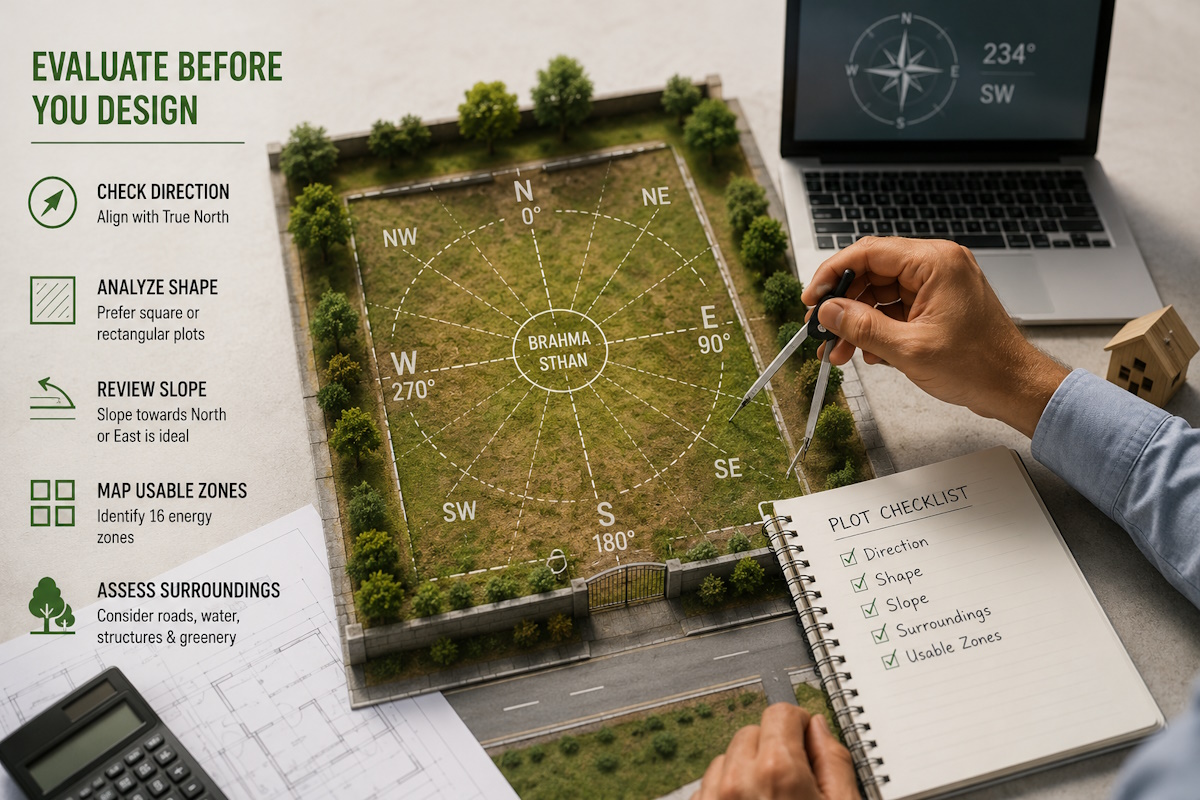
Purchasing a piece of land is one of the most substantial financial and emotional commitments a person can make. When building a home or commercial project from the ground up, the underlying land serves as the energetic foundation for everything that follows. Many buyers focus entirely on road connectivity, municipal approvals, and square footage, overlooking how natural energy patterns, land slope, and directional alignment interact with the human nervous system and daily productivity. A layout created on compromised ground often forces awkward architectural workarounds later.
Using a structured calculation methodology allows you to look past surface aesthetics and understand how elemental forces move across a parcel of land. A modern plot vastu calculator framework evaluates directional degrees, geometric symmetry, environmental gradients, and usable zones before you draft blueprints or pour concrete. This proactive evaluation ensures you design with the land rather than against it, creating living spaces that support health, mental clarity, and enduring stability.
Understanding the Core Metrics of a Plot Vastu Calculator
Every piece of land interacts with solar paths, magnetic fields, and geothermal currents. Assessing these factors systematically removes guesswork, giving architects and buyers objective parameters to determine if a site is suitable for construction.
Evaluating Directional Degrees and True Magnetic North
A frequent error during site selection is assuming that the facing road strictly defines the plot orientation. In reality, properties are rarely aligned perfectly with true geographic north. A dependable Check Plot Shape Vastu evaluation begins by calculating the angular deviation using a compass. When a plot tilts more than twenty degrees off the cardinal axis, it is considered a tilted or skewed plot. This tilt changes how sunlight enters the building and shifts elemental quadrants, requiring specialized spatial adjustments before building.
The Mathematical Balance of Plot Shapes and Proportions
Energy distributes most evenly across balanced geometries. Traditional Vedic architecture and modern spatial dynamics both prioritize square and rectangular land parcels. A square plot offers symmetrical energy distribution, while a rectangular plot with a length-to-width ratio within 1:2 promotes stable energy flow. If you evaluate an irregular layout, taking exact measurements of all boundaries helps determine whether corner extensions or cuts require geometric correction before laying the foundation.
Evaluating Natural Slope, Soil Quality, and Water Gradients
Beyond two-dimensional boundary lines, the three-dimensional topography of land dictates how subtle energies and environmental elements settle across the site.
Determining Land Gradient and Drainage Patterns
A crucial factor in land Vastu analysis is the elevation and slope of the ground. Historically, plots sloping downward toward the North and East encourage the natural absorption of beneficial morning sunlight and magnetic flux. Conversely, land that drops sharply toward the South or West tends to drain environmental stability and financial resilience. Modern engineering reinforces this logic, because proper grading toward the northeast prevents water stagnation near the southern and western load-bearing foundations.
Plot Orientation Vastu and Environmental Surroundings
The energy of a property does not exist in isolation. Surrounding structures, large trees, electrical transformers, water bodies, and high-rise developments alter energy distribution. Using an accurate plot direction calculator approach involves assessing these external influences. Heavy structures or hills in the South and West provide natural grounding, whereas massive obstructions in the North and East can block vital morning light and positive atmospheric energy.
Understanding these parameters early prevents costly structural corrections later. Homeowners can Analyze Plot Zones Before Construction to ensure the physical building sits harmoniously within the larger environmental matrix.
Mapping the 16 Energy Zones Across the Plot
Traditional Vastu Shastra divides any demarcated space into distinct functional zones, each governing specific aspects of physical health, emotional harmony, and financial growth.
Dividing the Plot Matrix Using the Center Point (Brahmasthan)
To accurately calculate the 16 zones, you must establish the geometric center, or Brahmasthan, of the plot. From this central reference point, the 360-degree radius is divided into sixteen directional bands of 22.5 degrees each. Each sector governs a primary elemental force: Water in the North-East, Air in the East, Fire in the South-East, Earth in the South-West, and Space across the center and North-West. Accurate zonal mapping prevents critical utilities, like septic tanks or water reservoirs, from being placed in conflicting elemental zones.
Allocating Functional Utilities and Open Setbacks
Once the grid is established, you can plan structural setbacks and infrastructure logically. Consider these structural planning rules:
- North and East Zones: Keep open, light, and lower in elevation; ideal for gardens, main access pathways, and underground rainwater harvesting tanks.
- South and West Zones: Best suited for heavy construction, master bedrooms, retaining walls, and overhead water storage.
- South-East Zone: Natural placement for the electrical meter, generator sets, and the primary kitchen layout.
- North-West Zone: Ideal for car parking, guest structures, and above-ground auxiliary services.
Applying structured plot selection Vastu ensures that building utilities align with these core elemental guidelines before civil works commence.
Addressing Irregularities, Cuts, and Road Impacts
Very few urban plots are perfectly rectangular or completely unencumbered by external road conditions. Recognizing common layout challenges allows for timely, non-invasive remediation.
Managing Corner Cuts and Extensions
When a plot has an extended or missing corner, energy distribution becomes unbalanced. For example, an extended North-East corner is traditionally viewed as beneficial because it expands the Water element, supporting clarity and wisdom. However, an extension in the South-East or South-West can introduce restlessness or financial volatility. When irregularities are present, you can Evaluate a Plot With Vastu and Ayadi to re-square the usable core through intentional compound wall alignments, landscaping, or energetic demarcation lines.
Assessing Road Hits and T-Junctions (Veethi Shoola)
A road terminating directly into any side of a plot generates intense, focused kinetic energy. While certain road hits from the North-East or East can be advantageous when managed correctly, road hits from the South, South-West, or North-West often create environmental stress and disruption. Addressing a road hit requires assessing traffic velocity, constructing protective buffer zones, and using strategic landscaping rather than abandoning the plot unnecessarily.
Practical Steps Before Finalizing Your Plot Purchase
Integrating spatial science into your real estate decisions should be empowering, practical, and grounded in logic. You do not need to seek an unattainable, flawless plot; the objective is to understand your land’s baseline dynamics so your architect can design an intelligent, supportive floor plan.
Before executing a deed or finalizing building plans, perform a systematic evaluation of directional angles, topographical grade, soil vitality, and surrounding physical structures. Professional spatial assessments conducted by Vastu Consult use digital directional mapping and grid analysis to resolve design dilemmas early, saving significant time, money, and structural remodeling down the road.
Frequently Asked Questions
1. Can an irregular or triangular plot be made Vastu-compliant?
Yes. An irregular or triangular plot can often be normalized by demarcating a square or rectangular usable boundary within the land. The remaining irregular angles can be separated using boundary walls, dense green landscaping, or utility paths, isolating the primary residential zone from chaotic energy patterns.
2. How do I know if my plot has a directional tilt?
To determine directional tilt, stand in the center of the plot and use an accurate magnetic compass or digital surveying tool. Note the degree reading of the front boundary. If the front boundary does not align within 0 to 10 degrees of Magnetic North, East, South, or West, the plot is tilted and requires angular spatial calibration.
3. What is the ideal placement for a borewell or water reservoir on a vacant plot?
The North, North-East, and East sectors are the most suitable locations for underground water sources such as borewells, wells, and municipal storage tanks. These areas correspond to the Water element and allow smooth energetic circulation. Avoid placing underground water storage in the South-West or South-East quadrants.
4. Does road connectivity on multiple sides change the Vastu of a plot?
Yes. Corner plots with roads on two sides, particularly North and East, offer substantial natural light and balanced energy movement. Plots surrounded by roads on all four sides are also favorable if built with adequate setbacks. However, the exact location of the main gates must be determined through precise zonal calculations.