Sleep quality directly impacts physical vitality, emotional stability, and professional performance. When a bedroom feels unsettling or fails to provide deep rest, many homeowners look at mattress quality, ambient noise, or room temperature. While these physical factors are important, the underlying spatial geometry and directional alignment of the room play an equally foundational role. In classical spatial planning, the bedroom is not just a room with furniture, but a private sanctuary where your physical body recharges against the subtle magnetic and energetic currents of the earth.
Applying sound principles of Bedroom Vastu helps create an environment that supports nervous system recovery and long-term well-being. Modern architectural constraints often place bedrooms in compromises dictated by plot boundaries or duct locations. Understanding how room placement, bed alignment, door flow, mirror reflections, and storage systems interact allows you to identify subtle imbalances and make informed corrections without resorting to structural demolition.
The Fundamentals of Bedroom Placement Vastu and Spatial Energy
The positioning of rooms within a floor plan dictates the primary elemental influences experienced by the occupants. In spatial science, the south-west and southern quadrants of a house carry grounding, stabilizing earth energy, whereas the north-east carries light, ethereal water energy. Aligning the primary resting zones with appropriate quadrants ensures that sleep remains calm, uninterrupted, and deeply restorative.
Directional Zonal Strengths for the Master Bedroom
The primary resting space for the head of the household requires stability, authority, and emotional grounding. In traditional spatial analysis, master bedroom Vastu strongly prioritizes the South-West (Nairutya) zone. The Earth element dominating this quadrant brings a steadying influence that supports decision-making, relationship stability, and restorative sleep. When planning or evaluating a home, prioritizing a south-west or south bedroom placement provides natural energetic grounding.
Alternative zones for bedrooms include the South and West sectors. The South zone promotes deep relaxation and physical restoration, while the West zone supports prosperity and structured routine. Conversely, placing the main bedroom in the North-East or South-East often leads to sleep disturbances. The North-East possesses active intellectual and spiritual energy that keeps the conscious mind alert, while the South-East carries the active Fire element, which can elevate restlessness or irritability.
Why Master Bedroom Vastu Matters for Household Stability
The primary occupants of a home carry the central responsibilities of managing finances, family relationships, and personal careers. If their recovery space is unsettled, mental fatigue accumulates over time. To ensure that your resting zones do not clash with vulnerable structural areas, you can Check Sensitive Vastu Zones in Your Home to evaluate whether your sleeping quarters support stability.
Optimal Bed Direction Vastu and Alignment for Restorative Sleep
Once the room itself is situated, the physical placement and orientation of the bed become the most critical operational factor in Bedroom Vastu. Your body acts as a biological conductor influenced by the earth’s natural geomagnetic fields. Proper alignment reduces electromagnetic friction and promotes lower heart rate variability during deep sleep cycles.
Recommended Sleeping Direction Vastu Principles
The term sleeping direction Vastu refers to the direction your head points while lying down in bed. The orientation of your crown determines how your bio-magnetic field aligns with the planet’s North-South magnetic axis.
Sleeping with Head Towards the South
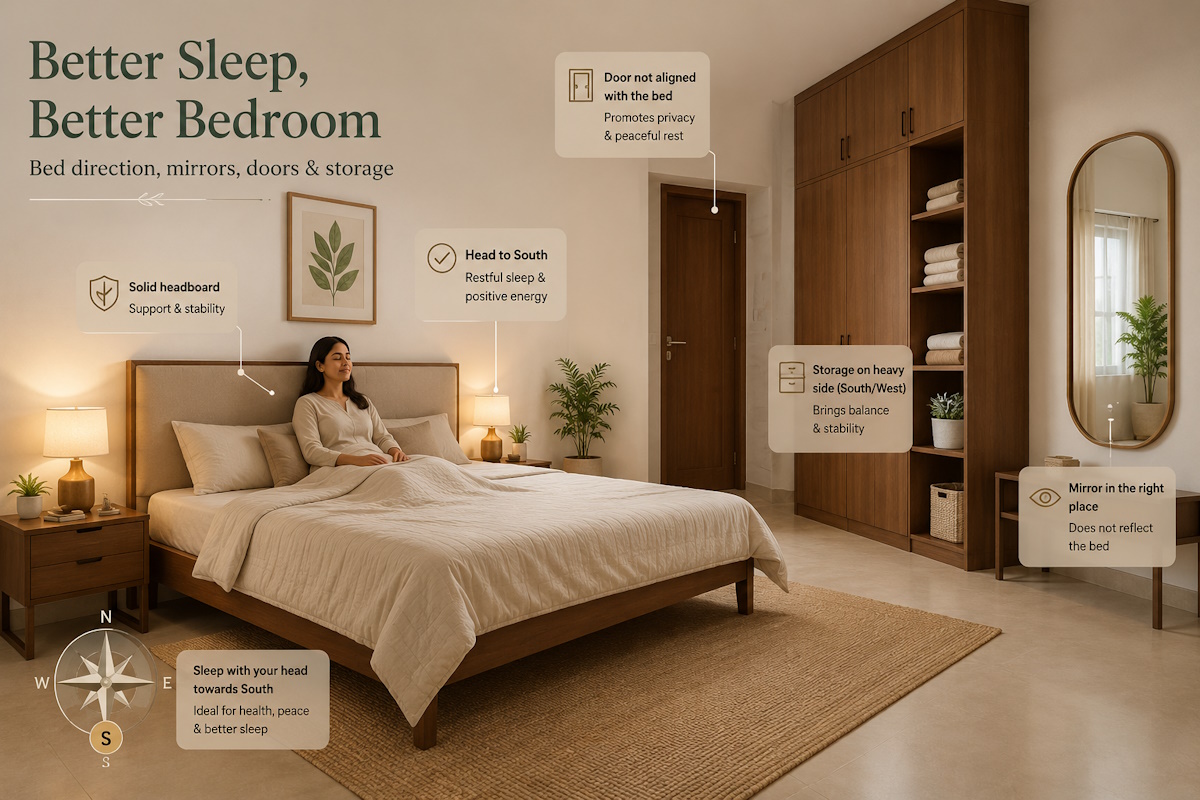
Aligning your head toward the South is widely considered the most beneficial orientation for human health. The earth’s positive magnetic pole is located near the geographic north, while the human head carries a positive magnetic polarity. When you sleep with your head to the South, opposite polarities attract, creating a stabilizing bio-magnetic loop that supports blood circulation, deep REM sleep, and overall cardiovascular health.
Sleeping with Head Towards the East
Sleeping with the head facing East is particularly advantageous for students, researchers, working professionals, and those seeking intellectual clarity. The East represents solar energy, growth, and renewal. Aligning the head eastward promotes memory retention, balanced mental focus, and energetic mornings.
Directions to Avoid
Sleeping with the head pointed directly to the North should be strictly avoided. When the positive pole of the head aligns with the northern magnetic pole, magnetic repulsion exerts subtle pressure on cerebral blood circulation. Over time, this can manifest as broken sleep, recurring headaches, chronic morning fatigue, and irritability. Sleeping with the head toward the West is considered neutral and acceptable for guest rooms or secondary bedrooms, though South and East remain superior.
Bed Position Relative to Walls, Windows, and Overhead Beams
Beyond directional orientation, the structural context around the bed influences emotional security and nervous system relaxation. Ideal bed direction Vastu dictates that the headboard should rest firmly against a solid internal wall rather than an open window or flimsy partition. A solid wall provides psychological grounding and stability.
Avoid positioning the bed directly underneath heavy structural ceiling beams. Exposed beams create downward compressive spatial pressure, often resulting in physical tension in the body area positioned below the beam. If structural beams cannot be removed, concealing them behind a false ceiling or using non-invasive acoustic paneling helps neutralize the downward pressure.
Doorways, Circulation, and Structural Flow Inside the Bedroom
A bedroom must maintain smooth air circulation and energetic movement while protecting the privacy and rest of the sleeper. The relationship between the entry door, attached bathrooms, and the bed determines whether the room feels peaceful or chaotic.
Door Alignment Relative to the Sleeping Zone
The bed should ideally not sit directly in line with the main bedroom door. When a door opens straight onto the bed, sharp kinetic energy flows directly toward the sleeper, creating subconscious vulnerability and shallow sleep. Place the bed diagonally across from the door so you maintain a clear visual line of sight to the entryway while remaining out of the direct path of motion.
Managing Attached Bathrooms and Ensuite Openings
Modern homes and apartments frequently feature ensuite bathrooms. While convenient, bathrooms represent drainage and moisture zones. In bedroom placement Vastu, bathroom doors should never face the head of the bed directly. Keeping the bathroom door closed when not in use and ensuring good mechanical ventilation prevents moisture and draining energy from spilling into the sleeping zone. To address how moisture zones correlate with physical wellness, you can Understand Health-Related Vastu Zones across your floor plan.
Bedroom Mirror Vastu: Managing Reflections and Visual Distractions
Mirrors are powerful spatial tools that reflect light, double visual space, and activate energetic flow. In resting environments, improper mirror placement is one of the most common causes of restlessness and fragmented sleep patterns.
The Spatial Logic Behind Mirror Placement
Under authentic bedroom mirror Vastu guidelines, mirrors should not reflect the bed or the sleeping occupants. As you transition into sleep, your peripheral vision remains sensitive to light and movement. Reflective surfaces amplify ambient light and can create subconscious visual triggers that interrupt deep sleep phases.
Practical Adjustments for Wardrobe Dressing Mirrors
In compact master suites, wardrobes often come with full-length mirrored doors. If your dressing mirror or wardrobe reflection directly catches the bed, practical solutions include placing the mirror on the inside of the closet door or using curtains and lightweight fabric screens to cover the reflective surface during the night. The Northern and Eastern walls of the bedroom are the most suitable zones for small dressing units, as these directions welcome gentle ambient morning light.
Storage, De-Cluttering, and Under-Bed Storage Solutions
Storage management is an integral component of spatial balance. Storage units represent weight, density, and physical load. Distributing storage correctly stabilizes the room, whereas cluttered storage creates stagnant pockets that disrupt airflow and calm thinking.
Heavy Wardrobes and Directional Loading
In accordance with traditional load distribution principles, heavy furniture such as wardrobes, armoires, and built-in cupboards should be positioned along the South and West walls of the bedroom. Keeping the Southern and Western zones structurally heavy provides anchoring stability to the room while leaving the North and East zones open, light, and easy to clean.
The Real Impact of Under-Bed Clutter
Under-bed storage is popular in modern apartment living, but it requires careful management. Avoid storing metallic tools, unorganized clutter, old electronics, or unused shoes beneath the mattress. Storing heavy, disorganized items directly beneath your resting body obstructs ambient air circulation and creates subtle energetic tension. If under-bed storage is necessary, use it exclusively for clean linens, extra pillows, and soft blankets kept in neat containers.
Environmental Harmony: Lighting, Colors, and Internal Zones
The sensory environment within a bedroom dictates how quickly the brain shifts from active daytime beta waves to relaxing alpha and theta waves. Integrating subtle, warm lighting alongside balanced chromatic choices supports the deeper objectives of Bedroom Vastu.
Harmonizing Color Palettes for Rest
Bright, hyper-stimulating primary colors such as harsh reds, dark purples, or stark jet blacks should generally be avoided on large wall surfaces in the bedroom. Instead, opt for soothing earth tones, soft creams, warm off-whites, pastels, or muted almond shades that promote calm. To select shades that match your room orientation precisely, you can Choose Balanced Vastu Colors to complement your interior decor naturally.
Sensitive Zones Within the Bedroom Layout
Every individual room possesses its own directional sub-grid. The North-East corner of the bedroom should be kept relatively clear of heavy clutter to allow fresh energy to circulate. Keeping bedside tables uncluttered and maintaining soft, indirect warm lighting in the evening signals to your circadian rhythm that it is time to wind down.
Making Practical, Non-Invasive Vastu Adjustments in Modern Homes
Living in a modern apartment or rented property often means you cannot change where structural walls, windows, or plumbing lines are situated. The goal of balanced spatial design is not structural perfection through demolition, but intelligent optimization within existing physical parameters.
Evaluating Existing Layouts Before Renovating
Before initiating expensive interior modifications or breaking down partitions, perform a clear assessment of your current setup. Start by adjusting your sleeping orientation toward the South or East. Next, cover or reposition reflective surfaces that face the bed, declutter beneath your frame, and reorganize wardrobes along the Southern or Western perimeters. These simple, logical realignments often resolve sleep friction without structural upheaval.
Frequently Asked Questions
1. Which is the ideal sleeping direction Vastu recommends?
The most beneficial direction is sleeping with your head pointed toward the South, as it aligns harmoniously with the earth’s natural magnetic field. Sleeping with your head facing East is also highly recommended for mental clarity and academic focus. Sleeping with your head pointing North should be avoided.
2. What should I do if a mirror faces the bed directly?
If a fixed dressing mirror or wardrobe reflection faces your bed and cannot be relocated, cover the mirror with a curtain, frosted film, or fabric screen at night. Positioning dressing mirrors inside wardrobe doors is an effective alternative during remodeling.
3. Can the master bedroom be located in the North-East?
The North-East is dominated by the Water element and active spiritual energy, making it too intellectually stimulating for the master bedroom. If your bedroom is in the North-East, keep the space exceptionally light, use soothing pastel shades, and shift the bed position toward the southern or eastern wall of that room to minimize restlessness.
4. How does under-bed storage affect bedroom Vastu?
Cluttered under-bed storage restricts airflow and creates stagnation directly under your resting body. Avoid keeping metal tools, footwear, or old electronics under the bed. Use under-bed compartments strictly for clean, organized soft linens and seasonal clothing.
5. What is the best bed placement Vastu rule for apartments with fixed layouts?
In apartments with fixed entryways, ensure your bed is supported by a solid headboard against a sturdy wall. Position the bed diagonally from the entry door rather than directly in line with it, and orient your head toward the South or East whenever layout dimensions permit.