Selecting a property or renovating a home is one of the most significant investments an individual makes in their lifetime. While aesthetics and location often take precedence, the underlying energetic blueprint of a space determines the long-term well-being of its occupants. For decades, traditional practitioners relied on hand-held compasses and manual sketches to evaluate these energies. However, as modern architecture becomes more complex with skewed walls, multi-level layouts, and high-rise constraints, the margin for human error has increased. This shift has necessitated a more precise approach to spatial science.
The introduction of Vastu AI and advanced digital mapping has transformed how we perceive spatial energy. Unlike manual methods that are prone to subjective interpretation or physical interference, AI-driven analysis provides a mathematical certainty that is often required to detect subtle defects. Understanding the difference between a standard manual walkthrough and a data-backed analysis is crucial for anyone seeking to create a balanced, high-vibrancy environment. By leveraging technology, we can now see deeper into the 16-zone framework that governs the flow of health, wealth, and peace in any structure.
The Complexity of 16-Zone Mapping in Modern Architecture
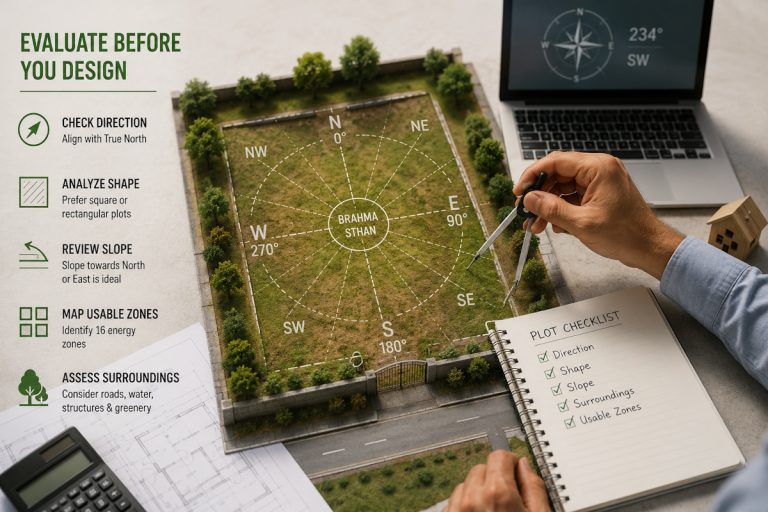
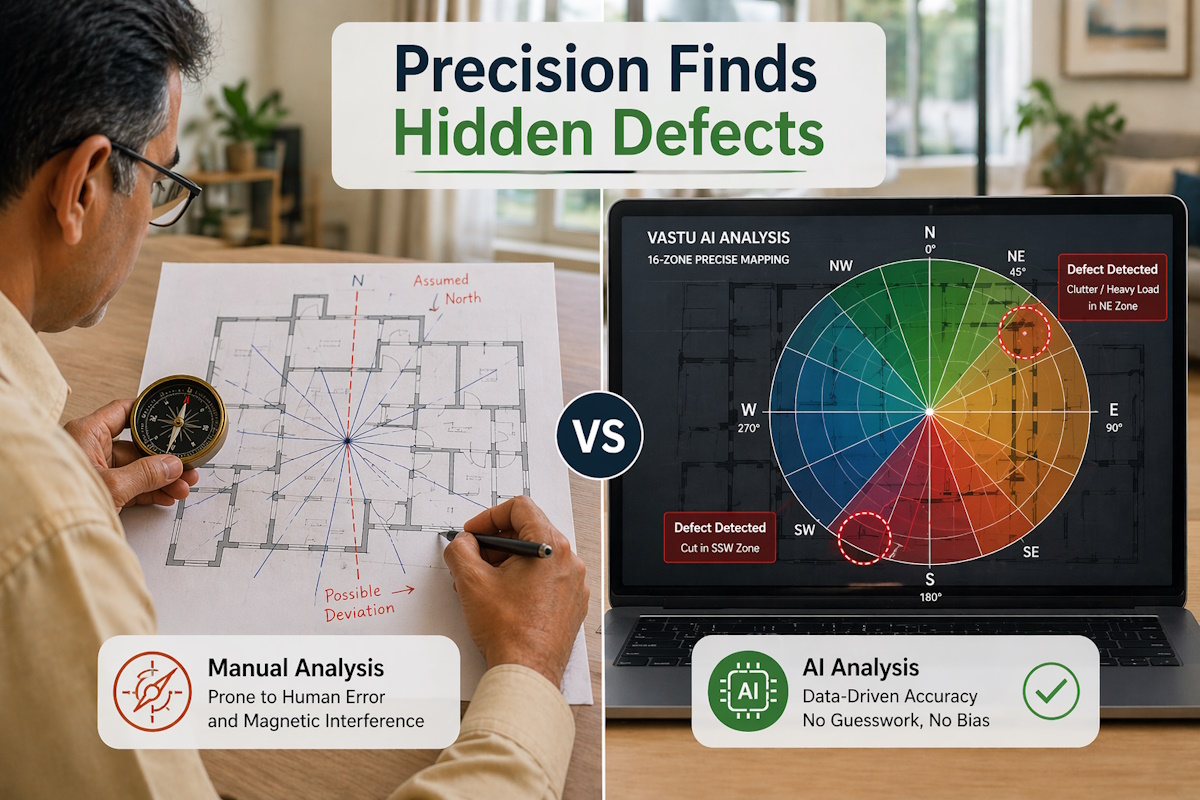
In traditional Vastu, many people are familiar with the basic eight directions. While these are foundational, professional Vastu Shastra utilizes a much more granular 16-zone system. Each of these zones occupies exactly 22.5 degrees of a 360-degree circle. When a practitioner attempts to map these zones manually, even a minor two-degree error at the center of the house can lead to a massive displacement of energy zones at the periphery. This is where most manual assessments begin to fail, especially in larger homes or irregularly shaped apartments.
Beyond the Eight Directions
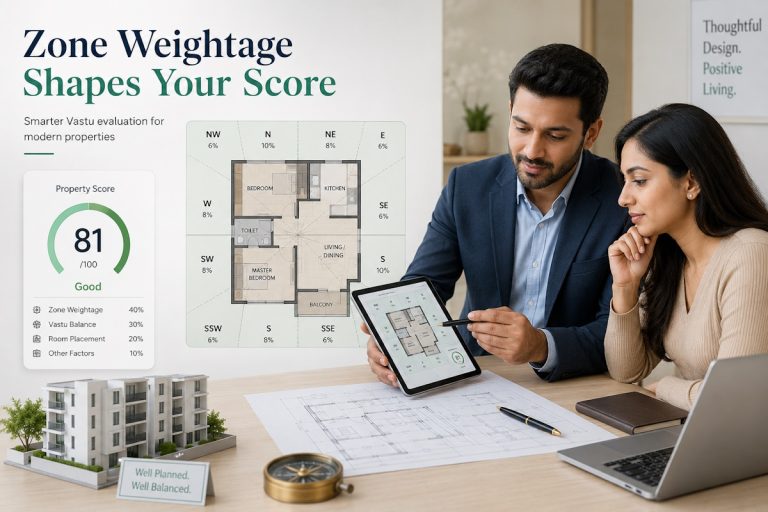
The 16 zones represent specific attributes such as clarity of mind, social connectivity, health, and cash flow. For instance, the zone of North-North-West is significantly different in its impact compared to the North or North-West. A manual consultant using a simple compass might overlook the exact boundary where one zone ends and another begins. Vastu AI eliminates this ambiguity by overlaying a mathematically perfect grid onto the architectural floor plan, ensuring that every square inch is categorized correctly.
The Angular Precision Factor
The primary challenge with modern buildings is that they are rarely aligned perfectly with the cardinal North. Most properties are tilted at an angle. Manually calculating the “degree of tilt” and then manually drawing 16 slices of 22.5 degrees each is a labor-intensive process prone to drafting errors. If the tilt is 12 degrees but the consultant assumes 10 degrees, the entire energy map shifts, leading to the wrong placement of remedies or furniture. Digital systems handle these calculations instantly with 100 percent accuracy.
Common Human Errors in Manual Vastu Analysis
Even the most experienced Vastu experts are human, and manual analysis is subject to physical and environmental limitations. One of the most common issues is magnetic interference. In modern urban environments, the presence of steel structures, underground electrical cables, and high-tension wires can cause a traditional magnetic compass to deviate significantly. This phenomenon, known as magnetic declination or local attraction, can lead a consultant to believe they are looking at North when they are actually several degrees off.
Compass Deviation and Magnetic Interference
Inside an apartment, the large amount of reinforced steel in the pillars and slabs acts as a giant magnet. If a consultant takes a reading while standing near a pillar or a large appliance, the needle will jump. Without Vastu AI to cross-reference satellite data with physical readings, the resulting report might be based on a false North. This leads to the misidentification of kitchen or toilet placements, which are critical defects that can impact the residents’ health and financial stability.
The “Subjective Bias” in Manual Assessment
Human analysis is also prone to subjective bias. A consultant might subconsciously try to fit a house into a specific “type” or overlook a minor extension because it seems insignificant to the eye. However, in Vastu Shastra, an extension or a cut in a specific zone can have profound energetic consequences. Vastu AI does not have “feelings” or “intuition” that can cloud the data; it simply analyzes the geometry and the orientation to provide an objective truth about the property’s energy state.
How Vastu AI Revolutionizes Spatial Energy Assessment
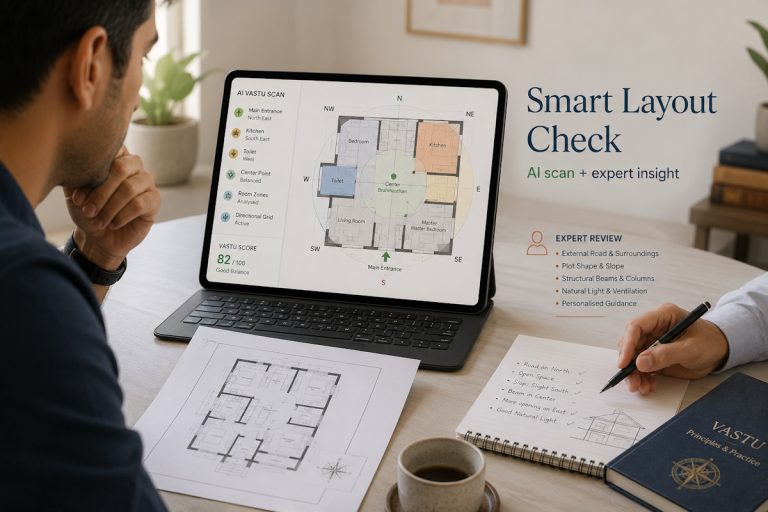
The core strength of Vastu AI lies in its ability to integrate multiple data points that a human simply cannot process simultaneously. Advanced software can pull satellite imagery to verify the orientation of the building, analyze the floor plan for geometric irregularities, and apply the 16-zone grid with sub-degree precision. This holistic approach ensures that no “micro-defect” goes unnoticed, which is essential for achieving true balance in a modern living or working environment.
Algorithm-Based Gridding Systems
The gridding process is the heart of Vastu analysis. When an AI system processes a floor plan, it calculates the geometric center, also known as the Brahmasthan, with mathematical exactness. It then projects the energy lines based on the exact degree of the building’s face. This level of detail allows the system to identify if a toilet is in the North-East zone or the North-North-East zone. The remedies for these two locations are entirely different, and getting it wrong can sometimes worsen the situation.
Eliminating the Margin of Error
By using digital tools, we eliminate the margin of error that comes with hand-drawn lines on paper. Digital floor plan analysis allows for the zooming and scaling of specific areas, ensuring that even a small utility closet or a balcony is accounted for in the energetic map. This is particularly important in commercial spaces where Every square foot contributes to the productivity and success of the business.
Recognizing Micro-Defects in Large Floor Plans
In large villas or sprawling office complexes, manual analysis becomes exponentially more difficult. The sheer distance from the center to the outer walls means that a tiny error in the center is magnified at the edges. Vastu AI maintains the same level of precision regardless of the size of the property. It can identify “cuts” in zones that might look like simple architectural features but are actually draining the energy of the occupants.
Why Zone Defects Matter for Health and Wealth
The primary reason people seek Vastu consultation is to improve their quality of life. Whether it is a persistent health issue, a stagnant career, or friction in family relationships, the physical environment is often a silent contributor. Each of the 16 zones is linked to specific organs and specific life outcomes. When a zone is “defective”—meaning it is either cut, extended, or cluttered with an incompatible element—the corresponding area of life suffers.
The Impact of “Cut” or “Extended” Zones
A “cut” in the North zone, which governs opportunities and money flow, can lead to a struggle in finding new jobs or clients. Conversely, an “extension” in the South-East might lead to excessive aggression or health issues related to fire energy. Manual analysis often misses these subtle geometric variations, especially when walls are not perfectly straight. Vastu AI detects these variances instantly, allowing for non-invasive remedies to be placed precisely where they will be most effective.
Managing the North-East and South-West Extremes
The North-East (Ishanya) and South-West (Nairutya) are the two most sensitive points in any Vastu analysis. The North-East brings in positive, solar energy, while the South-West provides stability and groundedness. A manual error in identifying these zones can lead to placing heavy storage in the North-East or a water feature in the South-West, both of which are major Vastu doshas. Precision tools ensure these critical areas are protected and utilized correctly.
Practical Application: When to Choose AI Over Manual Methods
While traditional wisdom is the foundation of Vastu, modern application requires modern tools. If you are living in a standalone house in a rural area with no nearby steel structures, a manual compass might suffice. However, for 90 percent of property buyers today, the environment is urban, dense, and architecturally complex. In these cases, Vastu AI is not just an option; it is a necessity for accuracy.
Commercial vs. Residential Accuracy Requirements
In a commercial setting, the stakes are even higher. An office layout that places the CEO in a zone of “expenditure” rather than “power” can lead to poor decision-making and financial loss. Because commercial spaces often have central air conditioning, false ceilings, and extensive wiring, manual compasses are almost always unreliable. AI-based analysis bypasses these physical interferences by using architectural coordinates and satellite data to establish the true orientation of the business.
Integrating Human Expertise with AI Precision
It is important to understand that Vastu AI is a powerful tool, but it works best when guided by an experienced professional. The AI provides the data, the precision mapping, and the identification of defects. The Vastu consultant then provides the context, the priority of remedies, and the human understanding of the resident’s needs. This combination of technology and tradition offers the most robust solution for modern living.
Why the Consultant Still Matters
A machine can tell you that a zone is blocked, but an expert at Vastu Consult can help you decide how to fix that block without breaking down a wall. The consultant interprets the AI’s findings to suggest practical, non-invasive changes like color therapy, metal strips, or the strategic placement of plants. This nuanced approach ensures that the remedies fit your lifestyle and your interior design while still achieving the desired energetic shift.
The future of Vastu Shastra is a blend of ancient principles and cutting-edge technology. By moving away from purely manual, error-prone methods, we can provide homeowners and business owners with the clarity they need to thrive. If you are ready to see your property through a lens of scientific precision, now is the time to act.
Reach out today to Get an AI-Based Vastu Analysis
FAQs
1. Does Vastu AI replace a traditional Vastu consultant?
No, it enhances the consultant’s work. The AI handles the mathematical mapping and zone identification with 100 percent accuracy, while the consultant uses that data to provide personalized advice and practical remedies that fit your specific life situation.
2. Why is manual compass reading often inaccurate in apartments?
Apartments are filled with reinforced steel, electrical conduits, and neighboring electronic devices. These create magnetic interference that causes a standard compass needle to deviate, often leading to an incorrect North reading and a flawed Vastu report.
3. Can Vastu AI analyze a property that is already built?
Yes, AI-based analysis is perfect for existing properties. By using the floor plan and the exact building coordinates, the system can identify existing defects and suggest corrections that do not require structural demolition.
4. What are “micro-defects” in Vastu?
Micro-defects are small spatial imbalances, such as a misplaced stove by just a few inches or a tiny extension in a negative zone. These are often missed by the human eye but are easily caught by the high-resolution gridding used in AI analysis.
5. How long does a digital Vastu analysis take compared to a manual one?
A digital analysis is often faster and more comprehensive. Once the floor plan is uploaded and coordinates are set, the mapping is instantaneous. This allows the consultant to spend more time discussing solutions rather than manual drafting.