In the high stakes world of logistics and supply chain management, the efficiency of a storage facility often determines the profitability of the entire business. A warehouse is not merely a shell for storing goods; it is a dynamic environment where the movement of physical products must align with the flow of spatial energy. When this energy is stagnant, businesses often experience the phenomenon of dead stock, where inventory sits untouched for months, draining capital and occupying valuable floor space. Warehouse Vastu provides a sophisticated framework to address these operational bottlenecks by aligning the physical layout with elemental forces.
For warehouse owners, developers, and logistics managers, understanding the connection between directional energy and inventory turnover is crucial. Scientific Vastu principles suggest that every direction governs a specific type of activity. When these activities are misplaced, such as placing fast moving consumer goods in a zone meant for long term stability, the result is friction. By applying a systematic 16 zone analysis, a facility can be transformed into a high performance hub where goods move rapidly from receiving to shipping without unnecessary delays. This article explores how professional Vastu planning can optimize warehouse operations and eliminate the financial burden of stagnant inventory.
The Scientific Logic of Warehouse Vastu and Energy Flow
Modern industrial Vastu is grounded in the balance of the five primordial elements: Earth, Water, Fire, Air, and Space. In a warehouse setting, these elements manifest as physical stability, financial liquidity, operational speed, and the movement of goods. For instance, the Air element, which dominates the Northwest, is directly linked to movement. If the Northwest zone is blocked or heavily weighted with permanent fixtures, the “Prana” or life force of the building cannot circulate, leading to delays in dispatch and shipping errors.
The Role of Magnetism and Solar Energy
The orientation of a warehouse relative to the Earth’s magnetic field significantly impacts the people working within it and the preservation of the goods stored inside. The North and East directions bring in positive, constructive energy, which is ideal for administrative tasks and the storage of light, high value items. Conversely, the South and West provide heavy, grounding energy. A warehouse that ignores these natural gradients often faces issues with labor unrest, mechanical breakdowns, or unexplained inventory shrinkage.
Zonal Planning for Optimal Productivity
Zonal planning is the cornerstone of effective Warehouse Vastu. It involves dividing the massive floor area into specific functional sectors based on their elemental attributes. When the loading bays, racking systems, and sorting areas are placed in their correct Vastu zones, the natural flow of work becomes more intuitive. This reduces the time spent on internal material handling and minimizes the risk of damage to goods. Evaluating these zones requires a deep understanding of how industrial machinery and massive inventory loads interact with the site’s underlying energy grid.
Strategic Directional Placement for Different Inventory Types
Not all inventory is created equal. Some products require rapid turnover, while others are bulk items intended for long-term storage. Warehouse Vastu dictates that the physical weight and the “velocity” of the product should determine its placement within the facility.
The Southwest: Stability and Bulk Storage
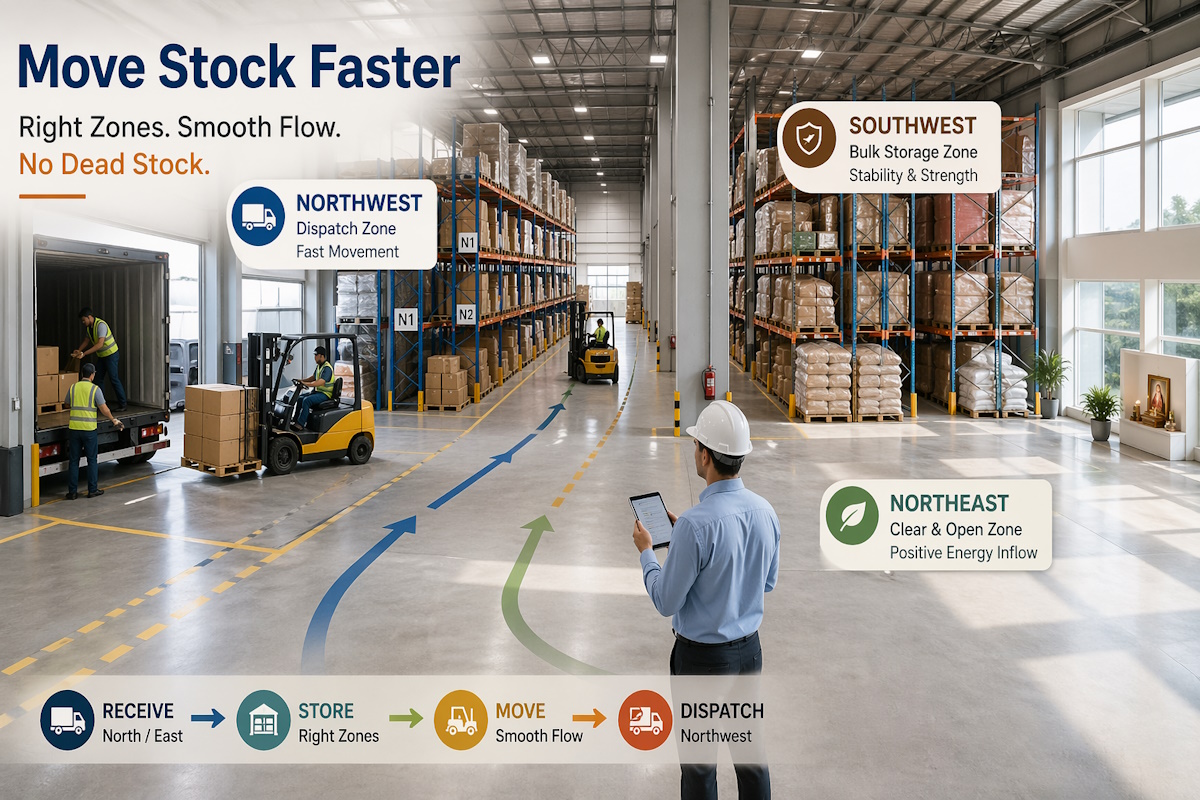
The Southwest corner, governed by the Earth element, is the most stable part of any plot. This is the ideal location for heavy machinery, permanent racking for bulk raw materials, or items that are not expected to move quickly. Placing heavy loads here provides a “foundation” for the building’s energy. However, if fast-moving items are placed in the Southwest, they tend to become “stuck,” turning into dead stock because the energy of this zone is heavy and stationary. For a business to thrive, the Southwest should remain the heaviest part of the warehouse structure.
The Northwest: The Zone of Movement and Dispatch
The Northwest is the domain of the Air element (Vayu). In a logistics context, this is the most critical zone for inventory turnover. Goods placed in the Northwest have a natural tendency to move out quickly. Therefore, the dispatch area, finished goods ready for shipping, and fast-moving SKUs should ideally be positioned in the North-of-Northwest or Northwest sectors. When the Northwest is kept clear of permanent obstructions and used for transit-related activities, the warehouse experiences fewer shipping delays and higher throughput. Professional logistics managers often find that shifting their dispatch desk to this area improves operational speed significantly.
Managing the Northeast for Clarity and Flow
The Northeast is the entry point for positive energy and is associated with the Water element. In a warehouse, this area should be kept light, clean, and ideally open. It is a suitable place for a small temple, a water cooler, or light administrative functions. Placing heavy junk, scrap yards, or toilets in the Northeast can create a “blockage” that clouds the judgment of management and leads to poor inventory forecasting. Keeping this zone pristine ensures that the flow of new stock into the facility remains consistent and profitable.
Eliminating Dead Stock Through Vastu Corrections
Dead stock is often a symptom of an energy imbalance in the West or Southwest zones. When goods are stored in areas where energy is stagnant or “trapped,” they fail to catch the attention of the sales team or the market. Warehouse Vastu looks for structural defects like floor slopes that tilt toward the South or West, which cause energy to pool and stagnate in the wrong places.
Correcting Floor Slopes and Drainage
In a Vastu-compliant warehouse, the floor should ideally be slightly higher in the Southwest and lower in the Northeast. This encourages the natural flow of energy and prevents the accumulation of “negativity” or stagnation in the heavy storage zones. If your warehouse floor is level or sloped incorrectly, it can be corrected using non-invasive remedies such as specific metallic strips or energy neutralizers placed under the flooring. These corrections help in “virtually” tilting the energy flow toward the prosperous North and East directions, thereby encouraging the movement of even the oldest stock.
The Fire Element and Operational Efficiency
The Southeast is the zone of Fire (Agni). In an industrial environment, this zone governs electricity, transformers, boilers, and the speed of labor. If the Southeast is weak or afflicted by a water body, the warehouse may suffer from frequent power outages, machinery failure, or low labor productivity. A vibrant Southeast ensures that the “heat” of the business—the actual work of picking, packing, and moving—happens at a brisk pace. Ensuring the pantry or the electrical room is in the Southeast can help maintain the momentum required to prevent inventory from piling up.
The Impact of Loading Bays and Entrance Placement
The main gate of the warehouse and the loading shutters act as the “mouth” of the building, through which both goods and energy enter. Their placement is perhaps the most significant factor in Warehouse Vastu for determining the financial health of the logistics business.
Optimizing Loading and Unloading Docks
Loading and unloading are two distinct energies. Unloading (receiving) is best handled in the North or East zones, where the energy is incoming and fresh. Loading (dispatch) is highly effective when placed in the Northwest, as it leverages the “wind” energy to push goods out to the market. Having a single dock for both can sometimes create a chaotic energy mix. If structural constraints force a single entry/exit point, specific color coding or symbolic Vastu remedies can be used to differentiate the energies of incoming and outgoing freight.
Vehicle Movement and Internal Driveways
The movement of trucks and forklifts inside the compound also matters. Vehicles should ideally enter from the North or East and move in a clockwise direction around the building. This mimics the natural rotation of the Earth and the movement of solar energy, creating a harmonious environment. Internal driveways that are cluttered or broken can create “irritants” in the energy field, leading to accidents or logistical errors. Maintaining smooth, clear paths in the North and East portions of the plot is essential for long-term operational success.
Office Placement and Human Resource Management
A warehouse is only as efficient as the people managing it. The placement of the warehouse manager’s office and the labor rest zones significantly impacts the overall “command and control” of the facility. Warehouse Vastu emphasizes that the leadership should be positioned in a place of power.
The Manager’s Cabin: The Seat of Authority
The ideal location for the warehouse manager or owner’s office is the Southwest. Sitting in this zone allows the manager to have a figurative “view” of the entire operation while being backed by the grounding energy of the Earth element. This placement enhances decision-making and ensures that the staff respects the hierarchy. A manager sitting in the Northeast may become too stressed or overwhelmed by details, while one in the Southeast might become overly aggressive or prone to conflict with the workforce.
Labor Welfare and Staff Productivity
The Northwest is an excellent area for staff change rooms or a rest area, as it keeps the energy of the workers light and mobile. However, toilets and heavy waste disposal units should be carefully placed, preferably in the West-of-Northwest or South-of-Southwest, to ensure that “waste” energy is properly eliminated without affecting the primary storage zones. When the staff feels energetically supported, the accuracy of inventory counting and the speed of material handling naturally improve, directly reducing the chances of stock becoming “lost” or dead.
Modern Warehouse Challenges: Automation and Cold Storage
As warehouses evolve into highly automated fulfillment centers with robotics and climate-controlled zones, Warehouse Vastu principles must be adapted to modern technology. The placement of server rooms, automated guided vehicles (AGVs), and refrigeration units requires specialized knowledge of spatial energy.
Vastu for Cold Storage and Specialized Zones
Cold storage units involve a heavy concentration of the Water and Air elements. These are best placed in the North or Northwest portions of the warehouse. However, the heavy compressors and electrical equipment required to maintain these temperatures must be anchored in the Southeast or South to balance the elements. If a cold storage unit is incorrectly placed in the Southwest, it may lead to frequent technical failures or high operational costs that eat into the profit margins of the stored inventory.
Integrating AI and Technology with Vastu
In the modern era, we can use data to validate Vastu findings. By overlaying heat maps of inventory movement with a 16 zone Vastu grid, we often see a direct correlation between Vastu doshas (defects) and the slowest moving parts of the warehouse. This scientific approach removes the guesswork and allows for practical, non-invasive remedies that don’t interfere with automated systems.
Practical Guidance for Warehouse Optimization
Achieving a Vastu-compliant warehouse does not always require massive demolition. Most issues related to dead stock and slow inventory movement can be resolved through strategic reorganization. Start by decluttering the Northeast and North zones to allow energy to enter. Move your heaviest, slowest-moving items to the Southwest and ensure your high-velocity goods are staged in the Northwest. Pay attention to the lighting; a well-lit warehouse in the East and North encourages an active, high-energy work environment.
The goal of Warehouse Vastu is to create a frictionless environment where the physical layout supports the business’s financial goals. By aligning your facility with natural laws, you reduce the “resistance” in your supply chain, leading to faster turnover, happier labor, and a healthier bottom line.
FAQs
1. How can Warehouse Vastu help reduce dead stock?
Vastu helps by identifying zones of stagnation, usually in the Southwest or West, where energy flow is blocked. By realigning the inventory so that fast-moving goods are in the Northwest (the zone of movement) and heavy items are in the Southwest, the natural flow of energy encourages faster turnover and better visibility of stock.
2. Where should the main loading dock be located?
Ideally, the loading dock for dispatch should be in the Northwest to utilize the Air element’s movement. For receiving goods, the North or East is preferred. If you only have one dock, Vastu remedies can be applied to balance the conflicting energies of incoming and outgoing stock.
3. Is it necessary to demolish walls to fix Vastu issues in an old warehouse?
No, demolition is rarely necessary. Most industrial Vastu issues can be corrected using elemental balancers, color therapy, metallic strips, and the strategic relocation of inventory and machinery. These non-invasive methods are highly effective in large scale storage facilities.
4. Can Vastu improve labor relations in a warehouse?
Yes. By placing staff rest areas, toilets, and the manager’s office in their correct zones, you reduce stress and conflict. A balanced environment leads to better communication, fewer accidents, and higher productivity among the workforce.
5. Does the slope of the warehouse floor really matter?
In Vastu, the floor slope determines the direction in which energy and prosperity flow. A slope toward the Northeast is considered highly auspicious for financial growth, while a slope toward the Southwest can lead to financial drain and stagnant inventory. If the slope is wrong, it can be corrected “virtually” through expert interventions.