Selecting a plot of land is the most foundational decision in real estate. Among the various land types available in urban and suburban developments, corner plots often command a premium price due to better ventilation, enhanced visibility, and dual access points. However, evaluating these properties through the lens of classical spatial science reveals a nuanced reality. A corner plot naturally interacts with two or more environmental pathways, making its energy profile significantly more dynamic than an intermediate, single-facing parcel of land.
When applying principles of Plot Vastu, a corner site cannot be evaluated purely by its commercial appeal or open aesthetic. The surrounding roads, natural land gradient, directional extensions, and entry points determine whether that open exposure invites stability or creates environmental turbulence. Understanding how these distinct geographic and architectural variables interact allows buyers, builders, and architects to make informed decisions before committing capital or laying the foundation, utilizing an authentic Vastu Guide for Plot Selection to secure long-term harmony.
The Spatial Dynamics of Corner Plots in Plot Vastu
In spatial design, land is not an isolated geometric rectangle; it is an energetic grid receiving cosmic, solar, and geomagnetic inputs. Corner plots, positioned at the intersection of two roads, experience higher kinetic momentum from vehicular and pedestrian traffic. This movement accelerates environmental currents around the site boundaries.
Why Multiple Road Facing Plot Vastu Scenarios Require Deeper Analysis
A standard plot experiences boundary interaction primarily along one facade, with three protected sides buffered by adjacent properties. In contrast, road facing plot Vastu for corner locations must account for continuous activity along at least two perimeter walls. This dual exposure alters how air currents, noise vibrations, and solar trajectories penetrate the buildable footprint. When properly aligned with cardinal directions, dual-road exposure can amplify positive pranic flow. When misaligned, it may disperse beneficial energy or expose private zones to excessive external disturbance.
The Influence of Open Sides on Energy Movement
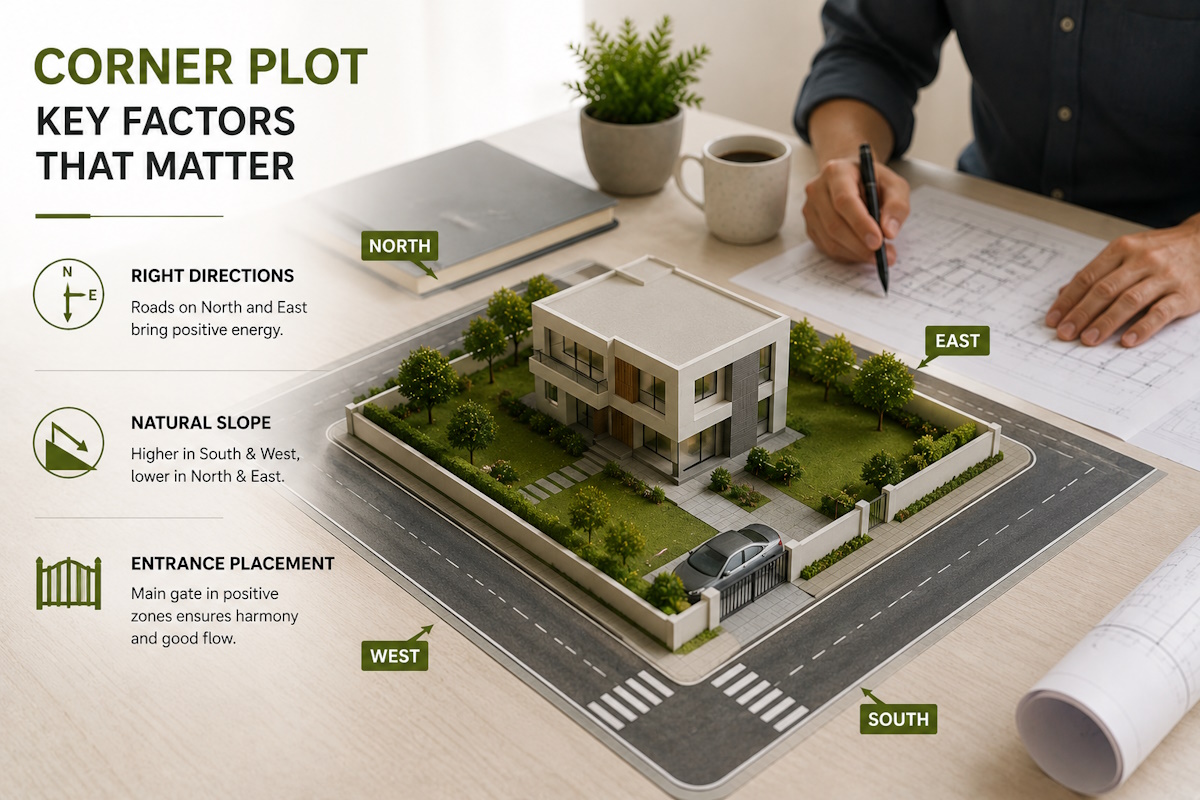
Traditional spatial science emphasizes that open spaces generate lightness, while solid, elevated structures create grounding. In corner plot Vastu, the presence of two open sides naturally creates an energy gradient toward those unbuilt sectors. If the roads run along the North and East, the property benefits from light morning sunlight and unhindered bio-magnetic currents. Conversely, if the open roads sit along the South and West boundaries, the site becomes vulnerable to intense afternoon infrared radiation and excessive kinetic dispersal in zones that traditionally require stability and mass.
Road Alignments and Directional Impact on Corner Sites
The cardinal orientation of the intersecting roads defines the fundamental energy quality of a corner plot. Each directional junction represents a unique meeting of elemental forces, from earth and water to fire and air.
North-East Corner Plots: The Eshanya Junction
A plot surrounded by roads on the North and East is widely considered one of the most auspicious configurations. Known as the Eshanya corner, this intersection allows unhindered entry of geomagnetic energy from the North and regenerative solar light from the East. Properties situated on an authentic North-East corner foster mental clarity, peaceful living, and financial continuity, provided the boundary design preserves openness without structural clutter.
North-West Corner Plots: Balancing the Vayu Zone
When a plot is bordered by roads on the North and West, it interacts heavily with the air element, or Vayu zone. This location supports dynamic movement, commercial trade, and social networking. However, if the construction on such a plot fails to provide adequate weight in the inner core, the occupants may experience restlessness or inconsistent progress. Implementing balanced architectural massing on the West side helps stabilize this kinetic energy.
South-East and South-West Corner Plots: Managing Fire and Earth Energies
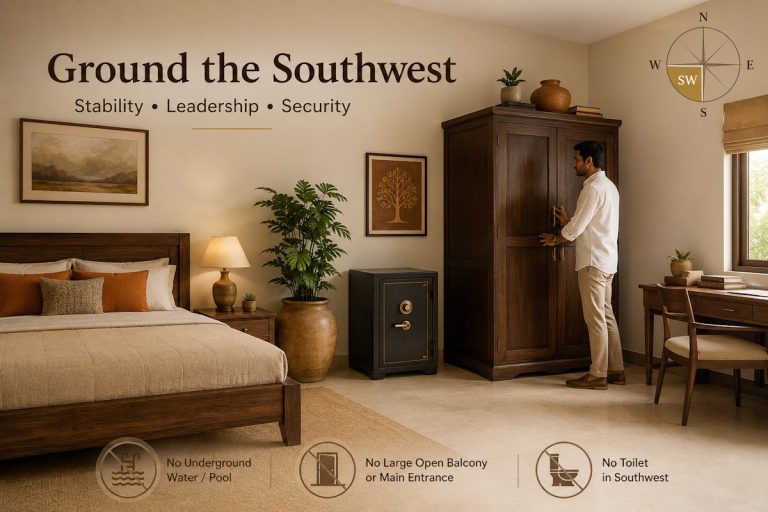
Plots located at the South-East junction face roads from the South and East, activating the Agni or fire sector. While this can benefit commercial operations that thrive on rapid action and enterprise, residential designs must carefully regulate internal heat and light distribution. Meanwhile, South-West corner plots, bounded by South and West roads, require rigorous evaluation. Because the South-West represents stability, weight, and earth energy, excessive openness here can lead to financial leakage or physical fatigue unless balanced by elevated boundary walls, substantial structural weight, and disciplined landscaping.
To accurately gauge the geometric symmetry of these directional junctions, it is vital to Analyze Plot Shape According to Vastu before final acquisition.
Plot Slope Vastu: Balancing Natural Gradients and Elevations
The directional slope of the land is as critical as its surrounding road alignment. The natural grading dictates how surface water runoff and environmental energy collect across the site.
Favorable Drainage and Elevation Slopes
According to plot slope Vastu, the natural tilt of the terrain should ideally guide surface water toward the North, East, or North-East. A plot that sits higher in the South-West and slopes gently downward toward the North-East creates natural stability and prosperity. This elevation profile preserves solar vitality during morning hours while shielding the site from harsh western heat late in the day.
Correcting Negative Slopes on Road Junctions
Corner plots often encounter complex civil grading challenges where municipal roads are constructed at varying elevations. If the intersecting roads sit higher than the internal plot level, the site can turn into a depression basin, collecting runoff and stagnant energy. Similarly, a site that slopes down toward the South or South-West must be leveled mechanically during initial site preparation. Constructing elevated plinths and retaining earth on the southern and western margins effectively rebalances the site gradient.
Plot Entrance Vastu and Boundary Configuration for Corner Sites
Having two road-facing frontages often leads buyers to create multiple large gates for convenience. However, gate placement directly governs how life energy enters the compound.
Locating the Primary Gate on Dual-Facing Plots
When planning plot entrance Vastu for a corner property, the primary gate should always be placed in positive directional padas, or zones. On a North-East corner plot, opening the gate in the positive North or positive East sectors welcomes calm, progressive momentum. Avoid placing gates directly on the sharp geometric corner where the boundary walls meet, as structural corners act as energy convergence points that should remain sturdy and unified.
Managing Road Thrusts (Veethi Shoola) at Corner Intersections
Corner properties are frequently exposed to oncoming vehicular lights and road thrusts, known as Veethi Shoola. When an intersecting road aligns perpendicular to a corner plot without bending away, it can direct an intense beam of kinetic pressure toward the site. Identifying whether a road thrust hits a positive or sensitive zone is essential. Deflective landscaping, dense green hedges, and raised boundary walls serve as functional buffers to neutralize incoming kinetic stress without requiring invasive measures.
Addressing Irregular Plot Vastu and Corner Cut or Extension Challenges
Many urban corner plots suffer from chamfered corners, curved boundaries, or irregular extensions due to street-widening regulations. Dealing with irregular plot Vastu requires establishing a clean geometric square or rectangle within the usable boundary. If a corner exhibits an extension in the North-East, it enhances spatial value. However, an extension in the South-West or a severe missing corner (cut) in the North-East distorts the site geometry. Prior to building, planners should Check 16-Zone Vastu Before Construction to ensure that functional living zones align with balanced elemental grids.
Practical Guidelines for Building on a Corner Plot
Transforming an empty corner plot into a balanced home or workplace involves strategic zoning, setback management, and construction sequencing.
Setbacks, Compound Walls, and Open Space Distribution
When constructing on a corner plot, the distribution of open setbacks inside the boundary wall plays a decisive role in long-term comfort:
- North and East Setbacks: Maintain wider, unencumbered open spaces along the North and East sides to invite fresh morning air and positive energy.
- South and West Setbacks: Keep southern and western setbacks narrower while building the main structure closer to these sectors.
- Boundary Wall Heights: Construct the boundary wall slightly higher and thicker along the South and West sides compared to the North and East perimeter to block excessive afternoon heat and heavy street vibrations.
- Compound Corners: Avoid cutting corners internally. Ensure the inner compound boundary maintains precise 90-degree right angles even if the outer municipal road curves.
Non-Invasive Energy Corrections Before Laying the Foundation
If you already own a corner plot with imperfect road orientations or challenging slopes, practical adjustments can be integrated seamlessly into the design. Modern Vastu Consult experts emphasize structural zoning over superstition. Leveling the terrain, introducing dense tree plantations along unstable perimeters, utilizing brass or lead geometric stabilizers within the foundation trenches, and designing solid, elevated plinths in the South-West quadrant effectively ground the site without compromising modern architectural aesthetics.
Frequently Asked Questions
1. Are all corner plots considered good according to Plot Vastu?
No, not all corner plots are inherently good. While North-East corner plots are naturally beneficial due to favorable morning light and geomagnetic alignment, South-West corner plots require careful structural planning, boundary reinforcement, and massing to prevent energy instability.
2. Can we provide main entry gates on both roads of a corner plot?
Yes, having two gates is acceptable if both are situated in positive directional padas. However, one gate should be designated as the primary functional entrance, while the secondary gate remains smaller and is used selectively to maintain clear spatial hierarchy.
3. How does a curved or chamfered road corner impact plot energy?
A chamfered corner cuts off a small portion of the site boundary. If the cut occurs in the North-East, it reduces incoming beneficial energy and should be corrected using internal squaring techniques. If the cut is in the South-West, it must be stabilized with solid construction and elevated fencing.
4. What is the best way to handle a corner plot with a slope toward the road?
If the road sits lower than the plot on the North or East, the natural drainage slope is advantageous. If the road slopes downward toward the South or West, build a raised plinth and construct retaining walls to keep the southern and western ground levels higher than the internal compound.