Author: blog-vastu-consult

  • Which Zones Are Most Sensitive in a Home (And Why)?

    Which Zones Are Most Sensitive in a Home (And Why)?

    A house never reacts as one single unit. Certain areas take more pressure than others. When something goes wrong in these spots, you usually feel it fast. Sleep issues. Money stress. Arguments that appear out of nowhere. Delays that never seem to clear.

    These are not random. Some zones in a home act like pressure points. Small mistakes there create outsized impact. When these zones are stable, life flows smoother even if the rest of the house is average.

    If you live in an apartment, villa, independent home, or even manage rental property, understanding these sensitive zones helps you decide what to fix first. Not later. First.

    Let’s walk through them one by one in real terms.

    The North East Zone – The Nervous System of the Home

    If one zone reacts quicker than all others, it’s the North East.

    This area controls clarity, decision making, emotional balance, and mental calm. People often underestimate it because it doesn’t scream for attention. No heavy furniture here. No loud activity. That’s exactly the point.

    When the North East is blocked, cluttered, or used incorrectly, people inside the house feel stuck. You may notice confusion, overthinking, or a strange lack of direction. Things feel heavy without an obvious reason.

    Common mistakes seen in real homes
    Bathrooms placed here in apartments
    Storage rooms or bulky wardrobes
    Dark colors and poor lighting
    Unused corners filled with random items

    Even if you do nothing else in the house, cleaning this zone changes how the space feels. Light, openness, and silence work better here than décor.

    If your flat has a balcony in the North East, keep it open and clean. No dumping ground. No heavy planters. If there’s a toilet here and you cannot change it, reduce its effect by keeping it dry, bright, and minimally used.

    This zone responds to respect, not decoration.

    Find Vastu Imbalances

    The South West Zone – The Stability Anchor

    The South West controls grounding, authority, and long-term stability. Think relationships, career strength, property matters, and leadership roles inside the home.

    If this zone is weak, the household feels unsettled. People come and go. Decisions keep changing. Financial planning never sticks.

    A big red flag is when the master bedroom is missing from the South West. Another is when this zone is lighter or emptier than the rest of the house.

    Problems tied to South West imbalance
    Lack of control in personal or professional life
    Repeated delays in property matters
    Family members not listening to each other
    Feeling insecure without knowing why

    This area likes weight. Solid furniture. Earthy tones. Calm use.

    Avoid placing kitchens, toilets, or entrances here if possible. In apartments where the layout is fixed, use heavier wardrobes, beds, or storage units to strengthen the zone.

    If you are choosing a flat and the South West is cut or extended oddly, think twice. This is not a cosmetic issue. It shows up in life patterns.

    The Kitchen Zone – Fire That Needs Control

    The kitchen is not sensitive because it exists. It’s sensitive because fire energy reacts fast.

    This zone influences health, expenses, and emotional temperature in the home. When the kitchen is placed wrongly or handled carelessly, people experience frequent arguments, digestive issues, and money leaks.

    The South East works best for kitchens. East also works with adjustments. North East and South West create long-term trouble.

    Real-world kitchen issues seen often
    Gas stove placed under beams
    Cooking facing the wrong direction
    Fire and water clashing side by side
    Kitchen used as storage room

    A kitchen overloaded with unused appliances creates mental clutter too. People often complain of constant irritation without realizing the source.

    Keep the kitchen active, clean, and purposeful. Fire needs respect. Not chaos.

    The Main Entrance – Where Everything Enters

    Your main door decides what kind of energy walks in daily. Opportunities. People. Stress. Support.

    A weak entrance does not always look bad. That’s what confuses people. A shiny door in the wrong zone still creates issues.

    Sensitive entrance zones include the North East, North, and East. South West entrances often bring struggle unless strongly corrected.

    Signs of an affected entrance
    Good efforts with poor results
    Visitors bringing tension instead of comfort
    Repeated repair issues near the door
    People avoiding staying long

    The entrance must be clutter-free. No shoe piles. No broken frames. No dark corners.

    In apartments, you may not control direction. You still control cleanliness, lighting, and use. A neglected entrance slowly affects every area of life.

    The Center of the Home – The Silent Regulator

    Most modern homes ignore the center. Builders often place staircases, storage, or heavy walls here.

    The center controls overall balance. When it’s blocked, people feel restless. Health issues linger. Progress feels slow.

    This zone dislikes weight. It wants openness. Even a small open area works better than a loaded one.

    If your home has a staircase in the center, keep it light. No storage under it. No clutter around it.

    You don’t decorate the center. You protect it.

    The Bedroom Zones – Sleep Decides Everything

    Bedrooms are sensitive because sleep resets your system. Poor placement affects health and relationships quietly.

    The master bedroom belongs in the South West. Children do better in the West or North West. Guest rooms work well in the North West.

    Bedrooms in the North East often cause restlessness. South East bedrooms trigger arguments and health issues.

    Inside the bedroom, bed placement matters more than décor. Avoid placing beds under beams. Avoid mirrors facing the bed. Keep electronics minimal.

    If you wake up tired every day, the bedroom zone is talking. Listen.

    The Toilet Zones – Small Area, Big Impact

    Toilets carry draining energy. Placed wrongly, they pull down the zone they sit in.

    North East toilets are the most sensitive. They disturb mental peace and health. South West toilets affect stability. Center toilets disturb everything.

    In apartments, you may not have a choice. Damage control matters.

    Keep toilets dry, ventilated, and closed. Avoid leaks. Avoid storing cleaning junk inside.

    People ignore this area because it’s small. That’s a mistake.

    The North Zone – Money Flow and Growth

    The North handles income, opportunities, and flow. Block it, and money feels stuck. Open it, and movement improves.

    Heavy storage here causes delays. Dark colors slow things down.

    This zone benefits from movement. A living room works well. So does a workspace. Keep it active but not noisy.

    If your work-from-home setup sits in the North, maintain order. Mess here reflects in cash flow patterns.

    Why These Zones React Faster Than Others

    Not every area has equal responsibility. Sensitive zones connect directly to mental, physical, and financial systems.

    When disturbed, they respond fast. When corrected, they reward quickly.

    People often try to fix everything at once. That’s exhausting and unnecessary. Focus on the zones that matter most.

    North East for clarity
    South West for stability
    Kitchen for health and expenses
    Entrance for opportunities
    Center for balance

    Start there. Let the house breathe again.

    View Your 16 Zone Vastu Insights

    One Last Thought for Homeowners and Buyers

    Before buying a property, don’t get distracted by false ceilings and show furniture. Walk the space quietly. Notice where you feel calm and where you feel uneasy.

    A sensitive zone does not shout. It whispers. And once you learn to hear it, you stop making blind decisions.

    If you already live in a place that feels heavy, don’t panic. Most issues are manageable with awareness and small shifts.

    Your home is always responding to you.
    The question is whether you’re responding back.

    If you want, I can help you evaluate your floor plan zone by zone or guide you on corrections that actually work in modern apartments.

  • How Imbalance in One Zone Can Affect Multiple Life Aspects

    How Imbalance in One Zone Can Affect Multiple Life Aspects

    Your home is not working in isolated pieces. Every zone is tied to another. When one area slips out of balance, the effect rarely stays contained. You might notice stress at work, tension at home, health issues, or money delays and assume they are separate problems. In Vastu terms, they often share the same root.

    This article breaks down how imbalance in one zone can quietly spill into multiple life areas. Not theory. Not mysticism. Just practical cause and effect based on how modern homes actually function.

    Why one zone never acts alone

    Vastu divides a space into energy zones based on direction. Each zone carries a primary role, like finances, health, relationships, or career. But real homes do not live in neat boxes. Movement, light, clutter, water, heat, and human activity flow across zones all day.

    When one zone is blocked, overloaded, or weakened, the disturbance moves through shared walls, ceilings, and daily routines. You walk through it. You sleep near it. You work beside it.

    That is why fixing only the visible problem rarely gives lasting relief.

    You clean the bedroom but still feel restless.
    You change jobs but money stress continues.
    You renovate the kitchen but health stays off.

    The imbalance may be sitting somewhere else.

    Understand Your Vastu Zones

    The northeast zone and why its imbalance spreads fast

    The northeast zone carries mental clarity, planning ability, spiritual grounding, and decision making. In apartments, this area often becomes a storage corner, a toilet, or a blocked balcony.

    When the northeast is disturbed, the first symptom is mental noise. You may feel confused even when life looks fine on paper. Focus drops. Overthinking rises.

    This mental strain does not stay mental.

    Poor decisions affect career choices.
    Emotional fog affects relationships.
    Stress weakens immunity and sleep.

    People often chase productivity hacks or therapy while ignoring the space that quietly feeds mental fatigue every morning.

    If the northeast is dark, cluttered, or damp, expect ripple effects across health, career growth, and peace of mind.

    Southwest imbalance and how it shakes stability everywhere

    The southwest zone supports grounding, long term stability, and authority. It governs how secure you feel in life.

    When this zone is weak, like having a cut corner, slope, or excessive movement, life feels unstable even if income and family look steady.

    You may experience:

    Frequent job changes without clear reason
    Difficulty holding savings
    Power struggles in marriage or at work
    Constant feeling of being unsettled

    This zone affects your ability to stay rooted. Once that root weakens, everything above it wobbles.

    Many people focus only on money remedies when financial leaks happen. If the southwest lacks weight, structure, or privacy, money struggles are often just the surface issue.

    Kitchen issues that go beyond health

    The kitchen sits in the southeast or sometimes northwest in modern homes. Most people link kitchen Vastu only with physical health. That is incomplete.

    The kitchen controls:

    Daily energy levels
    Temper control
    Financial flow
    Relationship harmony

    When fire and water clash in the kitchen, like stove and sink placed incorrectly, you may notice irritability at home. Arguments rise over small things. Expenses feel harder to control.

    People blame stress or personality changes. The root can be as simple as chaotic kitchen energy.

    If the kitchen is placed wrong or poorly maintained, it often impacts money and relationships before showing up as health trouble.

    Bedroom imbalance and its effect on productivity

    Bedrooms affect rest, intimacy, and recovery. Yet their impact reaches much further.

    A bedroom placed in the wrong zone or cluttered with work items disrupts deep rest. You might sleep enough hours but wake up tired.

    That tiredness leads to:

    Poor focus at work
    Lower motivation
    Emotional reactions during the day
    Dependence on caffeine or distractions

    Productivity issues often start in the bedroom, not the office.

    If your bedroom sits in the northeast or above a kitchen or parking, the imbalance may quietly drain mental energy every day.

    Toilets placed wrongly and their hidden reach

    Modern apartments often squeeze toilets into every available corner. Toilets are heavy energy drainers.

    When placed in sensitive zones like northeast, southwest, or center, they do more than create hygiene concerns.

    They can cause:

    Career stagnation
    Frequent illnesses
    Relationship misunderstandings
    Blocked opportunities

    The center of the home is especially sensitive. If a toilet sits there, the imbalance spreads evenly to all zones. Life may feel stuck across multiple areas at once.

    People often ask why nothing improves even after many efforts. The answer is sometimes literally in the middle of the house.

    Center of the home and overall life flow

    The center acts like a distributor. It supports balance between all zones.

    When blocked by heavy furniture, stairs, storage, or toilets, energy circulation weakens. Life feels effortful.

    You may notice:

    Delayed results
    Repeated obstacles
    Feeling tired without physical cause
    Lack of clarity despite hard work

    Even strong zones struggle when the center is choked.

    Clearing the center often creates improvement across finances, health, and relationships without touching other areas.

    North zone issues and financial confusion

    The north zone supports income, opportunities, and networking.

    When blocked by heavy storage, dark colors, or closed spaces, money flow feels inconsistent.

    This does not always show as loss. It often shows as confusion.

    Income comes but savings do not grow.
    Opportunities appear but do not convert.
    Effort increases without matching reward.

    People chase side hustles or investments. The real fix may lie in opening up the north and restoring lightness there.

    East zone imbalance and motivation problems

    The east governs growth, discipline, and daily drive.

    If this zone is blocked, dark, or overloaded, motivation drops. You may struggle to stick to routines, exercise, or long term plans.

    This lack of discipline affects health, career, and personal goals all at once.

    You may feel lazy and blame yourself. The space may be quietly working against you.

    Living room imbalance and social tension

    The living room represents interaction with others.

    If cluttered, poorly lit, or placed wrong, social discomfort rises. Guests may avoid staying long. Conversations feel strained. Family members prefer isolation.

    This social friction often spills into professional networking and extended family relations.

    People focus on communication skills while ignoring the room where most interactions actually happen.

    How multiple symptoms point to one zone

    When you see problems in three or more life areas at once, look for a shared spatial cause.

    For example:

    Health issues plus money stress plus mental fatigue often link back to northeast or center imbalance.

    Relationship tension plus job instability often trace to southwest disturbance.

    Irritability plus rising expenses plus digestive trouble often point to kitchen imbalance.

    Life gives clues. You just need to read them spatially.

    Why modern homes feel this more strongly

    Apartments and high rises compress energy. Zones overlap vertically and horizontally.

    A toilet above your bedroom.
    A kitchen below your workspace.
    A neighbor’s heavy structure pressing against your northeast.

    These factors magnify imbalance. That is why people in apartments feel effects faster and stronger.

    Ignoring Vastu in modern homes does not make problems vanish. It just delays clarity.

    Fixing one zone can unlock several blocks

    The most misunderstood part of Vastu is that correction does not require rebuilding.

    Simple steps often trigger wide improvement:

    Decluttering the right zone
    Correcting placement of daily use items
    Adjusting light, weight, and activity
    Reducing water or fire conflict

    When the root imbalance is addressed, improvements appear in places you were not even targeting.

    That is when people say things like, “I did not expect this to help my work stress” or “Suddenly my sleep improved too.”

    How to identify your priority zone

    Instead of fixing everything at once, observe your life patterns.

    Ask yourself:

    What area of life feels most stuck
    When did multiple issues begin around the same time
    Which rooms feel heavy or avoided
    Where clutter naturally piles up

    The answers usually point to one or two zones asking for attention.

    Why Vastu works best when kept practical

    Vastu is not about fear or superstition. It is about how space supports human behavior and biology.

    Light affects mood.
    Clutter affects decision making.
    Noise affects sleep.
    Movement affects motivation.

    Direction based zoning simply organizes these effects in a structured way.

    When used practically, Vastu becomes a tool for clarity rather than belief.

    Discover Your 16 Vastu Zones

    Final thought for homeowners and buyers

    If you feel overwhelmed by problems that seem unrelated, pause and look at your space.

    One disturbed zone can quietly pull multiple life strings at once.

    Fixing that one thread often untangles more than you expect.

    Your home is always communicating with you. You just need to listen spatially.

  • Why Each of the 16 Zones Controls a Different Area of Life

    Why Each of the 16 Zones Controls a Different Area of Life

    Your home is not just walls and furniture. It is a working system. Every direction inside it reacts differently to how you live, think, earn, rest, and grow. Vastu Shastra explains this through the concept of 16 zones, also called 16 directions. Each one controls a specific area of life because each carries a different natural energy pattern.

    If you have ever felt stuck in one part of life even though everything looks fine on paper, the reason often sits quietly in one corner of your home. This article breaks down why each of the 16 zones controls a different life aspect and how that shows up in real homes, apartments, and commercial spaces.

    No theory for theory’s sake. Just practical understanding you can actually use.

    Understanding the 16 Zones Without Overthinking It

    Most people know the 8 main directions. North, South, East, West, and the four corners. Vastu goes deeper by dividing these into 16 precise zones. Each zone is linked to a natural element, a planetary influence, and a type of human activity.

    Why does this matter?

    Because life itself is layered. Career, money, health, relationships, focus, sleep, reputation, stability, and growth don’t run on the same energy. A single direction cannot handle everything. That is why nature spreads influence.

    Your house copies that system whether you follow Vastu or not.

    Check Your 16 Zone Vastu Balance

    North Zone – Cash Flow and Opportunities

    The North zone governs income movement, business growth, and fresh opportunities. This is not about savings. It is about money coming in regularly.

    In real homes, when the North is blocked with heavy storage, junk, or toilets, people often complain that money comes in but never stays. Or work keeps changing without stability.

    If you run a business from home and struggle with receivables or delayed payments, check this zone first. A clean, open North supports smoother financial flow. Even in apartments, this direction reacts strongly.

    North-Northeast – Mental Clarity and Decision-Making

    This zone handles clarity, intuition, and judgment. It decides how clearly you think under pressure.

    People living with clutter, dark colors, or electronic overload here often feel confused, anxious, or stuck between choices. Overthinking becomes normal.

    In modern homes, this zone is often sacrificed for storage or extra cabinets. That is where trouble begins. Keep this area light and calm. It helps with focus, exams, interviews, and business decisions.

    Northeast – Health, Healing, and Inner Stability

    The Northeast is the most sensitive zone. It influences physical health, emotional balance, and recovery.

    When this zone carries weight like kitchens, heavy wardrobes, or staircases, residents often report chronic health issues that refuse to fully resolve. Medical tests look normal but energy feels low.

    This zone needs openness. Light colors. Clean air. Even a small prayer corner or quiet seating changes the feel of the whole home.

    If health issues keep recurring without clear reasons, look here before blaming lifestyle alone.

    East-Northeast – Learning and New Beginnings

    This zone controls how you absorb new information and how easily new phases start.

    Students struggling to concentrate often have toilets or clutter here. People planning startups or new ventures feel unexplained resistance when this zone is disturbed.

    In apartments, this corner is commonly used for shoe racks or storage. That blocks fresh momentum. Even small changes here support learning, creativity, and smoother transitions.

    East Zone – Social Image and Growth

    East governs reputation, confidence, and how others perceive you.

    If your efforts go unnoticed or people misunderstand your intentions, check this zone. Heavy curtains, dark walls, or blocked windows here reduce visibility in life.

    For professionals, this affects promotions and recognition. For business owners, brand image and public trust.

    Natural light here is not decoration. It is fuel.

    East-Southeast – Energy Levels and Motivation

    This zone handles drive, enthusiasm, and physical energy.

    People who feel lazy, drained, or unmotivated despite sleeping well often have imbalance here. Kitchens placed incorrectly or cluttered electrical zones cause energy dips.

    In offices, this zone affects employee enthusiasm. In homes, it decides whether mornings feel easy or exhausting.

    Southeast – Fire, Money Use, and Spending Habits

    The Southeast is linked to fire energy. It governs expenses, spending discipline, and how money is used.

    If income is fine but savings never grow, or expenses keep popping up, this zone usually needs correction.

    Kitchens belong here because fire energy works best in this direction. When kitchens move elsewhere, spending patterns often go out of control without obvious reasons.

    This zone teaches discipline. When balanced, money feels easier to manage.

    South-Southeast – Risk Taking and Courage

    This zone controls bravery, initiative, and risk appetite.

    When balanced, it supports calculated risks and bold moves. When disturbed, people either become overly fearful or reckless.

    In real life, this shows up as hesitation to start projects or sudden losses due to impulsive decisions.

    Heavy water elements or toilets here weaken courage. Proper balance steadies confidence.

    South Zone – Stability and Responsibility

    South governs discipline, responsibility, and long-term stability.

    People lacking structure or struggling to stick to routines often have weak South zones. This affects career consistency and family responsibilities.

    Bedrooms here support restful sleep when planned correctly. But water features or open spaces weaken grounding energy.

    This zone makes you dependable. Without it, life feels scattered.

    South-Southwest – Physical Strength and Endurance

    This zone influences stamina, immunity, and physical resilience.

    Repeated fatigue, slow recovery, or body aches with no clear cause often relate here.

    Heavy structures support this zone. Lightness weakens it. That is why open balconies or water bodies here cause physical drain over time.

    For elderly residents, this zone becomes critical.

    Southwest – Relationships and Control

    Southwest controls relationships, authority, and emotional security.

    If family conflicts persist or one person dominates unfairly, check this zone. Incorrect bedrooms or missing weight here cause imbalance in power dynamics.

    Master bedrooms belong here for a reason. It stabilizes relationships when used properly.

    In business spaces, this zone affects leadership control.

    West-Southwest – Anxiety and Overthinking

    This zone affects mental pressure and stress handling.

    When disturbed, people experience constant worry, sleep disturbances, or emotional heaviness.

    In apartments, this zone often houses toilets or clutter. Over time, it creates psychological weight.

    Keeping this area clean and grounded reduces mental noise.

    West Zone – Gains and Rewards

    West governs profits, returns, and rewards for effort.

    If hard work does not translate into results, look here.

    Blocked West zones delay gains. Open and balanced West zones help results catch up with effort.

    In commercial spaces, this zone affects closing deals and client retention.

    West-Northwest – Networking and Support

    This zone controls friendships, partnerships, and helpful connections.

    If you feel unsupported or people back out at the last moment, this zone needs attention.

    Overloaded storage or dark colors here weaken external support. Proper airflow improves collaboration.

    For freelancers and consultants, this zone quietly shapes success.

    Northwest – Movement and Change

    Northwest governs travel, transfers, job changes, and adaptability.

    People stuck in unwanted situations often have imbalance here. Others face excessive instability when this zone is too open.

    Rental properties respond strongly to this zone. Frequent tenant changes often link here.

    Balance is key. Neither extreme works.

    North-Northwest – Communication and Deals

    This zone affects communication, negotiations, and agreements.

    Misunderstandings, legal issues, or failed discussions often trace back here.

    In offices, this zone influences client conversations. In homes, it affects family discussions.

    Clarity here supports smoother communication without conflict.

    Get a Detailed 16 Zone Vastu Report

    Why the 16 Zones Work Together

    Each zone handles one slice of life, but life never runs in isolation. A blocked Northeast affects health, which then affects work, which then affects money. That chain reaction is why fixing one corner sometimes improves multiple areas.

    Ignoring zones does not stop them from working. It only removes your control.

    You do not need to rebuild your home. Small shifts matter. Decluttering, light, placement changes, and awareness already start correction.

    Before blaming luck or timing, look at your space.

    Your home speaks. The 16 zones are its language.

    Once you understand which zone controls what, decisions become easier. And life starts responding with less resistance.

    If you want lasting change, start with direction.

  • Understanding the 16 Zones in Vastu: Names, Deities & Significance

    Understanding the 16 Zones in Vastu: Names, Deities & Significance

    If you live in an apartment, plan houses, sell property, or invest in real estate, you already know one thing. Direction matters. Not in an abstract way. In a very physical, everyday way. Where the kitchen sits. Where you sleep. Where money flows in and where it leaks out.

    This is where the 16 zones in Vastu quietly shape results.

    Most people hear about eight directions and stop there. North, South, East, West, plus the corners. That view is incomplete. Real homes do not operate in eight slices. They operate in sixteen. These zones come from the Vastu Purusha Mandala, the energetic grid that maps how space responds to human activity.

    Once you understand these 16 zones, decisions become clearer. You stop guessing. You stop relying on generic advice that does not fit modern layouts. You start seeing why certain rooms never feel right no matter how well designed they look.

    This guide breaks down each of the 16 zones in Vastu with their names, ruling energies or deities, and how they affect real-life spaces like flats, villas, offices, and shops.

    No fluff. No mysticism overload. Just usable clarity.

    Why the 16 Zones Matter More Than the 8 Directions

    A simple question. Have you ever noticed two bedrooms facing East behaving very differently?

    One feels calm. The other causes restless sleep or frequent arguments. Same direction. Different outcomes.

    That happens because East is not one zone. It has two.

    Each cardinal direction splits into two parts, creating sixteen zones. Each zone has its own behavioral pattern. Vastu looks at how these micro-directions interact with daily human actions like sleeping, cooking, earning, resting, and thinking.

    Ignoring these divisions is like reading only half a medical report and making decisions anyway.

    Apartments today are compact. Rooms overlap zones. Kitchens slide into corners. Toilets land where builders find space. The 16-zone system helps you work with what you have instead of chasing impossible layouts.

    Start 16 Zone Vastu Assessment

    The Core Structure of the 16 Zones

    The layout starts from North and moves clockwise. Each main direction splits into two sub-zones. Corners get special weight.

    Here is the flow you will see in every Vastu chart.

    • North
    • North-North-East
    • North-East
    • East-North-East
    • East
    • East-South-East
    • South-East
    • South-South-East
    • South
    • South-South-West
    • South-West
    • West-South-West
    • West
    • West-North-West
    • North-West
    • North-North-West

    Each of these has a name, a ruling force, and a natural role.

    Now let’s go zone by zone.

    North – Kubera Zone

    North is linked to wealth, income, and opportunities. This zone responds to movement and lightness.

    In homes, this area supports cash flow, work-related growth, and networking. In offices, it favors accounting, billing, and sales operations.

    When blocked with heavy storage or toilets, people often feel stuck financially. Money comes in but does not stay. Or income feels delayed without clear reason.

    This zone likes open space, light colors, and minimal weight.

    North-North-East – Mukhya Zone

    This is a sensitive transition area between money and clarity.

    It governs decision-making related to finances and long-term planning. Many people overlook it because it looks small on plans. Its impact is not small.

    Ideal uses include study corners, pooja shelves, or calm seating. When kitchens or heavy machinery sit here, people often overthink money matters or feel mentally drained by financial pressure.

    North-East – Ishanya Zone

    This is the most talked-about zone for a reason.

    North-East governs clarity, health recovery, spiritual grounding, and overall direction in life. It influences how you perceive situations and respond emotionally.

    In real homes, this zone works best when open, clean, and quiet. Living rooms, balconies, pooja areas, or meditation corners suit it well.

    Bedrooms, toilets, or staircases here often lead to confusion, health sensitivity, or lack of motivation. People living with disturbed North-East zones frequently say they feel stuck without knowing why.

    East-North-East – Jayant Zone

    This zone supports learning, growth, and recognition.

    For students, this area boosts focus. For working professionals, it helps visibility and appreciation. For children, it supports curiosity.

    Study tables, reading chairs, or open windows work well here. Heavy wardrobes or electrical overloads reduce its potential.

    If your child struggles with attention, check this zone before blaming gadgets.

    East – Indra Zone

    East governs social presence, confidence, and public image.

    This zone impacts how others see you. In homes, it affects how welcoming the space feels. In offices, it influences reputation and leadership presence.

    Living rooms, entrances, or meeting areas suit this zone. Dark colors, clutter, or blocked windows here often result in social hesitation or lack of recognition despite hard work.

    East-South-East – Agneya Assist Zone

    This is a supporting fire zone.

    It handles energy distribution related to action and execution. It is not ideal for heavy fire elements but supports activity-based functions.

    Good uses include dining spaces, work desks, or light kitchens in compact flats. Avoid water-heavy features here.

    When disturbed, people feel rushed or mentally overloaded.

    South-East – Agni Zone

    The fire zone.

    This governs digestion, metabolism, passion, and financial discipline. Kitchens belong here. So do electrical panels and equipment-heavy setups.

    In apartments, placing the kitchen in South-East stabilizes health and spending habits. When bedrooms occupy this zone, people report disturbed sleep, irritability, or impulsive behavior.

    If money burns fast, look at this zone.

    South-South-East – Action Zone

    This zone influences drive, ambition, and execution under pressure.

    It suits storage of tools, gym areas, or workspaces needing physical energy. It does not suit calm activities.

    When used incorrectly for bedrooms or meditation, residents feel restless or aggressive.

    South – Yama Zone

    South governs discipline, responsibility, and long-term stability.

    Contrary to fear-based myths, South is not bad. It simply demands weight and seriousness.

    Master bedrooms, storage, or heavy furniture work well here. Light or open designs in South often cause instability in career or family structure.

    If authority feels weak in your life, check this zone.

    South-South-West – Pitru Zone

    This zone connects to ancestry, emotional roots, and inherited patterns.

    It responds to heaviness and permanence. Master bedrooms and safes suit it.

    Toilets or frequent movement here often lead to unresolved family issues or emotional fatigue.

    People dealing with recurring family conflicts often find imbalance here.

    South-West – Nairutya Zone

    The heaviest zone of the house.

    This governs control, ownership, and grounding. It supports leadership and long-term security.

    Master bedrooms, vaults, or storage rooms fit well. Water features or open balconies here weaken stability.

    If you feel life is pulling you in many directions, this zone needs attention.

    West-South-West – Stability Support Zone

    This zone helps maintain consistency.

    It supports routine, patience, and sustained effort. Bedrooms and stores suit it.

    When disturbed, people start projects but struggle to finish them.

    West – Varuna Zone

    West governs gains, enjoyment, and satisfaction.

    It impacts how you enjoy results of effort. Dining rooms, children’s rooms, or living spaces work well here.

    Blocked West zones often cause frustration even after success.

    West-North-West – Vayu Support Zone

    This zone influences movement, networking, and communication.

    It suits guest rooms, marketing teams, or temporary stays. It does not suit long-term stability roles.

    Bedrooms here often lead to frequent travel or restlessness.

    North-West – Vayu Zone

    Air dominates here.

    This zone governs change, transitions, and adaptability. Guest bedrooms, sales departments, or storage of movable items work well.

    When master bedrooms sit here, relationships often feel unstable.

    North-North-West – Support Transition Zone

    This zone supports planning and coordination.

    It suits offices, scheduling desks, or small storage. Heavy misuse leads to confusion in execution.

    How the 16 Zones Apply to Apartments and Modern Homes

    You may wonder how to use this when your flat does not follow perfect squares.

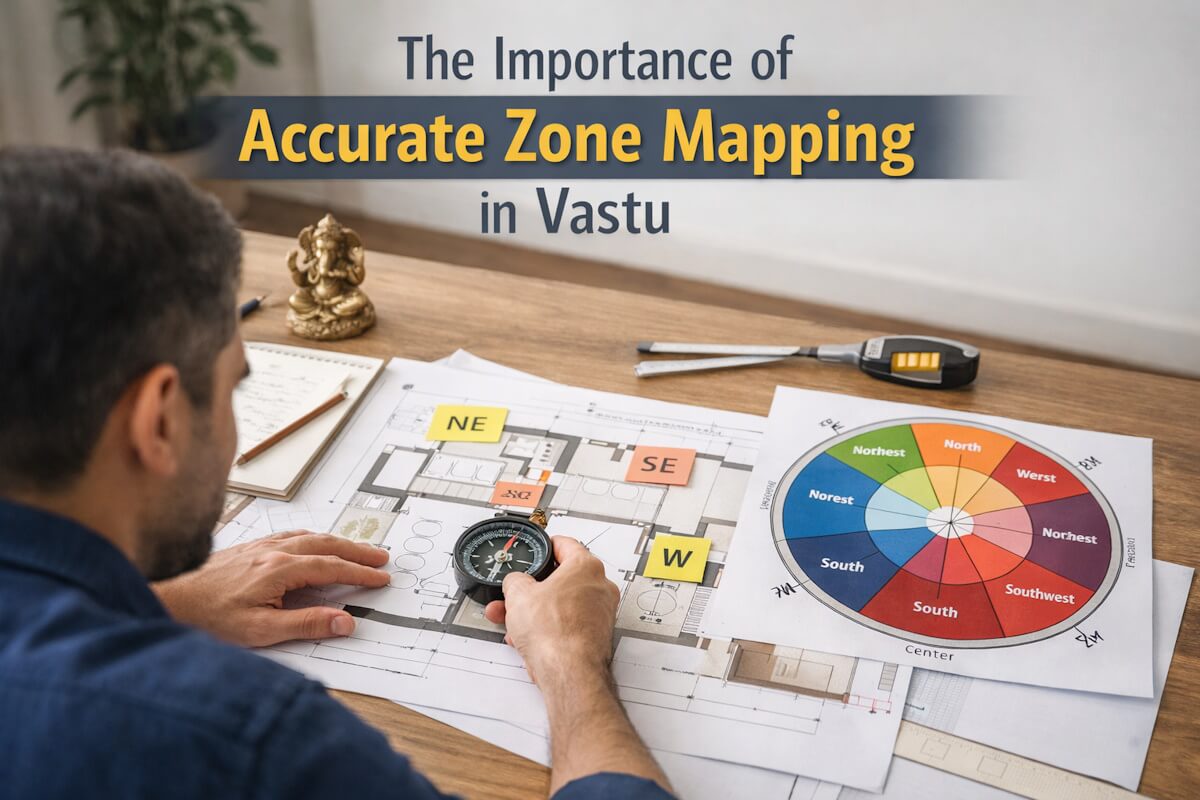
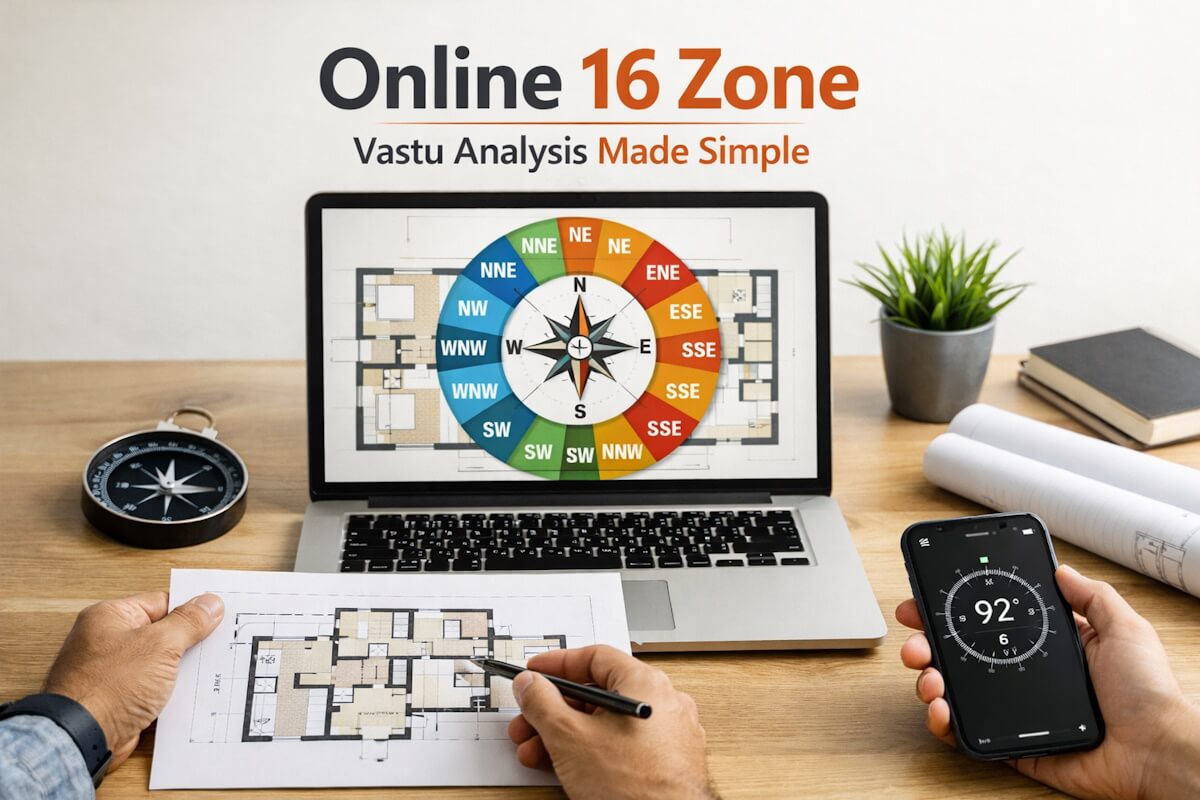
    Start by overlaying the 16-zone grid on your floor plan. See which rooms touch which zones. Even partial overlap matters.

    Do not panic if something is off. Vastu works on correction, not perfection. Furniture placement, usage shifts, and subtle adjustments make real differences.

    The goal is not to demolish. The goal is to align function with zone behavior.

    Common Mistakes People Make With the 16 Zones

    One big mistake is assuming corners alone matter. Every wall length counts.

    Another is treating deities as decorative labels instead of functional energies. Each zone responds to action, not belief.

    Also, people often over-fixate on North-East and ignore South-West. Balance matters.

    Get Your 16 Zone Vastu Analysis

    Final Thoughts on Living With the 16 Zones

    Understanding the 16 zones in Vastu changes how you look at space. Rooms stop being random boxes. They become tools.

    If something feels off in your life, your house might already be showing you where the friction is.

    Walk through your home with this knowledge. Ask simple questions. Is this activity right for this zone? Is this space supporting or resisting me?

    That awareness alone shifts outcomes.

    And once you see it, you cannot unsee it.

  • Is 16 Zone Vastu Applicable for Apartments and Small Flats?

    Is 16 Zone Vastu Applicable for Apartments and Small Flats?

    If you live in an apartment or are planning to buy one, this question probably crossed your mind at some point. You hear about 16 Zone Vastu from consultants, YouTube videos, or builders using it as a selling line. Then reality hits. Your flat is 800 or 1,100 square feet. Walls are fixed. Balconies are where they are. You do not control the plot shape or the building orientation.

    So you wonder.
    Does 16 Zone Vastu really apply to apartments and small flats?
    Or is it meant only for independent houses and villas?

    Let’s break this down in a practical way, without hype or fear-based talk. Just real guidance that helps you decide what to follow and what to ignore.

    Understanding What 16 Zone Vastu Actually Means

    Traditional Vastu divides a space into directions like North, South, East, and West. Over time, this expanded into eight directions. The 16 Zone approach goes one step further. Each direction is split again, creating sixteen micro-zones such as NNE, ENE, ESE, SSE, and so on.

    Each of these zones is linked with specific life themes. Money flow, health, relationships, stability, mental peace, and growth all get assigned zones. On paper, it looks very detailed and precise.

    In independent houses, this system makes more sense. You usually have control over room placement, entry points, open spaces, and structural changes. In apartments, things get tricky fast.

    That does not mean it is useless. It just means the way you apply it has to change.

    Analyze Vastu Zones Now

    The Biggest Limitation in Apartments

    Apartments are vertical homes. Your flat sits inside a larger structure that already decided many Vastu factors before you ever saw the floor plan.

    You do not control:

    • The building’s plot orientation
    • Staircase and lift positions
    • Structural walls
    • Neighboring flats and shared walls

    Most 16 Zone Vastu rules assume open land planning first and construction later. Apartments work in reverse.

    Trying to apply every rule blindly often creates confusion or stress. Some people end up thinking their flat is doomed because the kitchen sits in a “wrong” sub-zone or the toilet touches a sensitive angle.

    That mindset helps no one.

    What Still Works in Small Flats

    Even with limitations, some parts of 16 Zone Vastu remain useful when handled smartly.

    The key is scale and priority.

    In apartments, Vastu works more like internal zoning rather than plot-based planning.

    Rooms still hold weight. Furniture placement still matters. Usage of spaces matters a lot.

    For example, if your living room covers multiple zones, you can still activate the better zones through seating, lighting, and movement patterns.

    You are not redesigning the building. You are tuning the space you actually live in.

    Entrance Direction and Micro-Zones

    Main door direction is one of the most discussed parts of 16 Zone Vastu. In apartments, this is usually the first and last thing people can control.

    Micro-zones like ENE or NNW are often labeled as strong or weak based on theory. In reality, the impact depends on how the entrance behaves.

    Ask simple questions:

    • Is the entry cluttered?
    • Is it dark?
    • Does it open straight into a toilet or kitchen?
    • Is there airflow?

    A slightly off micro-zone with good light, cleanliness, and smooth movement often performs better than a so-called perfect zone blocked by junk and poor lighting.

    In small flats, function beats theory.

    Bedrooms and the 16 Zone Debate

    People worry a lot about bedroom placement in micro-zones. This is where fear usually creeps in.

    In apartments, bedrooms often overlap multiple zones. That alone breaks strict 16 Zone rules.

    Instead of stressing over exact compass degrees, focus on usage inside the room.

    Where is the bed placed?
    Which wall supports your head?
    Is there heavy storage above the bed?
    Is the room calm or noisy?

    If your master bedroom falls partly in South or Southwest, that is usually fine. Even if it leaks into a sub-zone considered average, stability matters more than precision here.

    Children’s rooms and guest rooms can tolerate more flexibility.

    Kitchen Placement in Small Flats

    Kitchens cause the most panic.

    In 16 Zone Vastu, fire-related zones are discussed in detail. In apartments, kitchens are often squeezed into corners due to plumbing lines.

    If your kitchen is not in an ideal micro-zone, look at how fire energy behaves inside it.

    Check these points:

    • Stove placement and direction
    • Sink and stove separation
    • Ventilation quality
    • Clutter around cooking area

    A well-maintained kitchen with clear fire and water separation performs better than a technically correct zone filled with chaos.

    You cook daily. Energy follows action.

    Toilets and Bathrooms in Micro-Zones

    This is another area where theory clashes with reality.

    Most apartments come with fixed toilet positions that cannot move. Worrying endlessly about toilet placement in a specific sub-zone only creates anxiety.

    Instead, manage what you can control.

    Keep toilets dry, ventilated, and clean. Avoid leaks. Keep doors shut when not in use. Use light colors and proper exhaust fans.

    These steps matter more in apartments than chasing perfect zoning.

    Living Room and Multi-Zone Overlap

    Living rooms in apartments usually sit across several zones. That is not a flaw. It is normal.

    This space handles movement, conversation, relaxation, and social energy. It should feel open and breathable.

    Use zoning within the room:

    • Seating in calmer zones
    • TV and electronics in heavier zones
    • Open space where movement flows naturally

    You are shaping behavior, not redrawing walls.

    Balconies and Openings

    Balconies often act as pressure valves in apartments. Their direction influences light, airflow, and mood.

    A balcony in East or North brings in freshness. South or West balconies need shading and heat control.

    Even if a balcony sits in a less favored micro-zone, plants, curtains, and seating use can soften its effect.

    Do not seal balconies completely unless safety forces you to. Air matters more than textbook rules here.

    What 16 Zone Vastu Cannot Fix in Apartments

    This part needs honesty.

    16 Zone Vastu cannot override:

    • Poor construction quality
    • Structural defects
    • Bad maintenance
    • Legal or layout issues
    • Noise pollution or lack of sunlight

    Some people expect Vastu tweaks to fix everything. That expectation leads to disappointment.

    Vastu supports living quality. It does not replace common sense or good design.

    When 16 Zone Vastu Is Still Worth Applying

    There are situations where this system helps even in apartments.

    • When choosing between two similar flats
    • When doing interior renovation
    • When placing heavy furniture or storage
    • When planning a home office or study
    • When correcting energy flow without breaking walls

    Used selectively, it becomes a guide rather than a rulebook.

    Mistakes People Make with 16 Zone Vastu in Flats

    One common mistake is applying land-based rules to vertical living. Another is obsessing over degrees measured on phone apps without understanding magnetic variation or building orientation.

    Some people also mix multiple Vastu systems and end up confused. Stick to one approach and apply it lightly.

    Overcorrection causes more stress than benefit.

    A More Realistic Way to Use 16 Zone Vastu

    Think of 16 Zone Vastu as a lens, not a verdict.

    Use it to:

    • Improve placement decisions
    • Understand why certain areas feel heavy or light
    • Balance daily activities with space behavior

    Ignore parts that demand structural changes you cannot make.

    You live in the flat. The flat should support you, not control you.

    Identify Vastu Zone Issues

    So, Is 16 Zone Vastu Applicable for Apartments?

    Yes, it is applicable.
    No, it should not be followed rigidly.

    In apartments and small flats, 16 Zone Vastu works best when adapted. Prioritize light, airflow, cleanliness, and sensible usage over strict compass precision.

    If your home feels stable, restful, and functional, you are already doing many things right.

    The goal is not perfection. The goal is comfort that lasts.

    If you are buying, renovating, or simply trying to feel better in your space, use Vastu as support, not pressure.

    Your home should feel like yours. That matters more than any grid.

  • How 16 Zone Vastu Is Derived from Vedic Sciences

    How 16 Zone Vastu Is Derived from Vedic Sciences

    If you live in an apartment, own a plot, design homes, or advise buyers, you’ve probably heard people talk about 16 Zone Vastu as if it’s a modern shortcut. It’s not. This system didn’t pop up randomly or come from guesswork. It grew out of layered Vedic sciences that were already deeply technical, spatial, and observation-based.

    You don’t need blind belief to understand it. You just need to see how the logic builds, step by step.

    This article breaks down where the 16 Zone Vastu system comes from, how ancient sciences shaped it, and why it still works for modern layouts where perfect square plots barely exist anymore.

    The Foundation Starts with Direction, Not Decoration

    Vedic sciences never treated land as neutral. Direction mattered before walls, rooms, or even rituals.

    The earliest base comes from directional awareness. Ancient observers noticed that the sun, wind, heat, and moisture behaved differently across directions. These patterns weren’t philosophical. They were physical.

    East brought light and freshness.
    South carried heat.
    West held moisture and heaviness.
    North stayed cooler and more stable.

    This simple observation laid the groundwork for dividing space based on how nature behaves, not how humans wish it behaved.

    From there, the science deepened.

    Find Vastu Imbalances

    Vastu Purusha Mandala Is the Core Grid

    The Vastu Purusha Mandala is the real backbone behind 16 Zone Vastu.

    Originally, this mandala was a square energy map used to analyze land. The most common version divides space into 9, 16, 32, or 64 parts depending on complexity.

    The 16 Zone system comes from the 16-part division, where the site is split evenly into directional segments starting from North and moving clockwise.

    Each zone occupies 22.5 degrees on the compass.

    This division wasn’t done to create labels. It was done to track subtle shifts in energy as you move from one direction to another.

    North is not the same as North-Northeast.
    South is not the same as South-Southwest.

    Once you stand on real land, this difference becomes obvious.

    Why 8 Directions Were Not Enough

    Most people learn Vastu using only 8 directions.

    North, South, East, West, and the four corners.

    That works for basic guidance. It fails when layouts get complex.

    Apartments don’t sit perfectly aligned.
    Plots are cut, angled, or merged.
    Rooms overlap directional boundaries.

    Ancient planners already knew this problem. That’s why they divided directions further.

    Each corner is not a single energy. It’s a transition.

    The moment you accept that, the 16 Zone system becomes logical rather than mystical.

    The Role of Panchabhuta in Zone Division

    Vedic science recognizes five elements, earth, water, fire, air, and space.

    These elements don’t sit evenly across land. They shift gradually as direction changes.

    Fire dominates more strongly in Southeast than in South.
    Water influence increases as you move from North to Northeast.
    Air peaks between West and Northwest.

    The 16 Zone model captures these gradual shifts.

    Instead of forcing a room into a rigid category, it asks a more practical question.

    Which element dominates here right now?

    That’s why kitchens feel different when placed in Southeast versus South-Southeast.
    That’s why toilets behave differently in West versus West-Northwest.

    Same room. Different zone. Different outcome.

    Astronomy and Solar Movement Shaped the Zones

    The sun was the main measuring tool in Vedic sciences.

    Solar angles, sunrise points, and seasonal shifts were tracked carefully.

    The East zone wasn’t just East. It was broken into:

    East-Northeast for early light and clarity
    East for balanced illumination
    East-Southeast for rising heat

    These solar distinctions shaped how zones were defined.

    That’s also why prayer, study, and entry points behave differently across these sub-directions.

    Light at 6 am is not the same as light at 9 am. The zones reflect that reality.

    Deities Are Symbolic, Not Religious Labels

    Each zone in the 16 Zone system is associated with a deity.

    This confuses modern readers.

    These deities are symbolic markers, not religious instructions.

    Agni represents transformation and heat.
    Varuna represents flow and containment.
    Vayu represents movement.
    Kubera represents accumulation and stability.

    Ancient sciences used stories and names to store data. The deity names are memory tools, not worship rules.

    When you hear that a zone belongs to Agni, it means fire-like qualities dominate there.

    This symbolic coding made it easier to pass technical knowledge across generations without textbooks.

    Ayurveda Influenced Spatial Health Logic

    Ayurveda and Vastu were never separate sciences.

    The same elemental balance that affects the body also affects space.

    Sleep quality worsens in zones with excess fire.
    Digestion improves when kitchens sit in zones with rising heat.
    Mental clarity improves where light and air combine smoothly.

    The 16 Zone system allows this tuning.

    Instead of saying “don’t place bedroom in South,” it refines the advice.

    South-Southwest is heavy and grounding.
    South-Southeast is active and restless.

    One helps sleep. The other disrupts it.

    This precision came directly from Ayurvedic observation.

    Why Modern Homes Need 16 Zones More Than Ever

    Old homes were symmetrical.
    Modern homes are compromised.

    Corners are cut.
    Balconies protrude.
    Toilets land where plumbing allows, not where Vastu prefers.

    Using only 8 directions in such homes creates confusion and fear.

    The 16 Zone system reduces that fear by offering flexibility.

    A toilet in West is not the same as a toilet in West-Northwest.
    A kitchen in Southeast behaves differently than one in East-Southeast.

    Instead of declaring a home bad, the system explains what’s happening and what can be adjusted.

    That’s why serious consultants rely on it.

    The Compass Became a Scientific Tool

    Once magnetic compasses became common, the directional science became more exact.

    Zones were measured precisely in degrees.

    Each 22.5-degree segment showed consistent results across climates, regions, and building styles.

    This repeatability is what makes 16 Zone Vastu practical, not symbolic.

    If it didn’t work, it wouldn’t have survived.

    Why Some Zones Feel Neutral

    Not every zone feels strong.

    Some are transitional. They buffer energies between extremes.

    For example:
    North-Northwest acts as a release zone.
    South-Southwest acts as a storage zone.

    These areas aren’t ideal for primary rooms, but they are perfect for staircases, stores, or toilets.

    This explains why certain layouts feel okay even when they break textbook rules.

    The zone absorbed the pressure.

    How the System Handles Multiple Floors

    Vedic sciences were not limited to single-story homes.

    Vertical energy movement was acknowledged.

    Lower floors hold heavier energies.
    Upper floors activate lighter ones.

    When you apply the 16 Zone system floor by floor, patterns emerge.

    Bedrooms in Southwest work better on lower floors.
    Puja rooms in Northeast perform better higher up.

    This wasn’t coincidence. It was observation.

    Why Remedies Came Later, Not First

    Early Vastu focused on placement, not correction.

    Remedies became popular only when people stopped building freely.

    The 16 Zone approach reduces the need for remedies because it respects micro-directional behavior.

    Instead of fixing a problem after construction, it avoids the problem during planning.

    That’s a big shift.

    What Happens When Zones Are Ignored

    Ignoring zones doesn’t cause instant disaster. That’s another myth.

    What happens is slow imbalance.

    Sleep patterns shift.
    Expenses rise.
    Conflicts increase.
    Health feels off without diagnosis.

    People sense it but can’t name it.

    The 16 Zone system gives language to those sensations.

    It connects lived experience to spatial cause.

    Why This System Survived for Thousands of Years

    Vedic sciences weren’t preserved because of belief.

    They survived because they worked.

    Farmers, builders, traders, and rulers used these principles daily. If they failed, they would’ve vanished.

    The 16 Zone division stayed because it adapted.

    It scaled from huts to palaces.
    From courtyards to apartments.
    From stone to concrete.

    That adaptability is rare.

    Using 16 Zone Vastu Without Overthinking

    You don’t need to memorize deity charts.

    Start simple.

    Know your North.
    Divide your space into 16 equal slices.
    Observe where key rooms fall.

    Ask practical questions.

    Is this zone active or calm?
    Is it heavy or light?
    Is it meant for movement or rest?

    The answers guide placement more than any rulebook.

    View Your 16 Zone Vastu Insights

    Final Thoughts You Can Actually Use

    16 Zone Vastu isn’t a trend. It’s a refined lens.

    It came from astronomy, Ayurveda, elemental science, and observation of daily life.

    It doesn’t demand perfection.
    It explains imperfection.

    That’s why it matters today.

    If your home feels slightly off but not disastrous, the answer is probably hiding in a sub-direction, not a major one.

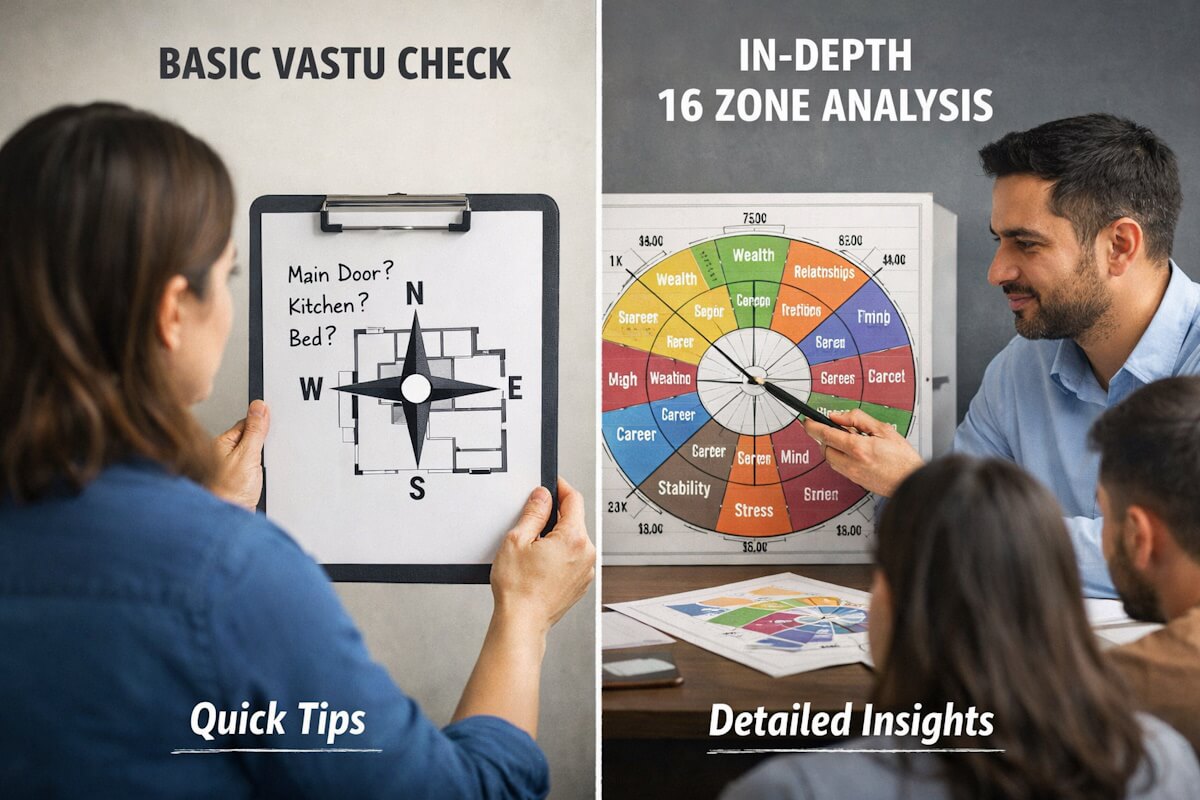
  • Difference Between Direction-Based Vastu and 16 Zone Vastu Analysis

    Difference Between Direction-Based Vastu and 16 Zone Vastu Analysis

    If you have ever spoken to two Vastu consultants and walked away more confused than before, you are not alone. One talks only about east, west, north, south. The other pulls out a 16-zone grid and starts naming areas you have never heard of. You stand in your living room wondering which advice to trust and which changes actually matter for your home.

    This article clears that fog. You will understand how direction-based Vastu works, how 16 zone Vastu analysis works, and where each approach fits into real homes, apartments, plots, and commercial spaces. No theory for theory’s sake. Just practical clarity you can use.

    What Direction-Based Vastu Really Focuses On

    Direction-based Vastu is the system most homeowners recognize first. It divides a plot or home into eight primary directions based on the cardinal and intercardinal points. These are north, south, east, west, northeast, northwest, southeast, and southwest.

    This approach looks at how major spaces sit within those directions and how natural elements interact with them. The logic is simple enough to apply without architectural drawings or software.

    How Direction-Based Vastu Is Applied in Real Homes

    In direction-based Vastu, each direction has a general role. East is linked with morning energy and openings. North relates to movement and money flow. South and southwest deal with stability and weight. Southeast is associated with fire and heat. Northwest connects with movement and change.

    When someone checks your house using this method, they usually focus on big-ticket items.

    Where is the main entrance
    Where is the kitchen
    Where is the master bedroom
    Where are toilets placed
    Where is the staircase or overhead tank

    The advice tends to sound like this. Keep the kitchen in the southeast. Place the master bedroom in the southwest. Avoid toilets in the northeast. Let more light enter from the east and north.

    For independent houses and plots, this works quite well. You can often make structural decisions at an early stage. Builders also like this method because it is straightforward and easy to explain to buyers.

    Strengths of Direction-Based Vastu

    The biggest strength of direction-based Vastu is clarity. You do not need complex calculations. A compass and a floor plan are often enough.

    It also fits modern decision-making. You want to know whether buying a south-facing plot is fine. You want to know if a west-facing flat is a deal breaker. Direction-based Vastu answers those questions quickly.

    Another plus is flexibility. Many homes cannot be rebuilt from scratch. This system lets you work with what you already have and make adjustments through furniture placement, usage changes, and small corrections.

    Where Direction-Based Vastu Falls Short

    Problems begin when people expect direction-based Vastu to explain everything. It cannot always explain why two homes with the same facing produce very different experiences for the people living inside them.

    In apartments, this method starts losing sharpness. You may have a northeast corner that technically exists but is cut off or shared with another unit. Toilets might sit in directions you cannot change. Direction-based Vastu then turns into a checklist rather than a diagnostic tool.

    This is where the second system enters the conversation.

    Understand Your Vastu Zones

    What 16 Zone Vastu Analysis Actually Examines

    16 zone Vastu analysis divides a property into sixteen equal parts rather than eight directions. Each zone represents a specific life theme. These themes go beyond elements like fire or water. They focus on daily human concerns such as authority, relationships, income, learning, rest, and support.

    This system does not stop at where a room is located. It looks at what is happening inside each zone.

    How the 16 Zones Are Mapped

    The 16-zone grid overlays the entire plot or apartment, regardless of shape. Even irregular layouts are divided evenly. Each slice has a role.

    For example, one zone connects with income stability. Another deals with decision-making. One relates to health recovery. Another focuses on relationships and harmony. These zones exist whether you acknowledge them or not.

    Once mapped, the consultant checks what occupies each zone.

    Is there a toilet in a money-related zone
    Is heavy storage blocking a growth zone
    Is a kitchen flame placed in a rest zone
    Is a bedroom sitting in an action-oriented area

    This system does not judge only by direction. It judges by purpose.

    How 16 Zone Vastu Is Used in Modern Spaces

    16 zone Vastu shines in apartments, high-rise buildings, office floors, and commercial layouts. These spaces often break traditional directional rules. Kitchens may be forced into odd corners. Entrances may not fall where textbooks say they should.

    Instead of declaring a space bad or unusable, 16 zone analysis asks a different question. What is this zone meant to support, and is the current usage helping or blocking that support?

    For example, you might live in a north-facing flat that follows direction-based Vastu nicely. Still, your income feels unstable. A 16 zone check may reveal that the income-related zone holds a cluttered store room or a leaking bathroom. That insight does not come from direction alone.

    Strengths of the 16 Zone Approach

    The biggest strength is precision. It explains patterns people experience but cannot link to directions.

    Why sleep feels restless even in a southwest bedroom
    Why business decisions stall despite a good office entrance
    Why relationships feel strained in a technically Vastu-compliant home

    The 16 zone system connects physical usage with lived experience. It also gives non-structural solutions. You might not need demolition. You may need reassignment of spaces, weight adjustments, or usage corrections.

    Another advantage is consistency across property types. A small studio apartment and a large villa can both be analyzed using the same grid logic.

    Where 16 Zone Vastu Can Feel Overwhelming

    For first-time buyers or homeowners, 16 zone Vastu can feel heavy. There is more to absorb. The terminology is unfamiliar. The analysis takes longer.

    If used without restraint, it can also lead to overthinking. Not every minor imbalance needs correction. A skilled practitioner prioritizes impact. An unskilled one may push unnecessary changes.

    Core Difference Between Direction-Based Vastu and 16 Zone Vastu Analysis

    The real difference is not complexity. It is perspective.

    Direction-based Vastu looks at orientation.
    16 zone Vastu analysis looks at function.

    One asks where a space is.
    The other asks what a space is doing to your life.

    Direction-based Vastu is like checking the frame of a house. 16 zone analysis is like checking how each room supports daily living.

    How Both Systems Treat the Same House Differently

    Let’s take a common situation.

    You live in an east-facing apartment. The kitchen sits in the southeast. The master bedroom is in the southwest. By direction-based rules, this looks fine.

    Yet you feel drained. Sleep is light. Work pressure spills into personal time.

    A direction-based review may end with reassurance. Everything is placed correctly.

    A 16 zone review might notice that your bedroom falls in a zone meant for activity and leadership rather than rest. The direction is fine, but the zone purpose clashes with usage.

    That single insight changes the solution. You might alter furniture weight, colors, or daily usage patterns instead of relocating rooms.

    Which System Is Better for Buying Property

    If you are shortlisting plots or independent houses under construction, direction-based Vastu is often enough. It helps you filter quickly. You can eliminate layouts that clash strongly with basic principles.

    For ready apartments, resale flats, and commercial offices, 16 zone Vastu analysis gives deeper value. You are not choosing structure anymore. You are choosing compatibility.

    Many investors now use both. Direction-based Vastu for initial screening. 16 zone analysis for final decision-making.

    Which System Works Better for Renovations

    Minor renovations benefit more from 16 zone analysis. You can rarely change directions. You can change usage, weight, lighting, and purpose.

    For example, turning a storage-heavy room into a light study may activate a growth-related zone without breaking walls.

    Direction-based Vastu helps during major renovations or rebuilds when walls can move and room locations can change.

    Common Misunderstandings That Create Confusion

    A big myth is that 16 zone Vastu replaces direction-based Vastu. It does not. It builds on it.

    Another misunderstanding is that direction-based Vastu is outdated. It still forms the base. Ignoring directions entirely creates its own issues.

    Some people assume 16 zone Vastu demands expensive remedies. In practice, many corrections involve decluttering, reassignment, or lifestyle shifts.

    How Architects and Builders Use These Systems Differently

    Architects lean toward direction-based Vastu during planning because it integrates smoothly with structural design.

    Interior designers and Vastu consultants often prefer 16 zone analysis once the shell is fixed. It gives room to work creatively without altering the building.

    Realtors usually speak in directional terms because buyers understand them faster. Investors ask for 16 zone insights because they care about outcomes.

    Choosing the Right Approach for Your Situation

    Ask yourself a few grounded questions.

    Are you buying land or a finished apartment
    Can you change walls or only usage
    Are you facing specific issues or just checking compliance
    Do you want quick clarity or deep diagnosis

    If you want fast answers, direction-based Vastu works. If you want explanations for lived experiences, 16 zone Vastu analysis offers more.

    In many cases, the smartest choice is not either-or. It is layered use.

    Why Many Homes Feel Stuck Despite Being Vastu Compliant

    This is where frustration often comes from. A home ticks all directional boxes. Still, something feels off.

    Direction-based Vastu confirms structure. 16 zone analysis confirms alignment with daily life. When structure and usage do not speak the same language, discomfort shows up.

    People often feel relief when this gap is identified. It shifts the conversation from fear to problem-solving.

    Discover Your 16 Vastu Zones

    Final Thoughts You Can Actually Use

    The difference between direction-based Vastu and 16 zone Vastu analysis is not about which is superior. It is about what question you are asking.

    If you ask, is this house acceptable, direction-based Vastu answers.

    If you ask, why does this house affect me this way, 16 zone analysis responds.

    You do not need to become an expert. You just need to know which lens to use at which moment. That awareness alone saves time, money, and unnecessary stress.

    If you are evaluating a property, renovating a space, or trying to understand persistent patterns in your home or office, choosing the right Vastu framework changes everything.

  • Why Traditional 8-Direction Vastu Is Not Enough in Modern Homes

    Why Traditional 8-Direction Vastu Is Not Enough in Modern Homes

    If you grew up hearing about Vastu, you probably heard the same advice again and again. Kitchen in the southeast. Master bedroom in the southwest. Pooja room in the northeast. Keep the toilet away from the northeast. Sounds simple, right?

    That logic came from a time when homes were simple. Single-floor houses. Clear plots. Roads on one side. Sunlight from predictable angles. Life was slower and buildings followed the land, not the other way around.

    Now look at your home.

    It might be a high-rise apartment on the 18th floor. Or a compact villa squeezed between two other buildings. Or a resale flat where walls can’t be shifted. Maybe your main door opens into a passage shared with three neighbors. Maybe your balcony faces another tower five feet away.

    This is where traditional 8-direction Vastu starts falling short.

    Not because Vastu is wrong. But because the way it’s applied hasn’t kept up with how people actually live today.

    Let’s break this down in a practical way, without hype or fear tactics.

    The 8-Direction Model Was Built for a Different World

    The classic 8-direction system works on a clean division of space. North, south, east, west, plus the four corners.

    This model assumes a few things.

    One, the plot is open on at least one side.
    Two, the house is built from scratch.
    Three, the owner controls every wall, door, and room placement.
    Four, external surroundings are stable and predictable.

    Most modern homes break all four assumptions.

    Apartments don’t sit directly on land in the same way independent houses do. They stack vertically. The ground energy, slope, soil type, and water flow that older Vastu relied on barely reaches upper floors.

    Even villas today are part of gated layouts with identical designs. You can’t rotate the kitchen because the builder already decided that for 200 homes at once.

    So when someone tells you “your kitchen is wrong because it’s in the north,” ask yourself a simple question.

    Could this home realistically be built any other way?

    In many cases, the answer is no.

    Check Your 16 Zone Vastu Balance

    Direction Alone Ignores How Energy Actually Moves Indoors

    Traditional Vastu treats energy as static. A room sits in a direction, so the effect is fixed.

    Modern homes don’t behave like that.

    Air moves through corridors. Light bounces off glass towers. Sound travels through shared walls. Elevators, generators, parking levels, and service shafts all affect how a space feels.

    Think about your own home.

    Does the northeast corner always feel calm just because it’s northeast? Or does it feel noisy because the elevator shaft runs behind it?

    Does the southeast kitchen actually get heat from fire energy? Or does it stay dark because another building blocks sunlight all day?

    Directional labels don’t account for these realities.

    Energy follows movement, not just compass points. Entry paths, walking lines, airflow, light exposure, and usage patterns matter more than textbook direction placement.

    If Vastu advice ignores how you actually use the space, it stops being helpful.

    Modern Floor Plans Break Traditional Room Logic

    Older Vastu texts assumed clear room purposes.

    Kitchen was only for cooking.
    Bedroom was only for sleeping.
    Living room was for sitting and talking.

    Now look at a modern apartment.

    The kitchen might be open and connected to the living room. The dining table might double as a work desk. The guest bedroom might be your full-time office. Kids study, play, and sleep in the same room.

    Traditional 8-direction rules struggle here because they assign one type of energy per room.

    But when one room serves three functions, which rule applies?

    If you work from your bedroom all day, does it behave like a bedroom or an office? If your kitchen island is where kids do homework, does fire energy still dominate?

    Real life doesn’t fit clean boxes. Vastu needs to adapt to how spaces are used hour by hour, not just what the builder labeled them as.

    Vertical Living Changes Everything

    Traditional Vastu focuses heavily on the plot. Slope of land. Underground water. Open spaces around the house.

    In a high-rise building, your home might be 150 feet above ground. Whatever water veins or soil conditions exist below are filtered through concrete, steel, parking levels, and other apartments.

    This doesn’t mean upper-floor homes have no energy. They do. But the source and flow are different.

    Vertical alignment matters more. What’s above you. What’s below you. What’s directly opposite your door. What kind of activity happens on other floors.

    If there’s a gym above your bedroom, you’ll feel it. If there’s a garbage room below your living space, that has an effect too.

    The 8-direction model rarely addresses vertical stacking in any practical way. Modern Vastu has to.

    Fixed Rules Create Fear, Not Solutions

    One of the biggest problems with rigid directional thinking is fear.

    People hear statements like:

    “This direction is always bad for toilets.”
    “This kitchen placement will ruin finances.”
    “This bedroom guarantees health problems.”

    No context. No adjustment. No remedy beyond drastic changes.

    For someone living in a rented flat or a resale apartment, this advice creates anxiety without offering realistic fixes.

    Good Vastu should calm you, not stress you out.

    A modern approach looks at balance, usage, and correction. It asks what can be improved within existing limits. Furniture placement. Lighting changes. Door usage. Color balance. Activity timing.

    Direction becomes one factor, not the final verdict.

    External Environment Matters More Than Ever

    Traditional Vastu looked at nearby temples, water bodies, and open land.

    Today, your surroundings include flyovers, metro lines, parking ramps, mobile towers, generator rooms, and neighboring balconies that stare straight into your bedroom.

    These external influences often overpower internal direction rules.

    For example, a northeast balcony blocked by another tower won’t behave like a classic open northeast, no matter how accurate the compass reading is.

    A main door facing a noisy service corridor feels very different from one opening into open space, even if both face the same direction.

    Modern Vastu must account for what your home faces, not just where it sits on a compass.

    The Compass Itself Isn’t Always Reliable Indoors

    This part surprises many people.

    Compass readings inside apartments are often distorted. Steel reinforcement, electrical wiring, appliances, and even nearby buildings can throw off readings.

    So when someone walks into your living room, holds a phone compass, and declares your sofa is in the wrong direction, take it lightly.

    Without understanding magnetic deviation and building interference, direction measurements can be misleading.

    Basing major decisions only on these readings is risky.

    A better approach combines directional awareness with physical observation. How does the space feel? Where does light enter? Where do people naturally gather? Where do you feel restless?

    Your body often senses imbalance faster than a compass app.

    Modern Homes Need Functional Vastu, Not Ritual Vastu

    Traditional advice often focuses on symbolic fixes. Mirrors here. Pyramids there. Objects placed without understanding how the space works.

    Functional Vastu looks at behavior.

    Where do you sit most of the day?
    Where do you sleep?
    Where do arguments usually happen?
    Which area feels neglected or cluttered?

    These patterns tell you more than directional charts alone.

    If your northeast corner is technically correct but piled with storage and unused items, it won’t deliver calm energy.

    If your southwest bedroom feels stable because of good furniture placement and lighting, it might work fine even if it’s not textbook perfect.

    Function beats symbolism in modern living.

    One Rule Cannot Apply to Every City and Climate

    Traditional Vastu evolved in specific climates.

    Sun paths. Wind directions. Seasonal patterns.

    Modern cities vary wildly. Coastal humidity. Dry heat. Cold winters. Pollution levels. Noise density.

    A home in Phoenix behaves differently from one in Seattle. The same directional rule won’t suit both.

    Even within the same city, a ground-floor villa and a 25th-floor apartment experience light, heat, and airflow differently.

    Modern Vastu must adapt to local conditions, not repeat universal rules without adjustment.

    Renovation Limits Are Real

    Most homeowners today are not building from scratch.

    They buy what’s available. They renovate within limits. Structural walls stay. Plumbing lines stay. Main doors stay.

    Traditional 8-direction advice often assumes full freedom to redesign.

    That gap creates frustration.

    A modern approach works within constraints. It prioritizes what can realistically be changed and ignores what can’t.

    This makes Vastu practical instead of idealistic.

    Direction Still Matters, Just Not Alone

    Here’s the part many people miss.

    This is not about rejecting direction-based Vastu.

    Direction still matters. It just isn’t the only thing that matters anymore.

    Think of it like health advice. Diet matters. Sleep matters. Exercise matters. Stress matters. You wouldn’t fix everything by changing only one factor.

    Vastu works the same way.

    Direction is one layer. Usage is another. Surroundings add another. Light, airflow, noise, and behavior complete the picture.

    When these layers work together, the home supports you. When they don’t, no amount of directional correction alone will help.

    Get a Detailed 16 Zone Vastu Report

    What You Should Do Instead

    If you’re buying, renting, or renovating a modern home, shift your mindset.

    Ask better questions.

    Does the layout support daily routines?
    Is there enough natural light where you spend time?
    Does the entrance feel welcoming or rushed?
    Are rest areas actually restful?
    Does the home allow flexibility as life changes?

    Use Vastu as a guide, not a rulebook carved in stone.

    Adapt principles to your reality instead of forcing your reality to fit outdated diagrams.

    That’s how Vastu stays relevant.

    And that’s how your home starts working for you, not against you.

    If you’re living in a modern home, you already know one thing. Life isn’t perfect on paper. Your living space shouldn’t be judged that way either.

    Look at how it supports you today. That’s where real Vastu begins.

  • What Is 16 Zone Vastu Analysis? A Complete Beginner’s Guide

    What Is 16 Zone Vastu Analysis? A Complete Beginner’s Guide

    If you have ever stood inside a home and felt something was off without knowing why, this topic is for you. 16 Zone Vastu Analysis is not mystical talk or blind belief. It is a practical way of reading how different parts of a property behave and how those parts affect daily life. Money flow, sleep quality, stress levels, career movement, family harmony. All of it connects back to zones.

    This guide is written for regular people. Homeowners. Buyers. Realtors. Architects. Investors. If you live in an apartment, plan villas, or deal with commercial spaces, this will make sense to you.

    Let us keep it grounded and usable.

    Understanding Vastu Beyond Myths

    Most beginners think Vastu is just about facing directions. North good. South bad. That is outdated thinking.

    Traditional Vastu Shastra talks about energy flow based on directions, elements, and human activity. Over time, this got simplified into shortcuts. The problem is shortcuts fail in modern layouts.

    High-rise apartments, irregular plots, corner flats, duplex homes. None of these fit old square-house logic.

    That is where 16 Zone Vastu Analysis steps in.

    It breaks the entire space into 16 clear zones instead of 8 vague ones. This extra precision helps you identify exact problem points instead of guessing.

    Why 16 Zones Instead of 8

    The basic Vastu compass uses 8 directions. North, South, East, West, and the four corners.

    Real life is not that clean.

    When you stand inside a room, energy does not move in straight lines. It spreads diagonally. It overlaps. It reacts to walls, doors, toilets, and heavy furniture.

    The 16-zone method splits each main direction into two sub-directions.

    North becomes N and NNE
    East becomes E and ENE
    South becomes S and SSW
    West becomes W and WNW

    You now have 16 precise energy pockets.

    This detail is what makes analysis accurate instead of generic.

    The Core Idea Behind 16 Zone Vastu Analysis

    Every zone controls a specific part of life. When that zone is used correctly, things feel smoother. When misused, problems show up in predictable ways.

    This is not instant magic. It is pattern recognition.

    For example, if a person keeps struggling with savings, and the North zone is blocked or heavy, the connection is not random. North governs cash flow and opportunities.

    Once you see enough homes, patterns become obvious.

    That is why professionals rely on zone-based reading instead of surface rules.

    How the 16 Zones Are Identified in a Property

    You start with the center of the home. Not the entrance. Not the master bedroom. The exact center.

    From there, you overlay a compass grid aligned to true north. Not magnetic north from random apps.

    Once aligned, the space naturally divides into 16 equal slices.

    Each slice becomes a zone.

    Important detail here. Zones do not change based on rooms. A kitchen can fall into two zones. A toilet can disturb three zones at once. That is where most people get confused.

    Zones matter more than room names.

    Get Your 16 Zone Vastu Analysis

    Brief Breakdown of All 16 Zones

    Let us walk through them in a practical way. No theory overload.

    North Zone (N)

    Money movement. Income sources. Financial clarity.

    Blocked North often links to delayed payments or unstable earnings.

    North-Northeast (NNE)

    Clarity of thought. Decision making. Guidance.

    This zone affects confusion, overthinking, and dependency on others.

    Northeast (NE)

    Mental peace. Growth. Learning. Spiritual balance.

    Disturbance here shows up as anxiety, lack of focus, or restlessness.

    East-Northeast (ENE)

    Social image. Confidence. Recognition.

    If ENE is weak, people feel ignored or undervalued at work.

    East (E)

    Health and vitality.

    Poor use of East often shows as low energy or recurring minor health issues.

    East-Southeast (ESE)

    Communication and creativity.

    This zone impacts how well ideas convert into action.

    Southeast (SE)

    Fire element. Expenses. Passion. Aggression.

    Misuse of SE leads to impulsive spending or frequent arguments.

    South-Southeast (SSE)

    Emotional stability.

    Imbalance here creates mood swings or emotional drain.

    South (S)

    Strength and stability.

    South supports responsibility and long-term grounding.

    South-Southwest (SSW)

    Control and authority.

    Weak SSW brings instability in leadership roles or family control issues.

    Southwest (SW)

    Relationships. Stability. Assets.

    This is the most sensitive zone. Errors here hit hard and fast.

    West-Southwest (WSW)

    Gains from effort.

    Problems here show delayed rewards despite hard work.

    West (W)

    Profits. Results. Productivity.

    A cluttered West limits output and recognition.

    West-Northwest (WNW)

    Networking and movement.

    This zone impacts travel, connections, and support systems.

    Northwest (NW)

    Change and adaptability.

    NW imbalance causes instability or excessive movement.

    North-Northwest (NNW)

    Opportunities and support.

    This zone affects help from others and external backing.

    How 16 Zone Vastu Applies to Apartments

    Most people think Vastu fails in apartments. That is incorrect.

    Apartments work well with zone-based analysis because structure is fixed. You work with what exists.

    You do not move walls. You adjust usage.

    If the toilet falls in a weak zone, you reduce damage with weight balance, color control, and activity shift.

    If the kitchen lands partly in SE and partly in SSE, you adjust stove and storage placement.

    Zone understanding gives flexibility without reconstruction.

    Common Mistakes Beginners Make

    One big mistake is obsessing over entrances.

    Entrance matters. Zones matter more.

    Another mistake is treating remedies as decoration. Copper items, pyramids, crystals. None of these work if the zone usage stays wrong.

    Third mistake is copying advice from random videos without measuring zones properly.

    Vastu is location-specific. Blind fixes cause confusion.

    Using 16 Zone Vastu for Buying Property

    If you are buying a home, zone analysis saves years of regret.

    Instead of asking vague questions like “Is this flat Vastu compliant?”, you check three things.

    Is the Northeast clean and open
    Is the Southwest heavy and stable
    Is the North usable and unobstructed

    If these three zones work, most issues are manageable.

    This applies to resale flats, builder floors, and villas.

    Application in Commercial Spaces

    Shops, offices, and showrooms behave differently from homes.

    In offices, North and West zones control revenue and output.

    In retail, East and North zones affect footfall and visibility.

    In factories, Southeast and Southwest zones impact machinery and management.

    Zone analysis adapts based on purpose. Same grid. Different interpretation.

    Remedies Through Usage, Not Objects

    The strongest corrections come from changing how a zone is used.

    Sleeping in a weak zone worsens problems. Storage in a weak zone stabilizes it.

    Heavy cupboards can protect unstable zones. Active spaces can activate dead zones.

    Objects help only after usage is corrected.

    This is why professional advice feels simple yet effective.

    Can You Do 16 Zone Vastu Analysis Yourself?

    Yes, to a basic level.

    You need a reliable compass, accurate floor plan, and patience.

    What you should avoid is jumping to conclusions. One zone issue does not explain everything.

    Life patterns repeat. When multiple issues align with specific zones, that is when conclusions hold weight.

    Why This Method Feels More Accurate

    People trust 16 Zone Vastu because it explains reality.

    When career stress matches East imbalance. When savings trouble matches North blockage. When relationship strain matches Southwest disturbance.

    It stops feeling abstract.

    It starts feeling logical.

    Start 16 Zone Vastu Assessment

    Final Thoughts for Beginners

    16 Zone Vastu Analysis is not about fear or superstition. It is about awareness.

    Your home already influences you. Ignoring it does not stop that influence.

    Understanding zones gives you control without extreme changes.

    If you live somewhere, work somewhere, or invest in property, learning this framework gives clarity you can use for life.

    Take your time. Observe patterns. Start with small corrections.

    Your space listens more than you think.

  • Astro-Vastu Guide: How Planetary Positions Influence Your Home’s Energy Flow

    Astro-Vastu Guide: How Planetary Positions Influence Your Home’s Energy Flow

    When people talk about Vastu, most think of directions, entrances, kitchens, and bedrooms. When astrology comes up, the focus shifts to birth charts, planets, and timing. In real life homes, these two systems overlap more than most realize. This Astro-Vastu Guide is about that overlap and how planetary positions quietly affect the way your home feels, functions, and supports your daily life.

    You do not need to be an astrologer to apply this. You do not need a perfect birth chart either. This is practical guidance for apartments, villas, independent homes, and even commercial spaces where real people live and work.

    If your home feels off even after basic Vastu corrections, planetary influence is often the missing piece.

    Why Astrology Matters in Vastu for Modern Homes

    Traditional Vastu focuses on land, directions, and structure. Astrology focuses on time and planetary motion. Your home exists at a specific place and at a specific time. Both matter.

    Every plot, flat, or building comes under planetary rulership. Construction date, house number, orientation, and even renovation timing tie back to planets. When a planet is weak or disturbed in your personal chart, the area of the home ruled by that planet often shows problems.

    You might notice repeated repairs in one zone.
    Or sleep issues linked to a bedroom direction.
    Or money flow problems tied to a workspace location.

    This is not coincidence. It is planetary energy playing out through space.

    Check Your Planetary Weak Zones at Home

    Understanding Planetary Directions in Astro-Vastu

    In Astro-Vastu, each planet governs a specific direction and function inside the home. When that zone is balanced, the planet supports you. When blocked or misused, challenges show up.

    Let us break this down in a way that makes sense for daily living.

    Sun Energy and the East Zone of Your Home

    The Sun represents confidence, health, authority, and clarity. In Astro-Vastu, the east direction belongs to the Sun.

    If the east side of your home is open, clean, and well-lit, you tend to feel motivated and mentally clear. Morning sunlight here is a big plus.

    Problems arise when:

    • East is blocked by heavy storage
    • Toilets or clutter sit here
    • Dark colors dominate this area

    People with a weak Sun in their chart often feel drained or overlooked when the east zone is disturbed.

    Practical fix for apartments:
    Keep the east wall light in color. Avoid placing heavy wardrobes here. Even a small window or bright lighting helps.

    Moon Influence and the North-West Zone

    The Moon governs emotions, peace of mind, sleep, and relationships. In Astro-Vastu, the north-west connects strongly with lunar energy.

    Homes with balanced north-west zones feel emotionally stable. Air flow is key here.

    Common issues show up as:

    • Restlessness
    • Sleep disturbances
    • Overthinking
    • Frequent mood swings

    This zone often gets ignored in modern layouts.

    What helps:
    Use light shades. Avoid water leakage here. Bedrooms work well in north-west for people dealing with anxiety or unstable routines.

    Mars and the South Zone Dynamics

    Mars represents action, courage, aggression, and drive. It rules the south direction.

    If Mars is strong, the south zone supports discipline and productivity. If disturbed, conflicts and impatience increase.

    Typical Mars-related home issues:

    • Frequent arguments
    • Electrical problems
    • Accidents or injuries
    • Anger issues among residents

    Avoid placing water elements or toilets in the south. Kitchens work well here since fire supports Mars energy.

    For flats where layout cannot change, reduce red tones if anger feels high.

    Mercury and the North Direction of Communication

    Mercury governs intellect, business, communication, and adaptability. The north direction is its territory.

    A clean and active north zone supports career growth, clarity in decisions, and smooth conversations.

    When blocked:

    • Business slows down
    • Miscommunication rises
    • Paperwork gets messy
    • Mental fog sets in

    In real homes, north often gets filled with storage or unused furniture.

    Simple corrections:
    Keep north clutter-free. Use greens or light shades. Work desks facing north often feel mentally lighter.

    Jupiter’s Role in the North-East Zone

    Jupiter is the planet of wisdom, growth, stability, and guidance. In Vastu, the north-east is the most sensitive zone and directly linked to Jupiter.

    This area impacts:

    • Financial stability
    • Family harmony
    • Spiritual grounding
    • Long-term peace

    Heavy construction or toilets in north-east weaken Jupiter energy. People then feel stuck or unsupported despite efforts.

    For apartments:
    Keep north-east open. Avoid heavy furniture. Even a small meditation corner or water element helps.

    If Jupiter is weak in your chart, this zone becomes extra important.

    Venus and the South-East Fire Zone

    Venus rules comfort, relationships, beauty, and luxury. In Vastu, Venus works closely with the south-east fire zone.

    This is why kitchens belong here.

    Balanced Venus energy supports:

    • Harmonious relationships
    • Enjoyment of life
    • Balanced desires

    When south-east is misused:

    • Relationship conflicts rise
    • Overspending becomes common
    • Health issues related to hormones show up

    Avoid bedrooms in south-east for couples facing frequent arguments. Warm colors work better than dark ones here.

    Saturn’s Impact on the West Zone

    Saturn represents discipline, delays, responsibility, and long-term rewards. The west direction falls under Saturn.

    A stable west zone brings patience and steady progress. A disturbed one brings delays and frustration.

    Common Saturn zone problems:

    • Projects dragging on
    • Career stagnation
    • Chronic fatigue

    Heavy furniture is acceptable in the west. Avoid keeping it empty or too light.

    People with strong Saturn often feel comfortable in west-facing homes when Vastu is handled well.

    Rahu and Ketu Zones in Astro-Vastu

    Rahu and Ketu do not rule directions directly but influence corners and transitional spaces.

    Rahu affects areas with electronics, technology, and unusual layouts.
    Ketu influences storage, unused rooms, and spiritual zones.

    Rahu imbalance shows as:

    • Sudden problems
    • Confusion
    • Anxiety without clear cause

    Ketu imbalance shows as:

    • Isolation
    • Lack of focus
    • Feeling disconnected at home

    These influences are common in high-rise apartments where layouts are irregular.

    Keeping these areas simple and uncluttered reduces their disruptive effect.

    How Your Birth Chart Connects to Your Home

    This is where Astro-Vastu becomes personal.

    If a planet is weak or troubled in your birth chart, the zone ruled by that planet needs extra care. Ignoring it often leads to repeating patterns in life.

    Example:
    If Mercury is weak and north is blocked, business problems repeat.
    If Venus is afflicted and south-east has Vastu defects, relationship stress grows.
    If Saturn is heavy and west is neglected, delays increase.

    You do not need remedies everywhere. You need focused correction where chart and space overlap.

    Apartment Living and Planetary Adjustments

    Most people live in apartments with fixed layouts. Structural changes are limited. Astro-Vastu still works when applied smartly.

    What you can control:

    • Furniture placement
    • Color choices
    • Lighting
    • Usage of rooms
    • Clutter levels

    Small changes in the right zone influence planetary energy more than major changes in the wrong place.

    One-liner worth remembering:
    Fix the planet first, not the floor plan.

    Get Practical Astro-Vastu Fixes for Your Apartment

    Renovation Timing and Planetary Transits

    Renovations carry strong planetary impact. Starting work during unfavorable planetary periods often leads to delays, cost overruns, or dissatisfaction with results.

    Even minor renovations like kitchen shifts or bedroom changes should respect planetary timing when possible.

    People often say, “Everything went wrong after renovation.” Timing usually explains why.

    Commercial Spaces and Astro-Vastu

    Shops, offices, and rental properties also respond to planetary energy.

    • North supports cash flow and clients
    • East supports reputation
    • South controls staff discipline
    • West stabilizes long-term operations

    If a business space struggles despite good location, Astro-Vastu analysis often reveals blocked planetary zones.

    For investors, this matters more than most realize.

    Common Mistakes People Make with Astro-Vastu

    Many apply Vastu blindly without planetary context.

    Some overuse remedies everywhere.
    Some copy layouts from others.
    Some ignore personal charts completely.

    Astro-Vastu works best when:

    • You observe patterns in your life
    • You connect them to space
    • You make focused corrections

    It is practical, not decorative.

    Signs Your Home Is Out of Planetary Balance

    You might relate to this:

    • Same problems repeating every year
    • One area of life never improving
    • Feeling tired at home
    • Sudden conflicts after shifting or renovating

    These are signals, not random events.

    Your home reflects planetary patterns back to you daily.

    How to Start Applying This Astro-Vastu Guide

    Start simple.
    Observe your home zones.
    Notice which life areas feel stuck.
    Match them with planetary zones.
    Make small but intentional changes.

    You do not need perfection. You need awareness.

    Homes respond when you work with them instead of fighting them.

    Final Thought for Homeowners and Buyers

    A home is not just walls and directions. It is a living space influenced by time, planets, and your personal journey.

    This Astro-Vastu Guide is not about fear or rigid rules. It is about understanding why certain spaces support you and others resist you.

    When planetary positions and Vastu work together, homes feel lighter. Decisions feel clearer. Life flows with less friction.

    Take a slow look around your space tonight. Something will click.

    Book a Personalized Astro-Vastu Home Review