Navigating home design and property selection often brings buyers and homeowners to a fascinating crossroads. Both Chinese Feng Shui and Indian Vastu Shastra offer time-tested frameworks for optimizing spatial energies to enhance health, relationships, and prosperity. However, when evaluating the orientation of a property, confusion frequently arises because each system interprets spatial orientation through distinct cosmological and environmental lenses.
A homeowner looking at Feng Shui house directions might discover that a South-facing entrance brings vibrant recognition energy, while a traditional Vastu consultant might urge caution regarding the same orientation. Understanding where these two ancient systems agree, where they diverge, and how their directional logic works allows you to make informed, practical decisions about your living environment without feeling overwhelmed by conflicting advice.
The Core Philosophies Behind Directional Energy
To appreciate how both traditions assess spatial layout, one must first look at the foundational worldview of each discipline. While both aim to harmonize human life with natural forces, they prioritize different environmental dynamics.
The Dynamic Chi Flow in Feng Shui Compass Directions
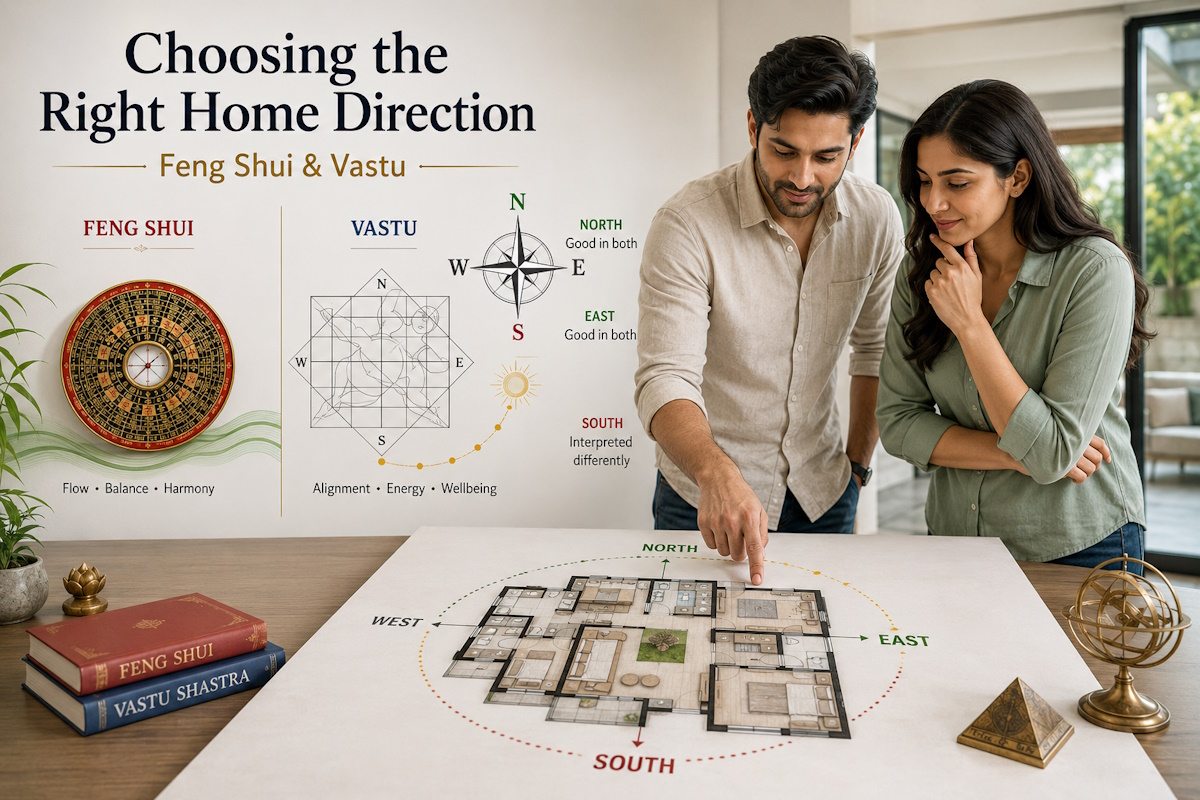
Feng Shui originated in China with a deep focus on the natural landscape, seasonal patterns, and the flow of vital life force, known as Chi. In Classical Feng Shui, Feng Shui compass directions are assessed using the Bagua map and the Luo Pan compass. Rather than viewing directions as rigid or static, Feng Shui considers how unseen energetic currents move across time and terrain.
Directional influence in Feng Shui is multifaceted. It takes into account the physical landscape surrounding the home, the year the structure was built, and the individual energetic profiles of its occupants. This dynamic approach means that the quality of an orientation can shift based on specific temporal cycles and spatial contexts. If you are exploring how property orientations affect fortune, reviewing the Best House Facing Direction in Feng Shui provides valuable context on directional suitability.
The Solar and Magnetic Grid of Vastu Shastra
Vastu Shastra, developed on the Indian subcontinent, is anchored in cosmic geometry, solar radiation, and geomagnetic forces. The foundation of Vastu is the Vastu Purusha Mandala, a metaphysical grid representing the cosmic being situated within physical space.
In Vastu, directional orientations are rooted in the path of the sun from East to West and the magnetic flow between the North and South poles. These forces create permanent energetic zones within every enclosed space. Consequently, Vastu places heavy emphasis on fixed cardinal sectors, viewing directional qualities as fundamental constants of physical architecture.
House Facing Feng Shui vs Vastu: Defining Property Orientation
One of the primary sources of confusion when comparing Vastu vs Feng Shui directions is how each methodology defines the main orientation of a structure.
Understanding Facing vs Sitting in Feng Shui
In classical practice, house facing Feng Shui does not always correspond to where the front door is installed. Instead, a building’s facing direction is defined by its most active, open, and light-filled side. This is typically the side facing a street, an open view, or where maximum sunlight enters the layout.
Opposite the facing side is the sitting direction, which represents stability, mountain energy, and support. Because modern apartments often feature large balcony windows on one side and a dark entrance hallway on the other, determining the true facing direction requires careful spatial assessment.
Cardinal Orientations and Entrance Gates in Vastu
Vastu Shastra primarily evaluates a building based on its precise alignment with the four cardinal directions: North, East, South, and West. The main entrance, or Mahadwara, holds immense importance because it acts as the primary conduit through which cosmic and pranic energy enters the home.
Rather than evaluating broad dynamic views, Vastu divides each cardinal side into specific energy fields, known as padas. An East-facing house, for instance, contains eight specific entrance zones along its eastern boundary, each yielding different functional outcomes. To understand how architectural layouts interact with modern real estate requirements, reading our guide on Feng Shui vs Vastu for Homes helps clarify these subtle distinctions.
Identifying the Real Direction of Influence
When assessing a property, homeowners must avoid guessing orientations using standard smartphone apps without calibration. Both systems require precise degree measurements to identify whether a home aligns cleanly to true cardinal directions or sits on an axis tilt that alters energetic distribution.
Where Feng Shui and Vastu Directions Agree
Despite their different terminologies and measurement techniques, Feng Shui and Vastu share profound structural harmonies. When examined closely, both systems strive toward balance, clarity, and unobstructed energy movement.
The Significance of the North and East Sectors
Both traditions assign immense value to the North and East directions:
- The North Direction: In Vastu, the North is ruled by Kubera, the custodian of wealth, and is associated with the element of Water. In Feng Shui, the North relates to the Water element in the Bagua and governs career trajectory and personal life path. Both systems emphasize keeping the Northern zone open, clean, and light.
- The East Direction: In Vastu, the East is the source of early morning solar rays and represents new beginnings, vitality, and enlightenment. In Feng Shui, the East corresponds to the Wood element, representing physical health, family harmony, and continuous growth.
Protecting the Center and Enhancing Natural Flow
Another major point of alignment between Feng Shui and Vastu is the treatment of the central core of a home. Vastu terms this central zone the Brahmasthan, which must be kept free of heavy structural elements, pillars, and toilets to allow cosmic energy to circulate unhindered.
Similarly, Feng Shui views the center of the Bagua, the Tai Chi, as the energetic heart of the residence. When the center is cluttered, burdened by heavy infrastructure, or compromised by sanitation lines, both systems predict an overarching sense of stagnation and stress across multiple life areas.
Major Differences Between Vastu and Feng Shui Directions
While the two systems share core principles, their specific recommendations for room placement, fire zones, and directional remedies can diverge significantly.
South-Facing Properties: Auspicious Fire vs Heavy Earth
The evaluation of South-facing spaces highlights a major difference between the two systems:
- Feng Shui Perspective: The South is governed by the Fire element and is tied to fame, recognition, illumination, and social status. A South-facing home that receives abundant sunlight can be highly auspicious for ambitious individuals seeking public visibility and active careers.
- Vastu Perspective: The South is ruled by Mars and Lord Yama, demanding heavier, grounding treatments. While specific South-facing entrances located in auspicious padas are beneficial, Vastu generally advises against large openings or water features in the South, prescribing substantial structural mass instead.
Personal Kua Numbers vs Universal Vastu Grids
A distinctive feature of Feng Shui is its personalized approach via the Eight Mansions (BaZhai) formula. By calculating a resident’s Kua number based on their birth year and gender, Feng Shui determines four favorable and four unfavorable compass directions tailored specifically to that individual.
Vastu, by contrast, relies primarily on universal spatial laws that apply consistently to all structures, regardless of who occupies them. While individual birth charts (Astrological Vastu) can fine-tune functional placements, the core spatial grid remains steady. To explore how directional mapping methods differ in depth, you can Understand Vastu Direction Analysis to see how modern experts evaluate functional zoning.
The Five Elements vs the Panchamahabhutas
The elemental mapping of directions also reveals structural differences:
- Feng Shui (Five Phases): Uses Wood, Fire, Earth, Metal, and Water. Directions are assigned based on generative and destructive cycles (for example, West and Northwest represent Metal).
- Vastu (Panchamahabhutas): Uses Earth (Bhumi), Water (Jala), Fire (Agni), Air (Vayu), and Space (Akasha). The Southeast is strictly the Fire zone, while the Northeast is the sacred Water/Space zone.
Practical Decision-Making for Homeowners and Buyers
When selecting a home or adjusting an existing floor plan, you do not need to choose between Feng Shui and Vastu through fear-based thinking. Instead, use a structured method to evaluate your living environment.
Resolving Directional Clashes Without Demolition
Modern apartments rarely conform perfectly to both systems. Fortunately, both traditions emphasize non-invasive corrections over structural demolition:
- Elemental Corrections: If an element is misaligned, balance it using colors, shapes, materials, and lighting rather than moving structural walls.
- Functional Alignment: Prioritize high-impact areas such as the master bed placement, workstation alignment, and cooking stove location.
- Clutter Clearance: Both disciplines agree that physical stagnation impedes energetic flow far more than minor directional flaws.
Conducting a Balanced Home Direction Analysis
When ordering a home direction analysis, establish your primary baseline first. If your property is designed around classical Indian structural principles, evaluate it through the Vastu framework. If your home has complex urban contours, irregular views, or you wish to personalize spaces for individual family members, incorporating classical Feng Shui provides excellent flexibility.
Making Informed Choices for Your Living Space
Understanding the interplay between Feng Shui house directions and Vastu principles reveals that both systems share a singular goal: aligning human habitation with natural energy flows. Rather than viewing minor discrepancies as structural flaws, recognize them as complementary tools designed for different environmental contexts.
By focusing on foundational spatial quality, proper lighting, ventilation, and functional organization, you can cultivate a home that supports long-term vitality, calm, and achievement. When planning renovations or evaluating a prospective property, seeking expert analysis ensures your decisions remain grounded, practical, and tailored to your specific living needs.
Frequently Asked Questions
1. Can I apply both Feng Shui and Vastu principles to the same house?
Yes, but it is best to avoid mixing contradictory remedial items. Focus on the core agreements: keeping the center and entrance clear, ensuring proper ventilation in the East, placing heavy furniture in the Southwest, and harmonizing color palettes with elemental zones.
2. Which direction is best for a main entrance according to both systems?
Both systems regard East and North entrances very favorably. The East fosters vitality and growth, while the North supports abundance, clarity, and smooth career movement.
3. How does a South-facing house differ between Feng Shui and Vastu?
Feng Shui views the South as a dynamic zone of Fire, fame, and social recognition. Vastu views the South as a grounding zone that requires weight and stability, though properly positioned entrances in the South can still yield positive financial results.
4. Why does my Kua number suggest a direction that Vastu discourages?
Kua numbers in Feng Shui provide personalized energetic alignments based on your birth year, whereas traditional Vastu utilizes universal directional grids. Neither is incorrect; they simply assess spatial compatibility from individual versus environmental vantage points.
5. How do I accurately measure the facing direction of my home?
Stand at the primary exterior threshold or the main light-facing facade of the building looking outward. Use a calibrated magnetic compass or professional surveyor tools away from metal grilles, electrical meters, and concrete reinforcement that can distort magnetic readings.