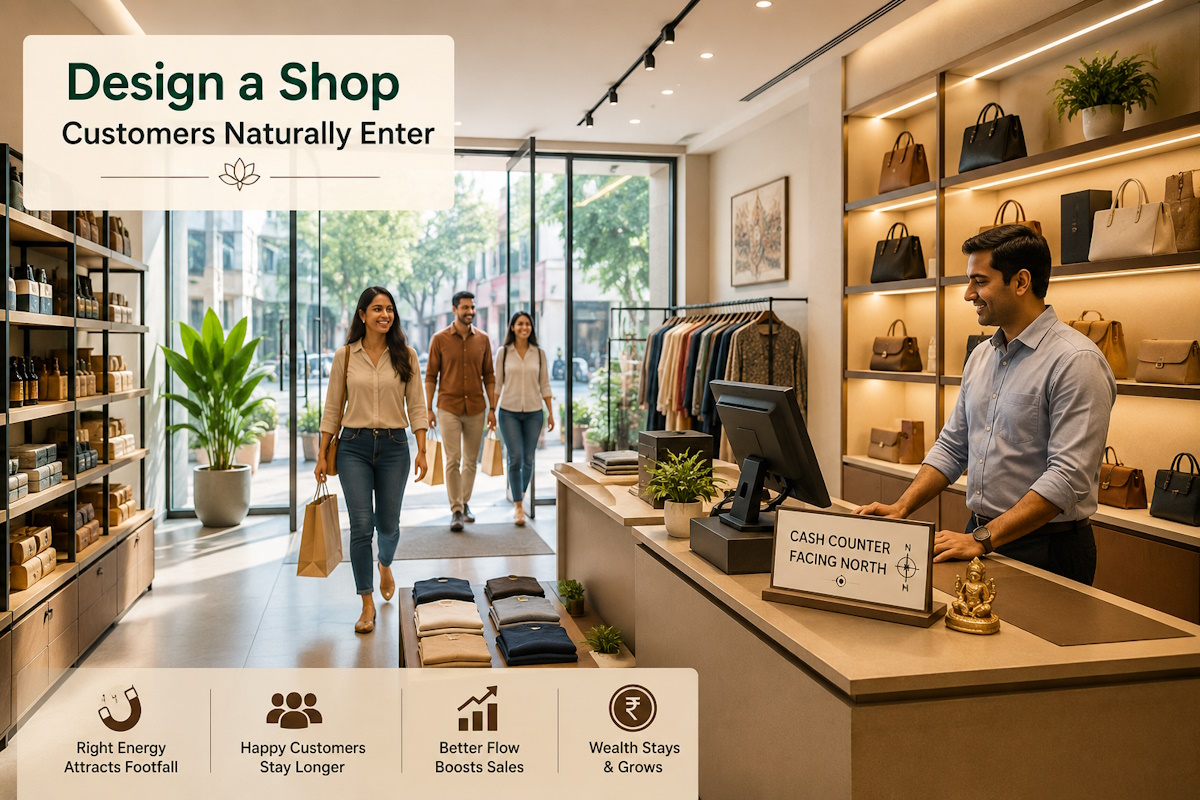
In the competitive world of retail, the difference between a thriving business and one that struggles often comes down to the environment. While marketing and product quality are vital, the spatial energy of a commercial space dictates how long a customer stays and how much they trust the brand. Shop Vastu is not merely a traditional practice but a sophisticated method of spatial optimization designed to align a business with the natural flow of energy. When a retail space is aligned correctly, it creates what we call a magnet effect, a natural pull that draws footfall and encourages repeat transactions.
Every shop, whether it is a small boutique or a large showroom, functions as a living ecosystem. The interaction between the entrance, the placement of merchandise, and the location of the cash counter determines the financial health of the enterprise. Business owners often face unexplained drops in sales or high employee turnover, which are frequently linked to imbalances in the five elements within the property. By applying professional Shop Vastu principles, owners can eliminate these energetic bottlenecks and create a high-vibration environment conducive to growth and prosperity.
The Directional Logic of Profitable Retail Spaces
The orientation of a shop is the first and most critical factor in determining its long-term viability. In the framework of Shop Vastu, different directions offer different types of energy that suit specific types of businesses. Understanding the directional logic helps a business owner choose the right property or adapt an existing one to maximize its commercial potential.
Why Orientation Dictates Customer Interaction
The direction a shop faces influences the type of customers it attracts and the speed of its sales cycle. For instance, shops facing the North are governed by the element of water and the deity of wealth, making them ideal for high-turnover retail and financial services. East-facing shops benefit from the rising sun, which promotes visibility and social connection, perfect for showrooms and lifestyle brands. When these orientations are utilized correctly, the shop feels welcoming and vibrant, naturally increasing the daily footfall.
Harnessing the Magnetic North
The North is often considered the most auspicious direction for retail. It is associated with opportunities and new beginnings. In a North-facing Shop Vastu plan, the entrance should be positioned in the specific positive zones of the North to ensure a steady stream of customers. This direction supports businesses that rely on quick decision-making and frequent transactions. Ensuring that the Northern side of the shop is open and clutter-free allows the positive magnetic energy to flow into the space without obstruction.
Sunlight and Vitality in East-Facing Shops
East-facing retail spaces enjoy the benefits of the morning sun, which brings vitality and freshness to the products on display. This direction is highly recommended for businesses related to health, fashion, and luxury goods. The solar energy helps in maintaining a positive mood among the staff and customers alike. To maximize this, large glass windows on the Eastern side are encouraged, provided they do not conflict with the structural requirements of the building.
Strategic Entrance Positioning for Maximum Footfall
The entrance is the mouth of the shop through which both customers and wealth enter. If the entrance is incorrectly placed, it can act as a barrier rather than an invitation. Shop Vastu emphasizes the placement of the main door in the most positive energy padas, or zones, of a given direction. A well-placed entrance ensures that the energy entering the shop is constructive and supportive of commercial activity.
Avoiding the Energy Sinkhole
One of the most common issues in modern retail design is the placement of entrances in negative zones, such as the southwest or the exact center of a wall in certain directions. Such placements can lead to a phenomenon where customers enter but leave quickly without making a purchase. This is often referred to as an energy sinkhole. Ensuring the entrance is in an auspicious zone creates a sense of comfort the moment a customer steps inside, making them more likely to explore the inventory.
Clearance and Visibility
Visibility is the lifeline of retail. However, Vastu principles suggest that the entrance must be clear of any physical or energetic obstructions. Poles, trees, or even large waste bins directly in front of the shop door can create a Vedh Dosha, which creates a psychological block for potential customers. Keeping the entrance area bright, clean, and decorated with auspicious symbols or plants can significantly enhance the magnet effect of the shop.
Optimizing Internal Layout for Sales Velocity
Once a customer enters the shop, their journey through the aisles is governed by the internal layout. The placement of products, the movement path, and the location of trial rooms or consultation areas all impact the final sale. Shop Vastu uses the 16-zone framework to ensure that each functional area of the shop is placed in its most supportive element.
The Cash Counter and Financial Stability
The cash counter is the most sensitive area of any retail establishment. According to Shop Vastu, the person handling the cash should ideally sit facing North or East. The cash drawer itself should be placed such that it opens toward the North, the direction of wealth. This alignment ensures that the money flowing into the business is retained and grows. It is also advised to keep the cash counter in the Southeast or Southwest zones, depending on the overall layout, to ensure stability and liquidity.
Southwest Stability for Financial Security
The Southwest zone is associated with the Earth element and provides stability. Placing heavy safes or primary storage in this zone ensures that the business remains grounded and financially secure. Avoid placing the cash counter in the Northwest, as this zone is governed by the Air element, which can lead to fluctuating finances and unstable cash flow. Stability in the Southwest provides the owner with the mental clarity needed to manage the business effectively.
Product Display and Elemental Balance
Merchandise should be categorized and placed according to its weight and nature. Heavier items should ideally be positioned in the South and West zones, while lighter, high-turnover items can be placed in the North and East. This creates a balanced distribution of weight, which is a fundamental principle of Vastu for commercial spaces. When the elements are balanced, customers feel a sense of harmony, which reduces their stress levels and increases their willingness to spend.
Lighting, Colors, and Sensory Vastu
Modern Shop Vastu goes beyond just directions and placements, it incorporates sensory elements like lighting and color psychology. The visual and atmospheric quality of a shop determines the customer’s stay duration. The longer a customer stays in a shop, the higher the probability of a sale. Utilizing the correct colors based on the directional zone can amplify the specific energy of that area.
Enhancing Customer Stay Duration through Visual Harmony
Color schemes should be chosen based on the zone of the shop. For instance, the North zone benefits from light blues and greens, while the South zone can handle bolder tones like reds and oranges. Using the wrong colors, such as dark blue in a South-facing zone, can create an elemental clash that makes the space feel uncomfortable or tense. Proper lighting is equally important. A well-lit shop attracts positive energy and makes the merchandise look more appealing. Shadowy corners or flickering lights can create pockets of stagnant energy that repel customers.
Color Psychology and Vastu Elements
In a retail environment, colors act as a silent communicator. Green in the East promotes growth and networking, making it great for service-oriented businesses. Yellow in the Southwest provides a sense of trust and reliability, which is essential for jewelry shops or high-ticket item showrooms. By aligning these colors with Vastu zones, a business owner can subconsciously influence the customer’s perception of the brand and its value.
Common Vastu Doshas in Modern Shopping Malls
Retailers in modern shopping malls often face unique challenges. Unlike standalone buildings, mall outlets have fixed shapes, often with cut corners or irregular proportions. These structural issues can lead to Vastu doshas that affect sales performance despite being in a high-traffic location. Understanding how to remedy these issues without major renovation is key to retail success in urban environments.
Irregular Shapes and Cut Corners
Many shops in malls are rectangular or L-shaped, which can lead to missing corners in important zones like the Northeast or Southeast. A missing Northeast corner can lead to a lack of vision and poor decision-making, while a missing Southeast can result in poor cash flow and low sales. Shop Vastu offers non-invasive remedies such as the placement of specific mirrors, crystals, or metallic strips to energetically complete these missing areas and restore balance.
Practical Remedies Without Demolition
In a commercial lease, structural changes are rarely permitted. Therefore, Shop Vastu focuses on functional remedies. For example, if a shop has a heavy structural pillar in a sensitive zone, the impact can be neutralized using specific colors or reflective surfaces. Similarly, the use of virtual corrections can help align the shop’s energy without moving a single wall. These practical adjustments allow business owners to thrive even within the constraints of modern architecture.
Integrating Vastu for Sustainable Business Growth
The ultimate goal of applying Shop Vastu is to create a sustainable and profitable business. While temporary sales spikes can be achieved through promotions, long-term success requires a foundation of stable and positive energy. When the owner, the staff, and the customers are all in a space that supports their well-being, the business naturally flourishes. This holistic approach ensures that the “Magnet Effect” remains active year-round, regardless of market fluctuations.
Retailers who invest time in understanding the spatial dynamics of their shops often find that their employees are more motivated and their customer relationships are stronger. This is because a Vastu-compliant shop minimizes friction and maximizes flow. It is about creating an environment where wealth is not just earned but is also retained and respected. By aligning with these ancient yet practical principles, modern business owners can secure a competitive edge in any market.
Frequently Asked Questions
1. What is the best direction for a shop to face?
While North and East are generally considered excellent for most retail businesses due to their association with wealth and growth, West-facing shops can also be very profitable for businesses related to logistics or hardware. The key is ensuring the entrance is in the correct zone within that direction.
2. Can Vastu help if my shop is in a basement?
Yes, basement shops often suffer from a lack of natural light and air, which can lead to stagnant energy. Vastu remedies for basements focus on enhancing the fire and air elements through specific lighting, ventilation, and color choices to keep the energy moving and attract customers.
3. Where should I place the trial rooms in my clothing store?
In Shop Vastu, trial rooms are best placed in the West or Northwest zones. These areas are stable and do not interfere with the primary energy flow of the North and East. Avoid placing trial rooms in the Northeast, as this is a zone that should be kept light and open.
4. Is it necessary to do major renovations for Vastu?
No, most Shop Vastu issues can be addressed through functional changes. Moving the cash counter, changing the color of a wall, or placing specific energetic boosters in certain zones can often produce significant results without the need for structural demolition.
5. How soon can I see results after applying Vastu corrections?
The impact of Vastu corrections can often be felt within a few weeks as the energy of the space begins to shift. However, for significant changes in footfall and sales, a period of one to three months is usually required for the new energy patterns to stabilize and manifest results.