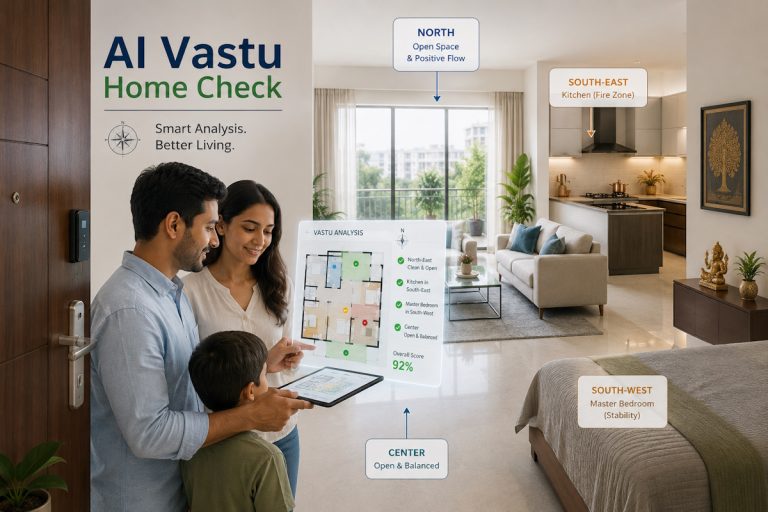
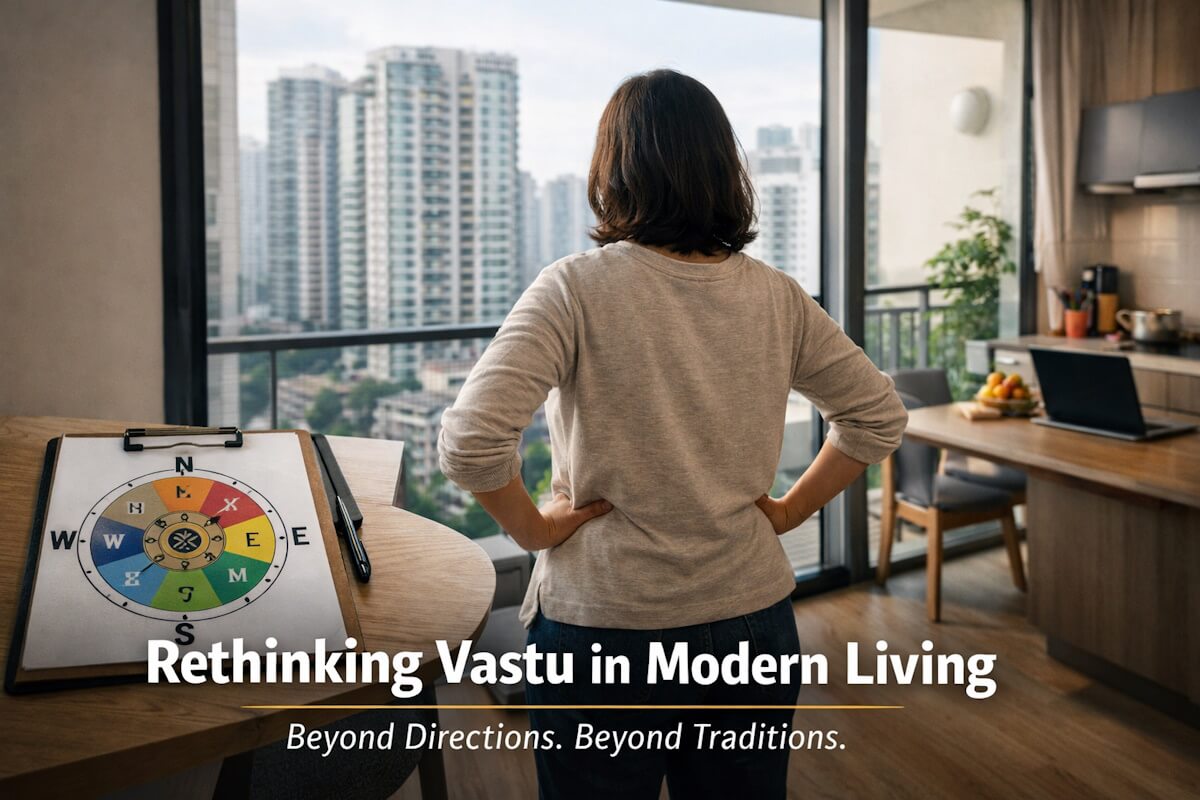
If you grew up hearing about Vastu, you probably heard the same advice again and again. Kitchen in the southeast. Master bedroom in the southwest. Pooja room in the northeast. Keep the toilet away from the northeast. Sounds simple, right?
That logic came from a time when homes were simple. Single-floor houses. Clear plots. Roads on one side. Sunlight from predictable angles. Life was slower and buildings followed the land, not the other way around.
Now look at your home.
It might be a high-rise apartment on the 18th floor. Or a compact villa squeezed between two other buildings. Or a resale flat where walls can’t be shifted. Maybe your main door opens into a passage shared with three neighbors. Maybe your balcony faces another tower five feet away.
This is where traditional 8-direction Vastu starts falling short.
Not because Vastu is wrong. But because the way it’s applied hasn’t kept up with how people actually live today.
Let’s break this down in a practical way, without hype or fear tactics.
The 8-Direction Model Was Built for a Different World
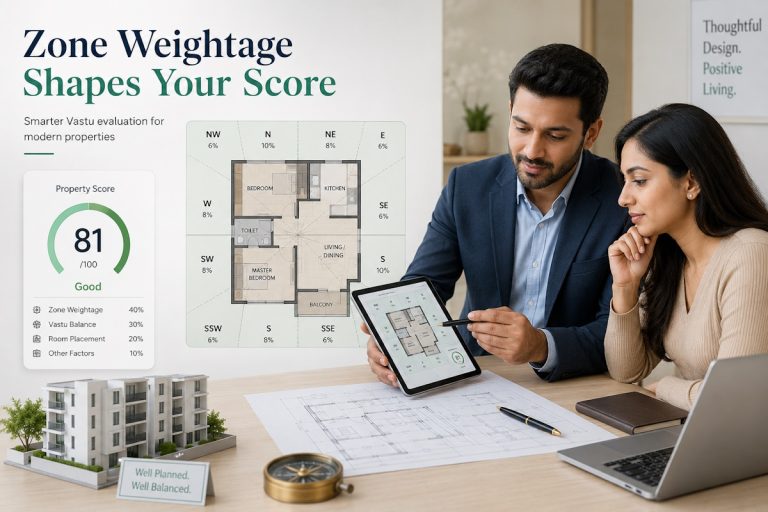
The classic 8-direction system works on a clean division of space. North, south, east, west, plus the four corners.
This model assumes a few things.
One, the plot is open on at least one side.
Two, the house is built from scratch.
Three, the owner controls every wall, door, and room placement.
Four, external surroundings are stable and predictable.
Most modern homes break all four assumptions.
Apartments don’t sit directly on land in the same way independent houses do. They stack vertically. The ground energy, slope, soil type, and water flow that older Vastu relied on barely reaches upper floors.
Even villas today are part of gated layouts with identical designs. You can’t rotate the kitchen because the builder already decided that for 200 homes at once.
So when someone tells you “your kitchen is wrong because it’s in the north,” ask yourself a simple question.
Could this home realistically be built any other way?
In many cases, the answer is no.
Direction Alone Ignores How Energy Actually Moves Indoors
Traditional Vastu treats energy as static. A room sits in a direction, so the effect is fixed.
Modern homes don’t behave like that.
Air moves through corridors. Light bounces off glass towers. Sound travels through shared walls. Elevators, generators, parking levels, and service shafts all affect how a space feels.
Think about your own home.
Does the northeast corner always feel calm just because it’s northeast? Or does it feel noisy because the elevator shaft runs behind it?
Does the southeast kitchen actually get heat from fire energy? Or does it stay dark because another building blocks sunlight all day?
Directional labels don’t account for these realities.
Energy follows movement, not just compass points. Entry paths, walking lines, airflow, light exposure, and usage patterns matter more than textbook direction placement.
If Vastu advice ignores how you actually use the space, it stops being helpful.
Modern Floor Plans Break Traditional Room Logic
Older Vastu texts assumed clear room purposes.
Kitchen was only for cooking.
Bedroom was only for sleeping.
Living room was for sitting and talking.
Now look at a modern apartment.
The kitchen might be open and connected to the living room. The dining table might double as a work desk. The guest bedroom might be your full-time office. Kids study, play, and sleep in the same room.
Traditional 8-direction rules struggle here because they assign one type of energy per room.
But when one room serves three functions, which rule applies?
If you work from your bedroom all day, does it behave like a bedroom or an office? If your kitchen island is where kids do homework, does fire energy still dominate?
Real life doesn’t fit clean boxes. Vastu needs to adapt to how spaces are used hour by hour, not just what the builder labeled them as.
Vertical Living Changes Everything
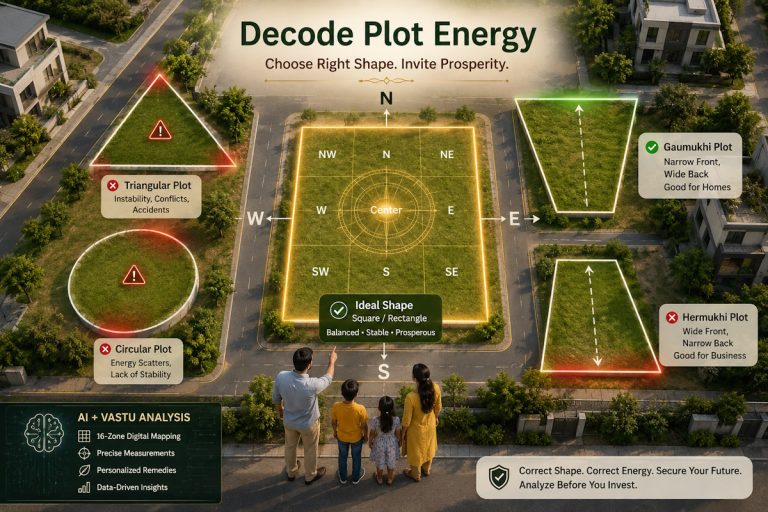
Traditional Vastu focuses heavily on the plot. Slope of land. Underground water. Open spaces around the house.
In a high-rise building, your home might be 150 feet above ground. Whatever water veins or soil conditions exist below are filtered through concrete, steel, parking levels, and other apartments.
This doesn’t mean upper-floor homes have no energy. They do. But the source and flow are different.
Vertical alignment matters more. What’s above you. What’s below you. What’s directly opposite your door. What kind of activity happens on other floors.
If there’s a gym above your bedroom, you’ll feel it. If there’s a garbage room below your living space, that has an effect too.
The 8-direction model rarely addresses vertical stacking in any practical way. Modern Vastu has to.
Fixed Rules Create Fear, Not Solutions
One of the biggest problems with rigid directional thinking is fear.
People hear statements like:
“This direction is always bad for toilets.”
“This kitchen placement will ruin finances.”
“This bedroom guarantees health problems.”
No context. No adjustment. No remedy beyond drastic changes.
For someone living in a rented flat or a resale apartment, this advice creates anxiety without offering realistic fixes.
Good Vastu should calm you, not stress you out.
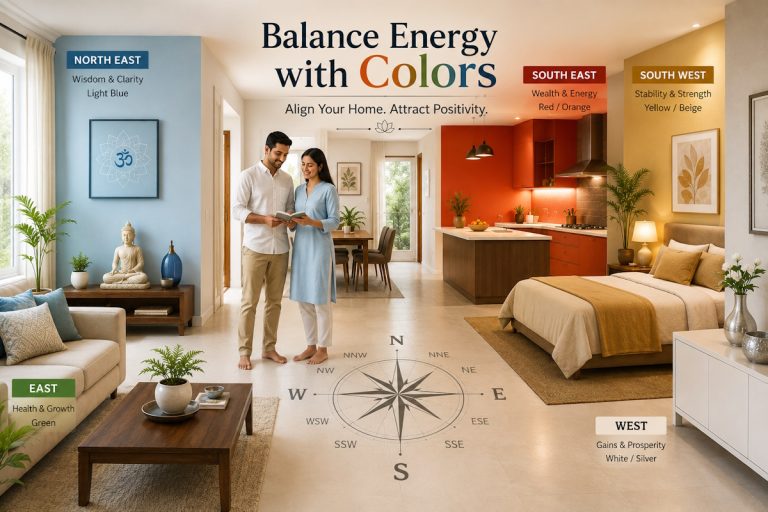
A modern approach looks at balance, usage, and correction. It asks what can be improved within existing limits. Furniture placement. Lighting changes. Door usage. Color balance. Activity timing.
Direction becomes one factor, not the final verdict.
External Environment Matters More Than Ever
Traditional Vastu looked at nearby temples, water bodies, and open land.
Today, your surroundings include flyovers, metro lines, parking ramps, mobile towers, generator rooms, and neighboring balconies that stare straight into your bedroom.
These external influences often overpower internal direction rules.
For example, a northeast balcony blocked by another tower won’t behave like a classic open northeast, no matter how accurate the compass reading is.
A main door facing a noisy service corridor feels very different from one opening into open space, even if both face the same direction.
Modern Vastu must account for what your home faces, not just where it sits on a compass.
The Compass Itself Isn’t Always Reliable Indoors
This part surprises many people.
Compass readings inside apartments are often distorted. Steel reinforcement, electrical wiring, appliances, and even nearby buildings can throw off readings.
So when someone walks into your living room, holds a phone compass, and declares your sofa is in the wrong direction, take it lightly.
Without understanding magnetic deviation and building interference, direction measurements can be misleading.
Basing major decisions only on these readings is risky.
A better approach combines directional awareness with physical observation. How does the space feel? Where does light enter? Where do people naturally gather? Where do you feel restless?
Your body often senses imbalance faster than a compass app.
Modern Homes Need Functional Vastu, Not Ritual Vastu
Traditional advice often focuses on symbolic fixes. Mirrors here. Pyramids there. Objects placed without understanding how the space works.
Functional Vastu looks at behavior.
Where do you sit most of the day?
Where do you sleep?
Where do arguments usually happen?
Which area feels neglected or cluttered?
These patterns tell you more than directional charts alone.
If your northeast corner is technically correct but piled with storage and unused items, it won’t deliver calm energy.
If your southwest bedroom feels stable because of good furniture placement and lighting, it might work fine even if it’s not textbook perfect.
Function beats symbolism in modern living.
One Rule Cannot Apply to Every City and Climate
Traditional Vastu evolved in specific climates.
Sun paths. Wind directions. Seasonal patterns.
Modern cities vary wildly. Coastal humidity. Dry heat. Cold winters. Pollution levels. Noise density.
A home in Phoenix behaves differently from one in Seattle. The same directional rule won’t suit both.
Even within the same city, a ground-floor villa and a 25th-floor apartment experience light, heat, and airflow differently.
Modern Vastu must adapt to local conditions, not repeat universal rules without adjustment.
Renovation Limits Are Real
Most homeowners today are not building from scratch.
They buy what’s available. They renovate within limits. Structural walls stay. Plumbing lines stay. Main doors stay.
Traditional 8-direction advice often assumes full freedom to redesign.
That gap creates frustration.
A modern approach works within constraints. It prioritizes what can realistically be changed and ignores what can’t.
This makes Vastu practical instead of idealistic.
Direction Still Matters, Just Not Alone
Here’s the part many people miss.
This is not about rejecting direction-based Vastu.
Direction still matters. It just isn’t the only thing that matters anymore.
Think of it like health advice. Diet matters. Sleep matters. Exercise matters. Stress matters. You wouldn’t fix everything by changing only one factor.
Vastu works the same way.
Direction is one layer. Usage is another. Surroundings add another. Light, airflow, noise, and behavior complete the picture.
When these layers work together, the home supports you. When they don’t, no amount of directional correction alone will help.
What You Should Do Instead
If you’re buying, renting, or renovating a modern home, shift your mindset.
Ask better questions.
Does the layout support daily routines?
Is there enough natural light where you spend time?
Does the entrance feel welcoming or rushed?
Are rest areas actually restful?
Does the home allow flexibility as life changes?
Use Vastu as a guide, not a rulebook carved in stone.
Adapt principles to your reality instead of forcing your reality to fit outdated diagrams.
That’s how Vastu stays relevant.
And that’s how your home starts working for you, not against you.
If you’re living in a modern home, you already know one thing. Life isn’t perfect on paper. Your living space shouldn’t be judged that way either.
Look at how it supports you today. That’s where real Vastu begins.