If you have ever stood inside a home and felt something was off without knowing why, this topic is for you. 16 Zone Vastu Analysis is not mystical talk or blind belief. It is a practical way of reading how different parts of a property behave and how those parts affect daily life. Money flow, sleep quality, stress levels, career movement, family harmony. All of it connects back to zones.
This guide is written for regular people. Homeowners. Buyers. Realtors. Architects. Investors. If you live in an apartment, plan villas, or deal with commercial spaces, this will make sense to you.
Let us keep it grounded and usable.
Understanding Vastu Beyond Myths
Most beginners think Vastu is just about facing directions. North good. South bad. That is outdated thinking.
Traditional Vastu Shastra talks about energy flow based on directions, elements, and human activity. Over time, this got simplified into shortcuts. The problem is shortcuts fail in modern layouts.
High-rise apartments, irregular plots, corner flats, duplex homes. None of these fit old square-house logic.
That is where 16 Zone Vastu Analysis steps in.
It breaks the entire space into 16 clear zones instead of 8 vague ones. This extra precision helps you identify exact problem points instead of guessing.
Why 16 Zones Instead of 8
The basic Vastu compass uses 8 directions. North, South, East, West, and the four corners.
Real life is not that clean.
When you stand inside a room, energy does not move in straight lines. It spreads diagonally. It overlaps. It reacts to walls, doors, toilets, and heavy furniture.
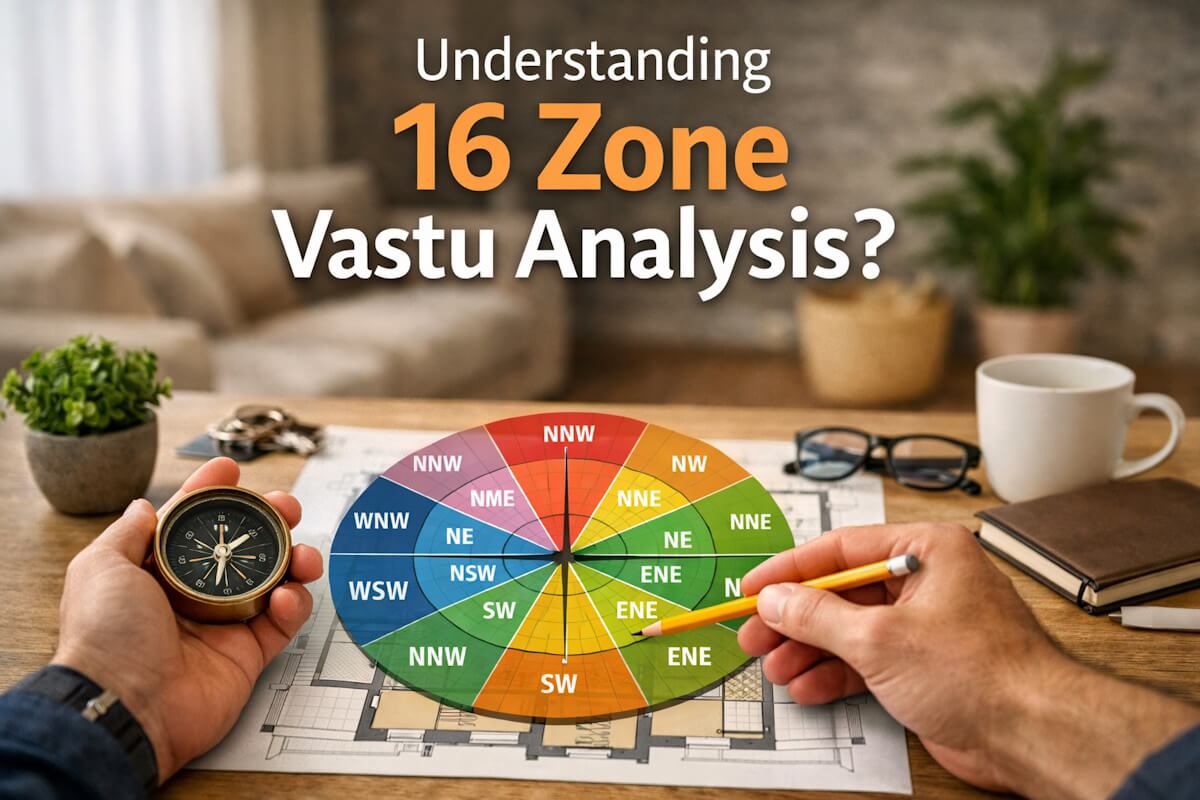
The 16-zone method splits each main direction into two sub-directions.
North becomes N and NNE
East becomes E and ENE
South becomes S and SSW
West becomes W and WNW
You now have 16 precise energy pockets.
This detail is what makes analysis accurate instead of generic.
The Core Idea Behind 16 Zone Vastu Analysis
Every zone controls a specific part of life. When that zone is used correctly, things feel smoother. When misused, problems show up in predictable ways.
This is not instant magic. It is pattern recognition.
For example, if a person keeps struggling with savings, and the North zone is blocked or heavy, the connection is not random. North governs cash flow and opportunities.
Once you see enough homes, patterns become obvious.
That is why professionals rely on zone-based reading instead of surface rules.
How the 16 Zones Are Identified in a Property
You start with the center of the home. Not the entrance. Not the master bedroom. The exact center.
From there, you overlay a compass grid aligned to true north. Not magnetic north from random apps.
Once aligned, the space naturally divides into 16 equal slices.
Each slice becomes a zone.
Important detail here. Zones do not change based on rooms. A kitchen can fall into two zones. A toilet can disturb three zones at once. That is where most people get confused.
Zones matter more than room names.
Brief Breakdown of All 16 Zones
Let us walk through them in a practical way. No theory overload.
North Zone (N)
Money movement. Income sources. Financial clarity.
Blocked North often links to delayed payments or unstable earnings.
North-Northeast (NNE)
Clarity of thought. Decision making. Guidance.
This zone affects confusion, overthinking, and dependency on others.
Northeast (NE)
Mental peace. Growth. Learning. Spiritual balance.
Disturbance here shows up as anxiety, lack of focus, or restlessness.
East-Northeast (ENE)
Social image. Confidence. Recognition.
If ENE is weak, people feel ignored or undervalued at work.
East (E)
Health and vitality.
Poor use of East often shows as low energy or recurring minor health issues.
East-Southeast (ESE)
Communication and creativity.
This zone impacts how well ideas convert into action.
Southeast (SE)
Fire element. Expenses. Passion. Aggression.
Misuse of SE leads to impulsive spending or frequent arguments.
South-Southeast (SSE)
Emotional stability.
Imbalance here creates mood swings or emotional drain.
South (S)
Strength and stability.
South supports responsibility and long-term grounding.
South-Southwest (SSW)
Control and authority.
Weak SSW brings instability in leadership roles or family control issues.
Southwest (SW)
Relationships. Stability. Assets.
This is the most sensitive zone. Errors here hit hard and fast.
West-Southwest (WSW)
Gains from effort.
Problems here show delayed rewards despite hard work.
West (W)
Profits. Results. Productivity.
A cluttered West limits output and recognition.
West-Northwest (WNW)
Networking and movement.
This zone impacts travel, connections, and support systems.
Northwest (NW)
Change and adaptability.
NW imbalance causes instability or excessive movement.
North-Northwest (NNW)
Opportunities and support.
This zone affects help from others and external backing.
How 16 Zone Vastu Applies to Apartments
Most people think Vastu fails in apartments. That is incorrect.
Apartments work well with zone-based analysis because structure is fixed. You work with what exists.
You do not move walls. You adjust usage.
If the toilet falls in a weak zone, you reduce damage with weight balance, color control, and activity shift.
If the kitchen lands partly in SE and partly in SSE, you adjust stove and storage placement.
Zone understanding gives flexibility without reconstruction.
Common Mistakes Beginners Make
One big mistake is obsessing over entrances.
Entrance matters. Zones matter more.
Another mistake is treating remedies as decoration. Copper items, pyramids, crystals. None of these work if the zone usage stays wrong.
Third mistake is copying advice from random videos without measuring zones properly.
Vastu is location-specific. Blind fixes cause confusion.
Using 16 Zone Vastu for Buying Property
If you are buying a home, zone analysis saves years of regret.
Instead of asking vague questions like “Is this flat Vastu compliant?”, you check three things.
Is the Northeast clean and open
Is the Southwest heavy and stable
Is the North usable and unobstructed
If these three zones work, most issues are manageable.
This applies to resale flats, builder floors, and villas.
Application in Commercial Spaces
Shops, offices, and showrooms behave differently from homes.
In offices, North and West zones control revenue and output.
In retail, East and North zones affect footfall and visibility.
In factories, Southeast and Southwest zones impact machinery and management.
Zone analysis adapts based on purpose. Same grid. Different interpretation.
Remedies Through Usage, Not Objects
The strongest corrections come from changing how a zone is used.
Sleeping in a weak zone worsens problems. Storage in a weak zone stabilizes it.
Heavy cupboards can protect unstable zones. Active spaces can activate dead zones.
Objects help only after usage is corrected.
This is why professional advice feels simple yet effective.
Can You Do 16 Zone Vastu Analysis Yourself?
Yes, to a basic level.
You need a reliable compass, accurate floor plan, and patience.
What you should avoid is jumping to conclusions. One zone issue does not explain everything.
Life patterns repeat. When multiple issues align with specific zones, that is when conclusions hold weight.
Why This Method Feels More Accurate
People trust 16 Zone Vastu because it explains reality.
When career stress matches East imbalance. When savings trouble matches North blockage. When relationship strain matches Southwest disturbance.
It stops feeling abstract.
It starts feeling logical.
Final Thoughts for Beginners
16 Zone Vastu Analysis is not about fear or superstition. It is about awareness.
Your home already influences you. Ignoring it does not stop that influence.
Understanding zones gives you control without extreme changes.
If you live somewhere, work somewhere, or invest in property, learning this framework gives clarity you can use for life.
Take your time. Observe patterns. Start with small corrections.
Your space listens more than you think.