The Significance of Lo Shu Grid Directions in Modern Living
The ancient wisdom of spatial energy provides a framework for understanding how our environment influences our daily lives. At the heart of this system lies the Lo Shu Grid, a 3×3 magic square that has served as the foundation for directional analysis for thousands of years. When we examine lo shu grid directions, we are not just looking at points on a compass, but rather a sophisticated map of how elemental energies interact within a physical structure. For the modern homeowner or business owner, understanding this grid is the first step toward creating a space that supports health, wealth, and emotional stability.
Navigating the complexities of property selection or renovation requires more than just an aesthetic eye. It demands a logical assessment of how energy flows through various sectors of a building. By mastering the lo shu grid directions, individuals can transition from feeling overwhelmed by their surroundings to making empowered decisions about their environment. Whether you are dealing with a cramped city apartment or a sprawling suburban villa, the principles of the feng shui directions lo shu square offer a timeless blueprint for alignment and balance. To begin your journey toward a balanced home, you can Find Your Direction through professional insights.
The Mathematical Logic of the Lo Shu Square
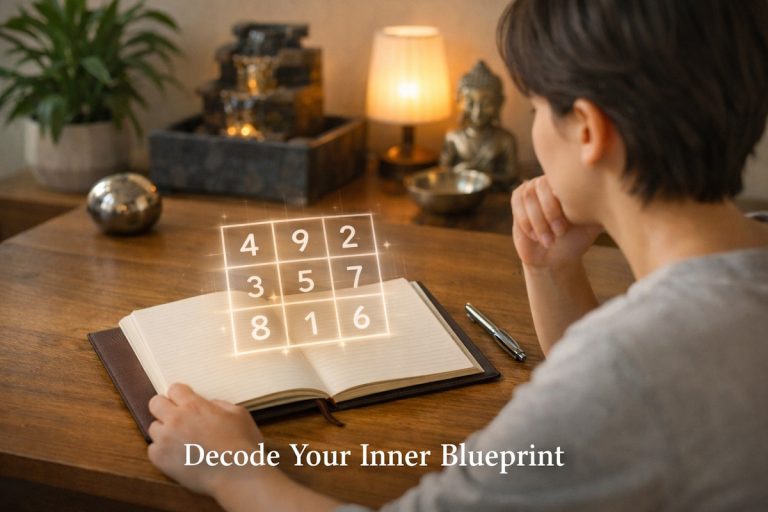
The Lo Shu Grid is often referred to as a magic square because every row, column, and diagonal adds up to the number fifteen. This mathematical symmetry is not merely a coincidence, it represents the concept of universal balance. In the context of lo shu grid directions, each number from one to nine is assigned to a specific compass point, creating a predictable and repeatable system for energy analysis. This logical structure allows experts to identify exactly where energy might be stagnant or overactive in a property layout.
The Historical Context of the Grid
Legend suggests that the markings of the grid were first discovered on the shell of a tortoise emerging from the Lo River. This discovery provided a way to categorize the natural world into nine distinct sectors. Each sector corresponds to a life aspiration, such as career, family, or wealth. When we use the lo shu grid compass directions, we are essentially overlaying this ancient map onto our modern floor plans to see which areas of our lives are being supported by our physical space.
The Concept of the 3×3 Matrix
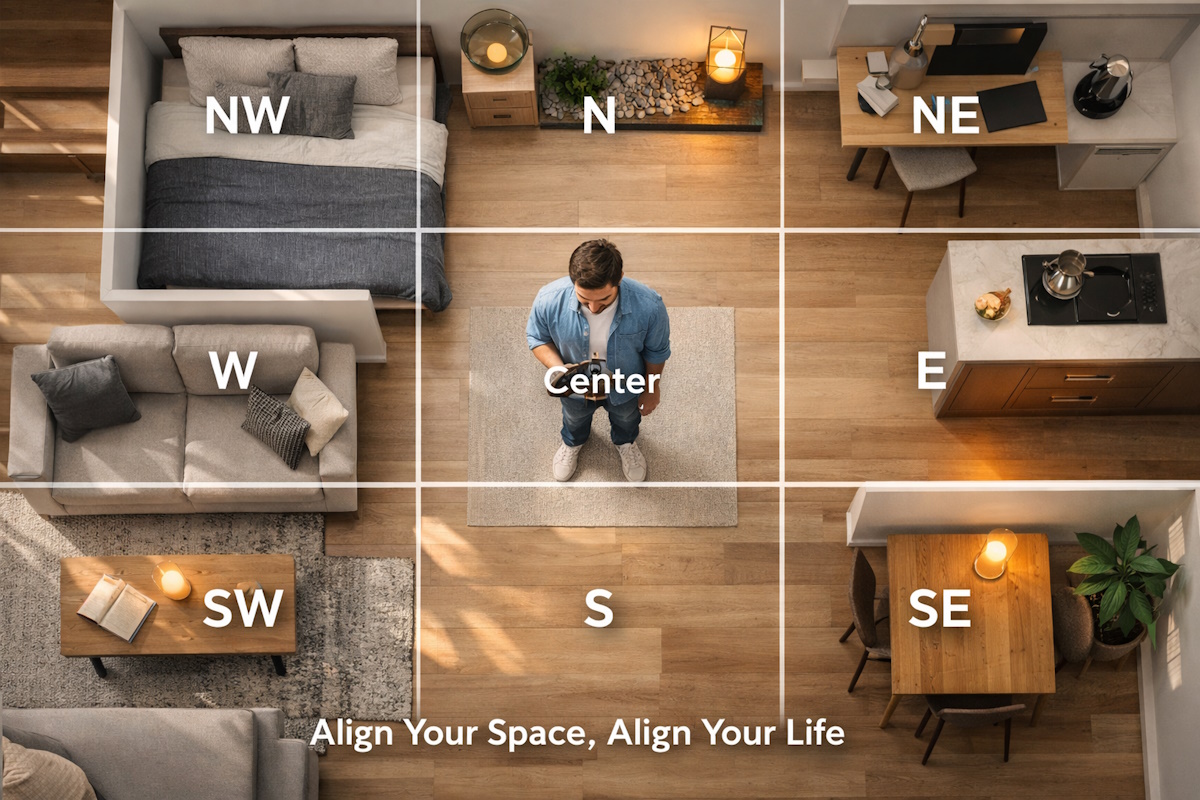
The matrix serves as a diagnostic tool. By dividing a home or office into nine equal squares, we can see how the architecture interacts with the natural flow of energy. If a specific direction is missing due to an L-shaped building or an extension, it indicates a potential deficiency in that area of the occupant’s life. This technical approach removes the guesswork from spatial planning and provides a clear path for correction.
Mapping the Lo Shu Grid Compass Directions
Understanding the feng shui directional energy map requires a clear knowledge of which direction corresponds to which number and element. The grid is traditionally oriented with South at the top, though modern practitioners often adapt this for ease of use with standard magnetic compasses. Each of the eight cardinal and intercardinal directions, plus the center, carries a unique vibrational frequency that affects the occupants of a building in different ways.
The Primary Cardinal Points
The North, South, East, and West form the pillars of the grid. North is associated with the number one and the element of water, representing career and life path. South is associated with the number nine and the element of fire, representing fame and reputation. East, linked to the number three and wood, governs family and health, while West, linked to the number seven and metal, influences creativity and children. Balancing these lo shu grid directions ensures that the basic foundations of life remain stable.
The Intercardinal Sectors and Life Transitions
The corners of the grid, Northeast, Southeast, Southwest, and Northwest, manage the transitions and nuances of human experience. The Southeast is the sector of wealth and abundance, while the Southwest focuses on love and relationships. The Northeast is the zone of knowledge and self-cultivation, and the Northwest governs helpful people and travel. When any of these sectors are cluttered or blocked, it can lead to specific challenges, such as financial stagnation or strained partnerships. To understand how these zones interact in your home, you can Find Your Direction with an expert assessment.
Deep Dive into Lo Shu Grid North South Meaning
The relationship between the North and South is perhaps the most critical axis in the grid. The lo shu grid north south meaning centers on the balance between our internal drive and our external recognition. North (Water) is the deep, quiet energy of our inner purpose, while South (Fire) is the bright, visible energy of how the world perceives us. If the North of a house is compromised by a heavy wall or a lack of openings, the occupants may feel stuck in their careers or lack a sense of direction.
Balancing Fire and Water Elements
In a healthy home, the fire of the South and the water of the North should coexist without extinguishing each other. This is achieved through proper placement of rooms and colors. For instance, a bathroom in the South sector can “dampen” the fire of reputation, leading to social misunderstandings or a lack of recognition at work. Conversely, a kitchen in the North might create “boiling” energy that leads to restlessness and career volatility. Analyzing the lo shu grid directions helps in identifying these elemental conflicts.
The Vertical Axis of Growth
The North-South axis also represents the flow of time and legacy. The North is often seen as the beginning or the source, while the South is the culmination or the peak. When we align our living spaces with the feng shui directional energy map, we ensure that the energy of our intentions can flow smoothly toward their ultimate manifestation. This vertical alignment is essential for long-term success and personal fulfillment. For a thorough check of these critical axes, you may Get an AI-Based Vastu Analysis for instant clarity.
The Role of the Center or Tai Chi
The center of the Lo Shu Grid, represented by the number five and the earth element, is the heart of the home. It is the point of neutrality and health that connects all other lo shu grid directions. In modern architecture, the center is often neglected or occupied by heavy furniture, which can disrupt the overall harmony of the property. Keeping the center open and clear allows energy to circulate freely to all other sectors.
Practical Application of the Feng Shui Directional Energy Map
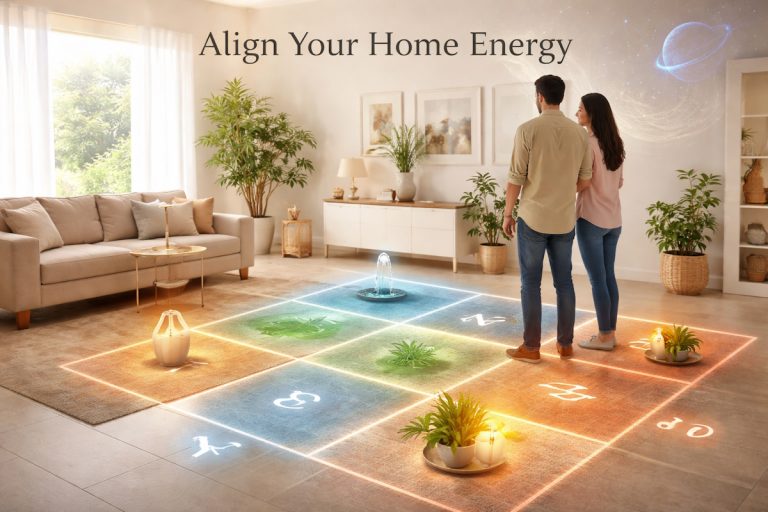
Applying the lo shu grid directions to your property is a systematic process. It begins with an accurate compass reading from the center of the building. Once the directions are established, the grid can be scaled and overlaid on the floor plan. This reveals which rooms fall into which sectors and highlights any areas where the grid might be incomplete. Using the lo shu grid compass directions accurately is the difference between a superficial change and a deep energy correction.
Identifying and Remedying Missing Corners
One of the most common issues in modern apartments is the presence of missing corners. An L-shaped or U-shaped floor plan means that one or more sectors of the feng shui directions lo shu square are physically absent from the structure. This “missing” energy can manifest as a lack of opportunities in the corresponding area of life. Professional consultants use mirrors, lights, or specific elemental placements to energetically “complete” the grid, ensuring that the occupants do not suffer from these architectural gaps. To see if your home has missing sectors, you can Find Your Direction and seek a professional review.
Optimizing Room Functions Based on Direction
Each room in a house has a natural affinity for a specific direction. For example, a home office is best suited for the North or Southeast sectors to enhance career growth and wealth. A bedroom in the Southwest supports stable relationships, while the East is ideal for a dining room or living area where family members gather. When we ignore the lo shu grid directions and place rooms haphazardly, we often find ourselves fighting against the natural flow of the environment, leading to unnecessary stress and fatigue.
Evaluating Your Property for Long-Term Well-Being
The ultimate goal of studying lo shu grid directions is to create a sanctuary that fosters well-being. A property that is aligned with the feng shui directional energy map acts as a battery, recharging the occupants and providing them with the vitality needed to face external challenges. This is not about superstition, but about recognizing that humans are sensitive to the magnetic and elemental qualities of the spaces they inhabit. By choosing or correcting a home based on these principles, you are making a proactive investment in your future.
When evaluating a new property, look beyond the surface level of paint and fixtures. Consider how the lo shu grid north south meaning impacts the flow of light and air. Think about how the placement of the entrance relative to the grid sectors dictates the quality of energy entering the home. These subtle factors often have a much greater impact on long-term happiness than the cosmetic features of a house. For those looking to make a confident decision, you can Find Your Direction by accessing specialized spatial reports.
For more complex challenges, such as commercial spaces or multi-story buildings, the 16-zone analysis or advanced grid techniques may be required. However, the lo shu grid directions remain the foundational starting point for any serious inquiry into spatial energy. If you are ready to take the next step in optimizing your environment, you can Check Your Property’s Vastu Compliance with a professional consultant.
FAQs
1. How do I determine the center of my home to apply the grid?
To find the center, use a scaled floor plan of your property. For rectangular or square homes, the center is where the two diagonals intersect. For irregular shapes, you may need a professional to calculate the geometric center or “brahmasthan” to ensure the lo shu grid directions are mapped accurately from the true source point.
2. Can I use the Lo Shu Grid if my apartment is not a perfect square?
Yes, but it requires careful mapping. In non-square apartments, some sectors of the feng shui directions lo shu square may be compressed, extended, or missing. Remedies such as placing specific elements or using reflective surfaces can help balance the energy flow even in irregularly shaped spaces.
3. What is the most important direction in the Lo Shu Grid?
While all directions are important, the North-South axis and the Center are often prioritized. The lo shu grid north south meaning relates to your core purpose and reputation, while the center sustains the health of all occupants. If these areas are balanced, the rest of the grid is much easier to manage.
4. Do the Lo Shu directions change every year?
The basic lo shu grid directions of a building remain constant based on its orientation. However, in advanced Feng Shui, “flying stars” or annual energies shift through these sectors every year. For most homeowners, focusing on the permanent directional energy map of the structure is the most effective way to ensure long-term stability.
5. How can I fix a missing wealth corner in the Southeast?
If the Southeast sector is missing from your floor plan, you can introduce wood elements, plants, or the color green in the area closest to where that corner should be. Additionally, using a mirror on the wall that blocks the Southeast can symbolically “expand” the space to include the missing sector of the lo shu grid directions.