People come to Vastu when something feels off. The house looks fine on paper, yet sleep is disturbed. Money comes and goes. Relationships feel strained for no clear reason. At that point, you want answers that actually work in real homes, not theory that sounds good in a book.
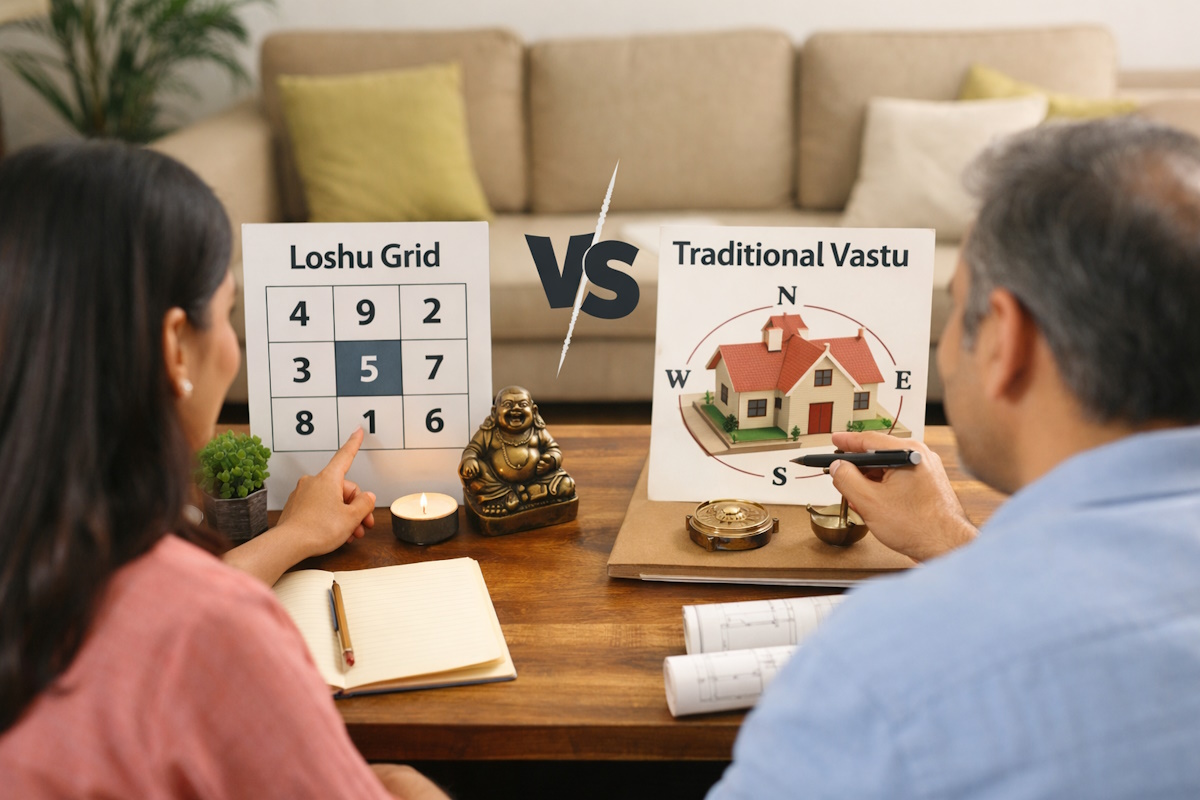
Two systems often come up in these discussions. The Loshu Grid and Traditional Vastu. Both claim to diagnose problems and offer corrections. Both have loyal followers. And both are often misunderstood.
If you are a homeowner, buyer, realtor, architect, or investor, the real question is simple. Which one gives more accurate results in practical, modern spaces?
Let’s break this down without fluff, mysticism, or textbook talk.
What Traditional Vastu Is Really About
Traditional Vastu is rooted in land orientation, directions, and elemental balance. It looks at how a structure sits on the plot, how rooms interact with directions, and how daily human activity flows through the space.
This system works from the outside in.
The main focus areas include:
- Plot shape and slope
- Road positioning
- Main entrance direction
- Kitchen, bedroom, and toilet placement
- Staircase location
- Open spaces and heavy zones
Traditional Vastu assumes the building has control over orientation. This makes it highly effective for independent houses, villas, farmhouses, and low-rise buildings.
When done correctly, it creates long-term stability. You often see gradual improvement rather than instant change. Families feel settled. Health stabilizes. Finances stop swinging wildly.
But there’s a catch.
Where Traditional Vastu Starts Struggling
Modern living has changed the game.
Apartments come pre-built. High-rise buildings lock you into fixed layouts. Entrances cannot be shifted. Kitchens sit where plumbing allows. Toilets end up in awkward corners.
Traditional Vastu becomes restrictive here. Many guidelines simply cannot be applied without structural demolition. That is not realistic for most people.
You may hear advice like:
- “This flat is not suitable”
- “Sell the property”
- “Major reconstruction needed”
For buyers or investors, that’s not helpful. For someone already living there, it creates stress instead of solutions.
This is where the Loshu Grid enters the conversation.
Understanding the Loshu Grid Without the Mystique
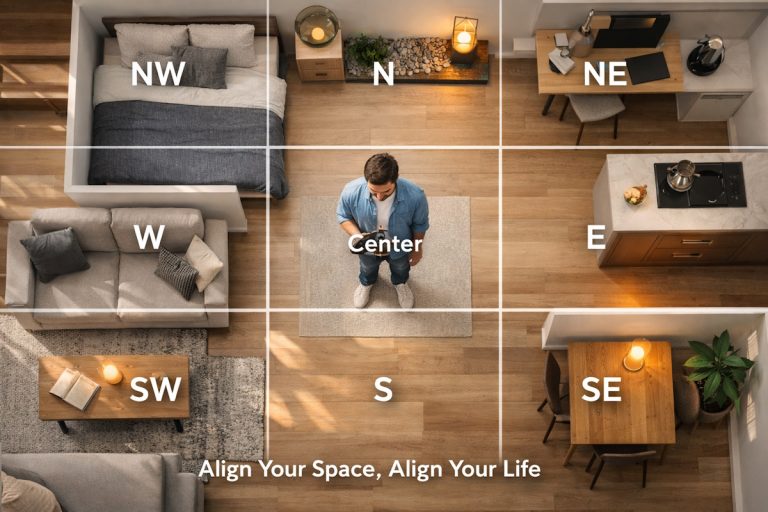
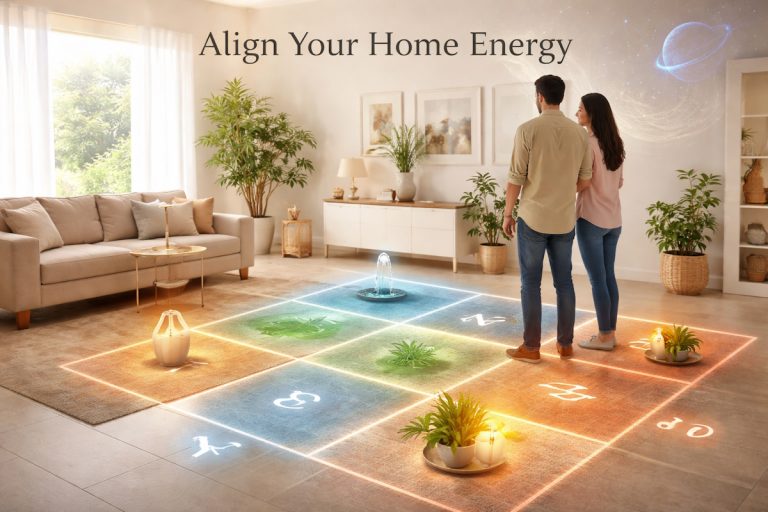
The Loshu Grid is a numerical energy map based on a 3×3 grid. Each square represents a specific life area tied to a number and direction.
Unlike Traditional Vastu, the Loshu Grid works from the inside out.
It focuses on:
- Energy distribution within the built space
- Missing or overloaded zones
- Behavioral and life patterns reflected in the layout
- Micro-level imbalances rather than structural perfection
The grid is overlaid on the floor plan, regardless of shape or orientation. That alone makes it appealing for apartments and commercial spaces.
You are not judging whether the building is perfect. You are reading how it affects the people inside.
Why People See Faster Results with Loshu Grid
One reason people gravitate toward the Loshu Grid is response time. Changes often feel noticeable within weeks.
That’s because corrections target lived experience:
- Sleep patterns
- Work focus
- Cash flow blocks
- Emotional friction
- Decision fatigue
The grid highlights zones that are overstimulated or completely ignored. Simple actions like rearranging furniture, activating unused areas, or calming overactive zones can shift daily rhythm.
No demolition. No fear-based advice.
For working professionals or families in apartments, this feels practical.
Accuracy Depends on the Question You Are Asking
This is where most comparisons go wrong.
Traditional Vastu and Loshu Grid are not trying to answer the same question.
Traditional Vastu asks:
“Is this structure aligned with natural directional forces?”
Loshu Grid asks:
“How is this space affecting the people living or working here right now?”
If you are buying land or designing a home from scratch, Traditional Vastu has stronger predictive power. It guides long-term foundation decisions that shape decades of use.
If you are already living in a space and facing specific issues, the Loshu Grid often gives clearer, faster insights.
Accuracy is not absolute. It is contextual.
Real-Life Apartment Scenarios
Let’s talk real apartments, not ideal floor plans.
A common situation:
- North-facing flat
- Kitchen in the southeast as per rules
- Master bedroom in the southwest
- Still, the resident struggles with anxiety and unstable income
Traditional Vastu says everything is fine.
Loshu Grid may show an overloaded center zone or a missing energy in the career area. Maybe heavy storage sits where openness is needed. Maybe constant noise occupies a zone linked to mental rest.
Once that is addressed, things shift.
This does not mean Traditional Vastu failed. It means it was not designed to read micro-level behavioral patterns.
Commercial Spaces and Offices
For offices, clinics, and retail spaces, Loshu Grid often proves more accurate.
Why?
Because businesses deal with people flow, decision-making, sales energy, and team dynamics. These change rapidly. Traditional Vastu principles for offices exist, yet they assume static roles.
Loshu Grid reads:
- Where money leaks happen
- Why staff turnover is high
- Why sales stagnate despite good location
- Why leadership feels stuck
Small layout tweaks bring noticeable impact. Investors appreciate this because downtime costs money.
The Risk of Using Loshu Grid Alone
Now for the honest part.
Loshu Grid is powerful, but it has limits.
It does not evaluate land energy. It does not account for plot slope, road pressure, or external directional forces. If the base structure is severely flawed, grid corrections act like band-aids.
You may feel temporary relief, yet deeper issues resurface.
This happens often when people ignore entrance direction completely or buy irregular plots assuming grid remedies will fix everything.
They won’t.
When Traditional Vastu Still Wins
There are cases where Traditional Vastu gives more accurate results hands down.
Examples include:
- Selecting a plot for long-term residence
- Designing a villa or bungalow
- Temple construction
- Large industrial facilities
- Multi-generational family homes
These spaces interact heavily with earth energy and directionality. Loshu Grid alone cannot replace that depth.
Ignoring Traditional Vastu here often leads to chronic issues that no amount of interior tweaking resolves.
Combining Both Systems the Right Way
The strongest results come when both systems are used together, not mixed blindly.
Think of Traditional Vastu as the skeleton. Loshu Grid is the nervous system.
One sets structure. The other reads response.
For architects, this means:
- Plan orientation and zoning through Traditional Vastu
- Fine-tune internal energy through Loshu Grid
For homeowners:
- Accept what cannot be changed structurally
- Use Loshu Grid to work with what exists
For buyers:
- Screen major deal-breakers using Traditional Vastu
- Assess livability using Loshu Grid overlay
This layered approach respects reality.
Why Conflicting Advice Confuses People
Many people feel lost because practitioners treat these systems as rivals. They give absolute statements.
“You must follow only this.”
“That system is wrong.”
“This one is more powerful.”
That mindset hurts the client.
Each system was developed for different needs and eras. Modern housing demands flexibility without abandoning core principles.
When someone forces Traditional Vastu rules onto a studio apartment, frustration follows. When someone ignores directional flaws entirely and relies only on grid fixes, disappointment follows later.
Balanced application avoids both traps.
Accuracy Is Also About the Practitioner
No system works without skilled interpretation.
A rigid Traditional Vastu consultant may declare a home doomed without exploring workable options. A careless Loshu Grid reader may oversimplify complex issues into color changes and symbols.
Accuracy improves when the practitioner understands human behavior, modern construction, and lifestyle patterns.
Ask yourself when choosing guidance:
- Does this advice feel practical?
- Does it respect your constraints?
- Does it explain cause and effect clearly?
If not, the system is not the problem.
So Which One Should You Trust?
If you want a single-line answer, here it is.
Traditional Vastu gives more accurate results for foundational planning and land-based decisions.
Loshu Grid gives more accurate results for lived experience, apartments, and quick course correction.
Neither replaces the other.
If you are already in a space and need relief, start with the Loshu Grid. If you are building or buying with long-term goals, start with Traditional Vastu.
And if you want the best outcome, use both with clarity, not dogma.
Final Thought for Homeowners and Buyers
Your home should support your life, not dominate it.
Vastu is meant to guide decisions, not create fear or regret. When applied with logic and real-world understanding, both the Loshu Grid and Traditional Vastu can serve you well.
The key is asking the right question before choosing the tool.
And that choice alone changes everything.