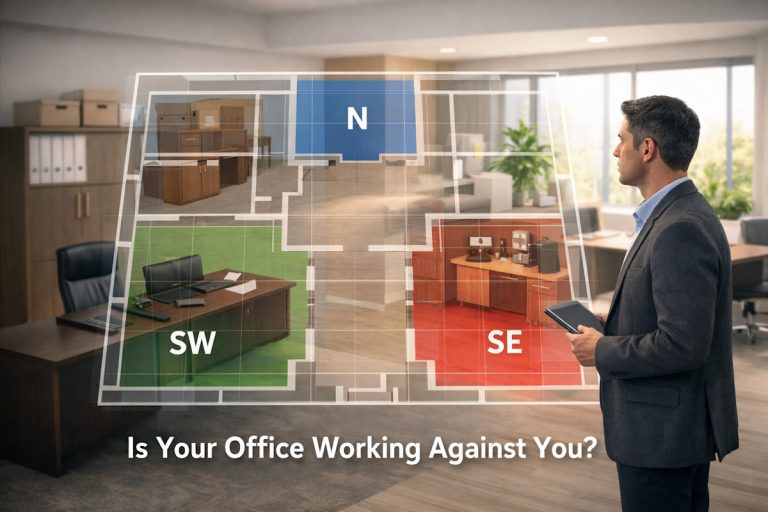

Most people check Vastu in a very surface-level way.
They ask questions like – Is the entrance in the right direction? Is the kitchen in the southeast? Is the bedroom in the southwest?
These checks are useful. But many homes still experience strange issues even after following these common Vastu rules.
Money gets stuck. Family members feel restless. Health problems keep repeating. Business opportunities slow down. Relationships become tense for no clear reason.
And the layout of the house looks perfectly fine.
This is where the Lo Shu Grid becomes extremely useful. It helps reveal hidden Vastu problems that normal directional checks cannot detect.
Many homeowners only discover these imbalances years after living in the property.
Let’s break this down in a practical way so you can actually understand what is happening inside your house.
What Is the Lo Shu Grid?
The Lo Shu Grid is a 3×3 numerical chart used in Vastu and numerology to study the energy pattern connected to a person.
Each number from 1 to 9 represents a specific life energy.
These numbers are derived from your date of birth.
The grid looks simple. Just nine boxes arranged in three rows and three columns. But each number has a meaning connected to personality, stability, growth, discipline, and decision-making.
Here is the basic structure:
4 9 2
3 5 7
8 1 6
Every number represents a certain type of energy. When a number repeats in your birth date, that energy becomes strong. When a number is missing, that energy is weak.
Now you might wonder – what does this have to do with your house?
A lot, actually.
Because your home’s Vastu directions interact with these personal energy numbers. When certain numbers are weak in your Lo Shu Grid, the corresponding Vastu directions in your home become extremely sensitive.
Small defects in those directions start creating bigger problems.
Why Some Homes Affect Certain People More
You may have seen this happen.
One family lives peacefully in a house for ten years.
Then a new owner moves in and suddenly faces financial loss, health issues, or constant tension.
Same property. Same layout. Totally different experience.
The Lo Shu Grid explains this.
Every person carries a personal energy pattern through their birth date. When that pattern interacts with the directional energies of a house, the result can either be supportive or stressful.
For example:
If someone has a weak number connected to financial stability, even a small Vastu imbalance in the north direction of the house can disturb money flow.
Another person with a strong number in the same area might not feel any impact.
So the house is not always the full problem.
Sometimes the interaction between the house and the person creates the issue.
The Meaning of Each Number in the Lo Shu Grid
Understanding the numbers makes it easier to connect them with Vastu directions.
Number 1 – Communication and Career Flow
Number 1 relates to water energy.
It influences communication, career growth, networking, and opportunities.
If this number is missing in your Lo Shu Grid, you may notice:
- Career delays
- Missed opportunities
- Trouble expressing ideas
- Networking struggles
Now look at the north direction of your house.
North represents career flow in Vastu.
If someone already has a weak number 1 and the north area of the house has problems like a toilet, clutter, heavy storage, or closed walls, career growth can slow down dramatically.
People feel stuck for years without understanding why.
Number 2 – Emotional Balance and Relationships
Number 2 represents emotional strength, patience, and connection with family.
People with weak number 2 often experience:
- Mood swings
- Relationship misunderstandings
- Emotional stress
This energy connects strongly with the southwest direction of a house.
Southwest represents stability and relationships.
If southwest has structural problems like:
- Cut corners
- Large windows
- Toilets
- Missing walls
Then people with weak number 2 in their Lo Shu Grid may face relationship instability or frequent disagreements at home.
Number 3 – Growth and Learning
Number 3 represents mental expansion, creativity, learning ability, and motivation.
Students and professionals benefit greatly when this energy is balanced.
This number relates strongly to the east direction of the house.
East governs new beginnings, learning, and growth.
If east is blocked by heavy walls, bathrooms, or large storage areas, people with weak number 3 may struggle with:
- Education delays
- Lack of focus
- Poor academic performance
Parents often blame the child or school.
The real issue sometimes sits quietly in the layout of the home.
Number 4 – Discipline and Planning
Number 4 connects to structure, order, discipline, and long-term planning.
People missing this number in their Lo Shu Grid may feel scattered.
They start projects but struggle to finish them.
Number 4 resonates with the southeast direction.
Southeast represents fire energy and financial movement.
If the southeast of your house has water elements like underground tanks, large bathrooms, or leakage problems, financial discipline becomes weak.
Money comes in but disappears quickly.
Savings remain low even with good income.
Number 5 – Core Stability
Number 5 sits at the center of the Lo Shu Grid.
It represents balance, decision-making, and internal stability.
When number 5 is weak or missing, people often feel confused about life direction.
The corresponding Vastu area is the center of the house, also called the Brahmasthan.
If the center area contains:
- heavy pillars
- staircases
- toilets
- storage rooms
then the entire house energy becomes unstable.
Residents may feel mentally unsettled without understanding why.
Number 6 – Responsibility and Authority
Number 6 is linked with leadership, responsibility, and authority.
People with strong number 6 often do well in management roles or business ownership.
This number connects with the northwest direction.
Northwest governs movement, support from others, and decision authority.
If northwest contains clutter, closed rooms, or improper usage, individuals lacking number 6 may struggle with:
- unstable job positions
- weak leadership presence
- unreliable partnerships
Business owners especially feel this imbalance.
Number 7 – Inner Strength and Spiritual Balance
Number 7 represents intuition, wisdom, and inner awareness.
When this energy is missing, people may feel disconnected or mentally exhausted.
Number 7 resonates with the west direction.
West controls emotional stability and long-term planning.
A damaged or cluttered west direction can cause people with weak number 7 to experience:
- constant overthinking
- stress
- sleep disturbances
The issue often feels psychological, but it is partially environmental.
Number 8 – Hard Work and Financial Strength
Number 8 is strongly connected with wealth accumulation and long-term success.
It relates closely to the south direction of a property.
If south has major defects such as:
- missing walls
- large openings
- underground water tanks
people missing number 8 in their grid often experience:
- unstable income
- hard work with little reward
- frequent financial pressure
The house amplifies the weakness already present in the personal grid.
Number 9 – Energy, Recognition, and Confidence
Number 9 carries powerful fire energy.
It supports ambition, public recognition, and courage.
This number resonates with the northeast direction, one of the most sensitive areas in Vastu.
If northeast contains heavy structures, toilets, or clutter, individuals lacking number 9 may face:
- lack of confidence
- blocked opportunities
- slow personal growth
Many people living in such houses feel they are capable but rarely receive recognition.
Why Normal Vastu Checks Miss These Problems
Most Vastu advice focuses only on directions and room placements.
Examples include:
- kitchen in southeast
- bedroom in southwest
- entrance in north or east
These guidelines are useful.
But they ignore personal energy patterns.
Two people living in identical apartments can experience completely different outcomes because their Lo Shu Grids are different.
One person may feel comfortable.
Another may feel constant pressure.
This difference becomes clearer when both the house layout and the Lo Shu Grid are analyzed together.
Signs Your House Might Have Hidden Vastu Problems
Some houses look perfectly fine but still create ongoing issues.
Watch for patterns like:
- finances improving briefly then dropping again
- repeated job instability
- family members arguing over small matters
- unexplained mental stress
- children losing focus in studies
- constant home repairs or leakage problems
If these patterns continue for years, the issue may not be visible in basic Vastu checks.
The Lo Shu Grid often exposes the weak points.
Simple Steps You Can Take
You don’t need to demolish walls or rebuild the house.
Most corrections are surprisingly simple once the weak directions are identified.
Start with these steps:
First, calculate your Lo Shu Grid using your date of birth.
Then observe your house layout carefully.
Pay attention to directions linked with missing numbers.
Ask yourself questions like:
Is the north direction blocked?
Is the northeast cluttered?
Is the southeast filled with water elements?
Is the center of the house crowded with heavy structures?
Small changes often make noticeable differences.
Sometimes moving storage, adjusting room usage, improving lighting, or removing clutter can shift the energy balance.
Why This Method Is Becoming Popular
Real estate buyers, homeowners, and architects are starting to pay attention to this approach.
It helps explain why some properties feel comfortable immediately while others create pressure even when they look beautiful.
The Lo Shu Grid adds a personal layer to Vastu analysis.
It connects your birth energy with the physical space you live in.
When both match well, the house supports your progress.
When they clash, problems quietly build over time.
Final Thought
Your house is not just walls and furniture.
It interacts with your personal energy every single day.
If you feel something in your home is constantly holding you back, it might not be obvious in the layout.
The Lo Shu Grid often reveals what normal Vastu checks miss.
Take a little time to understand it.
Look at your house again with this perspective.
You might notice patterns that suddenly make sense.
FAQs
1. What is the Lo Shu Grid in Vastu?
The Lo Shu Grid is a 3×3 number chart created from your date of birth. Each number represents a specific life energy such as career growth, relationships, finances, or mental stability. By studying the numbers present or missing in the grid, you can understand how your personal energy interacts with the directions of your house.
2. How does the Lo Shu Grid reveal hidden Vastu problems?
The grid shows which life energies are strong or weak for a person. Each number is connected to a direction in the house. If a number is missing and the related direction in your home has a Vastu imbalance, that area can start creating noticeable problems in areas like career, finances, or relationships.
3. Can two people experience different results in the same house?
Yes. Every person has a different Lo Shu Grid based on their birth date. When two people live in the same property, their personal energy patterns interact with the house differently. That is why one family may feel comfortable in a house while another experiences constant issues.
4. What are common signs that a house may have hidden Vastu issues?
Some common signs include repeated financial struggles, career delays, frequent family arguments, children losing focus in studies, or ongoing mental stress. If these patterns continue even when the house looks Vastu compliant, the Lo Shu Grid can help identify the underlying imbalance.
5. Do I need to make structural changes to fix these problems?
Not always. Many Vastu corrections involve adjusting room usage, clearing clutter, improving lighting, or balancing certain elements in specific directions. Once the weak directions connected to your Lo Shu Grid are identified, small practical changes can often improve the energy of the house.