
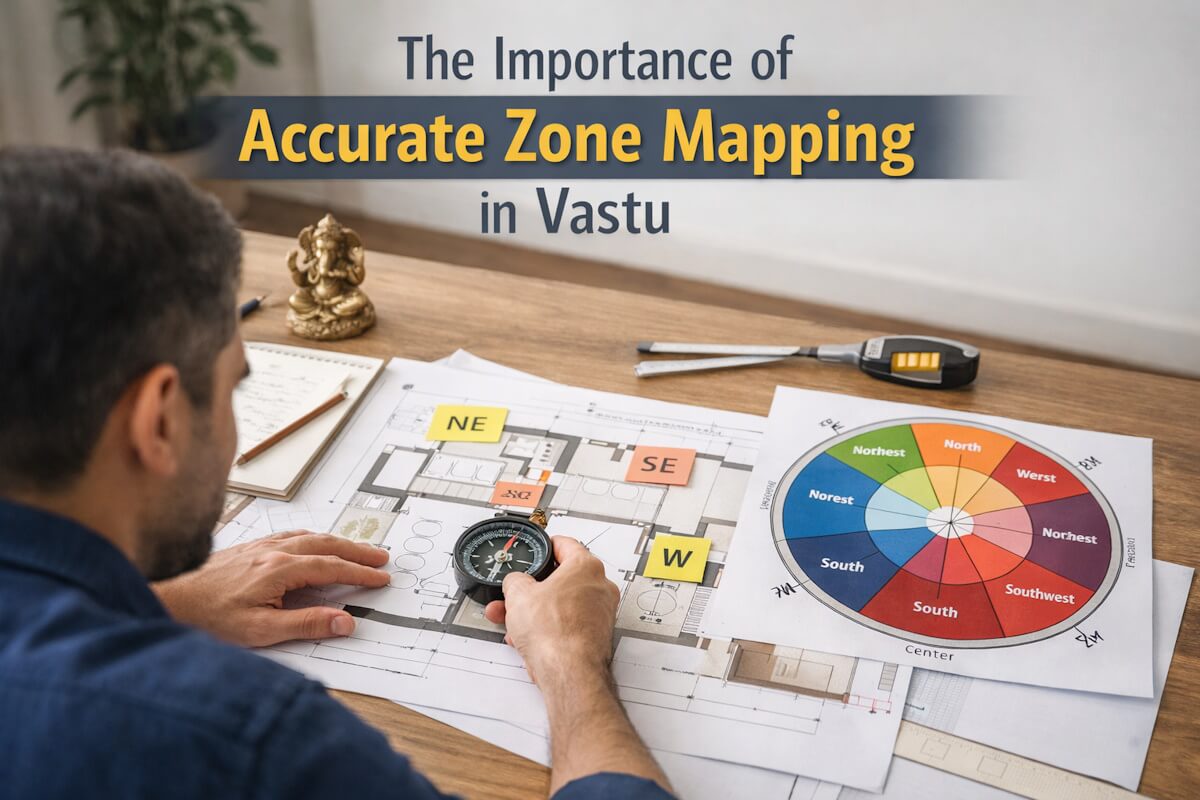
Accurate zone mapping is where real Vastu analysis begins. Not with mantras. Not with colors. Not with quick tips pulled from a chart. If the zones are mapped wrong, every suggestion after that is shaky. You might follow all the advice, spend money on changes, and still feel stuck. That usually traces back to one basic mistake – the zones were never identified correctly.
If you live in an apartment, work in a commercial space, or plan homes for clients, this part matters more than anything else. Zone mapping is the foundation. Miss it, and the whole structure feels off.
Let’s talk about why this step is non-negotiable and how it directly affects real-life outcomes.
What Zone Mapping Actually Means in Vastu
Zone mapping is the process of dividing a property into precise directional zones based on true orientation. These zones go beyond simple north, south, east, and west. Each direction carries a specific function, element, and behavioral influence.
This is not about standing in the living room and guessing where north feels like it might be. It involves identifying true north, aligning the layout accurately, and then overlaying the Vastu grid on the actual usable space.
In real homes, walls are rarely square. Balconies jut out. Bedrooms overlap directions. Staircases cut through zones. All of that has to be accounted for.
If someone labels a bedroom as southwest just because it sits at the back of the house, that’s not zone mapping. That’s assumption. And assumptions are where Vastu advice quietly breaks down.
Directional Errors Create Chain Reactions
One wrong zone affects many decisions at once. This is why accurate mapping is critical.
Say a kitchen is assumed to be in the southeast. All fire-related remedies and placements follow that assumption. But if the true mapping places it closer to the south-southeast or east-southeast, the energetic behavior changes. The advice given becomes mismatched.
This is how people end up saying Vastu didn’t work for them.
It’s not that the principles failed. The base data was wrong.
When zones are off, these issues show up fast:
• Remedies don’t bring relief
• Conflicting advice from different consultants
• Endless tweaks without results
• A feeling that the space never settles
People start blaming Vastu instead of questioning the map.
Apartments Are the Biggest Casualties of Poor Mapping
Apartments are tricky. Shared walls. Odd shapes. Missing corners. External walls that don’t match internal layouts.
Many residents assume Vastu doesn’t apply to apartments. That’s not true. What’s true is that apartments demand more precise zone mapping.
A common mistake is using the main door direction as the reference for the whole flat. That leads to skewed zones inside.
Another mistake is ignoring cut and extended areas. A balcony in the north changes things. A missing northeast corner changes things even more.
Accurate zone mapping in apartments involves:
• Using the flat’s internal usable area
• Accounting for structural cuts
• Adjusting zones based on shape
• Avoiding assumptions based on the building’s orientation
Without this, advice turns generic fast.
Why One-Room Analysis Without Zones Fails
You’ll often hear statements like:
“This bedroom is bad.”
“The kitchen placement is wrong.”
“The toilet causes problems.”
Without zone mapping, these claims mean nothing.
A bedroom isn’t good or bad by default. Its impact depends on which zone it occupies and how that zone interacts with the person using it.
For example, a bedroom in the northwest behaves very differently from one in the southwest. Same room type. Totally different influence.
Zone mapping allows you to see:
• Which activity suits which space
• Why certain rooms feel restless or heavy
• Why some areas stay unused
• Why conflicts cluster around specific rooms
Without zones, you’re just labeling rooms. With zones, you’re understanding behavior.
Investors and Buyers Miss Red Flags Without It
If you’re buying property or advising clients, zone mapping should happen before paperwork.
A flat may look perfect. Bright. Spacious. Well-priced. Yet something feels off after moving in.
Often, the issue isn’t obvious defects. It’s hidden zone imbalance.
Examples seen often:
• Northeast cut due to staircases
• Toilets sitting in financial zones
• Heavy bedrooms placed in expansion zones
• Kitchens occupying stability zones
These don’t always show up in casual walkthroughs. They show up when zones are mapped accurately.
For investors, this affects rental stability. For homeowners, it affects daily life. For realtors, it affects long-term satisfaction of clients.
Skipping this step saves time upfront but costs trust later.
Commercial Spaces Need Even Tighter Mapping
In offices, clinics, retail spaces, and factories, inaccurate zone mapping causes operational friction.
A few real-world patterns:
• Sales teams placed in heavy zones struggle with momentum
• Owners seated in volatile zones feel constant pressure
• Cash counters placed incorrectly cause leakage
• Staff turnover spikes without clear reasons
Commercial Vastu is not about décor. It’s about flow.
Zone mapping ensures that:
• Authority zones support leadership
• Activity zones stay active
• Decision zones remain calm
• Growth zones are not blocked
Without this, even well-designed offices feel chaotic.
Why Compass Accuracy Matters More Than People Admit
Using a phone compass casually is risky. Magnetic interference from steel, wiring, and appliances skews readings. Even a few degrees matter.
True north matters. Not approximate north.
Accurate zone mapping uses:
• Correct compass readings
• Multiple checks at different points
• Alignment with site plans when possible
• Awareness of magnetic disturbances
People often dismiss small deviations. That’s a mistake.
A shift of 5 to 10 degrees can move a room into a different sub-zone. That changes how remedies apply and why some work while others don’t.
This is where professional analysis separates itself from surface-level advice.
Remedies Fail When Zones Are Wrong
This deserves to be said clearly.
No remedy works if the zone is misidentified.
People add mirrors, metals, plants, colors, yantras, and symbols hoping something sticks. When nothing changes, frustration builds.
The problem isn’t the remedy. It’s the placement.
Accurate zone mapping tells you:
• Where a remedy belongs
• Whether it’s needed at all
• What not to touch
• When to leave a zone alone
Sometimes the best advice is to stop fixing what isn’t broken. You can only know that if the zones are mapped right.
Zone Mapping Explains Repeating Life Patterns
Many homeowners notice patterns they can’t explain.
Arguments always start in one room.
Sleep feels disturbed in one corner.
Work calls feel stressful in one spot.
These patterns are spatial. Not psychological.
Accurate zone mapping reveals why certain behaviors repeat in specific areas. It connects space with experience.
Once people see this, Vastu stops feeling abstract. It becomes practical.
You stop guessing. You start observing.
Why Generic Online Charts Don’t Help
Online Vastu charts assume perfect square plots. Real homes aren’t like that.
Applying a generic chart without mapping zones to your actual layout leads to confusion.
This is why one website says your kitchen is fine while another says it’s problematic. They’re not seeing your space. They’re seeing an idealized grid.
Accurate zone mapping customizes the grid to your reality.
That’s the difference between theory and application.
Architects and Designers Need This Early
When zone mapping is done at the design stage, everything gets easier.
Rooms fall into place naturally.
Circulation feels smoother.
Less correction later.
When it’s ignored early, fixes later become expensive or impossible.
Architects who understand zone mapping design spaces that feel settled without overthinking décor. It shows in how people respond to the space.
Design meets behavior. That’s where good planning lives.
What Accurate Zone Mapping Actually Solves
It clears confusion.
It prevents contradictory advice.
It reduces unnecessary remedies.
It explains why certain spaces feel right or wrong.
Most of all, it gives you clarity.
Once zones are mapped correctly, decisions stop feeling random. You’re not chasing fixes. You’re responding with intention.
A Final Thought You Should Sit With
If someone gives Vastu advice without mapping zones precisely, they’re guessing. Even if they sound confident.
You deserve better than guesswork in something as personal as your home or workplace.
Accurate zone mapping isn’t an extra step. It’s the step.
Before colors. Before remedies. Before judgments.
If something in your space hasn’t made sense so far, start here. That’s usually where the answers have been waiting.