
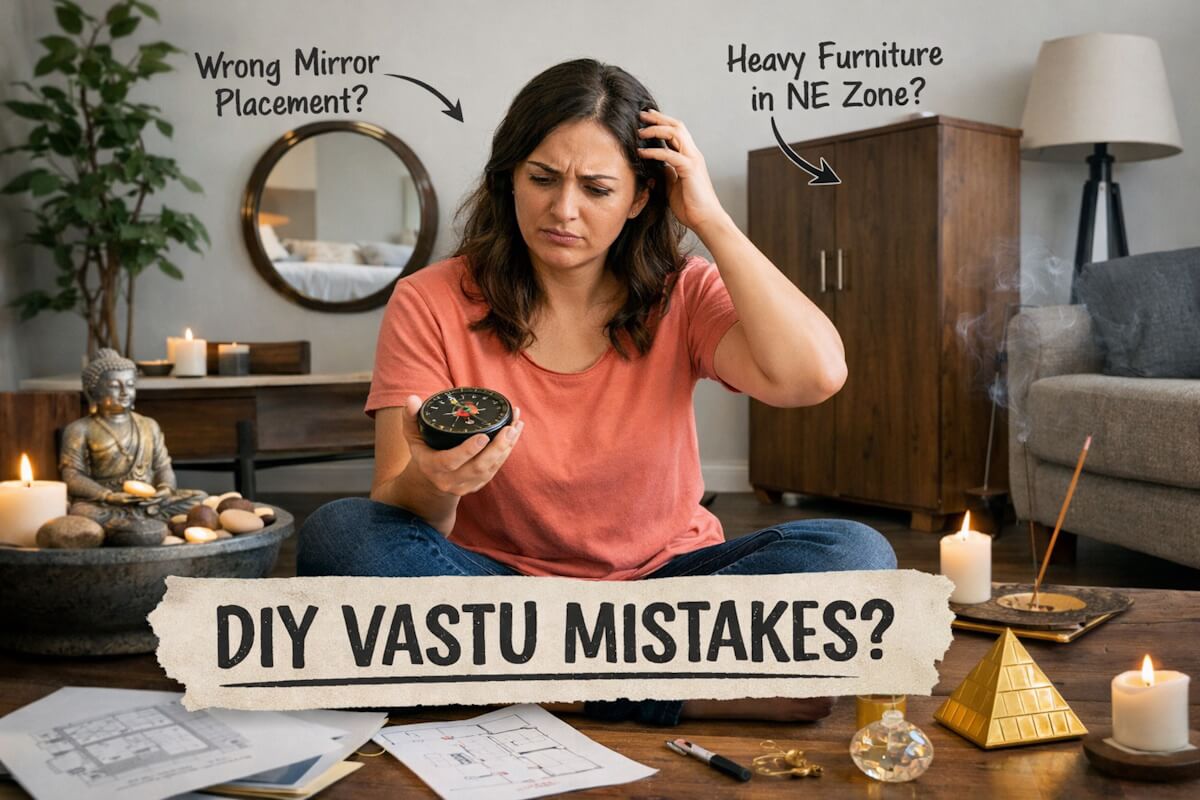
Most people start DIY Vastu corrections with good intent. You notice something feels off at home. Sleep is light. Money leaks. Arguments feel unnecessary. You search online, watch a few videos, read a couple of posts, and decide to fix things yourself. That approach is understandable. It feels practical and saves money.
Yet this is where many people go wrong.
Vastu is not fragile, but it is specific. Small misunderstandings can quietly create bigger imbalance than the original problem. This article walks you through the most common mistakes people make while doing DIY Vastu corrections, especially in apartments, modern homes, and commercial spaces. If you see yourself in some of these points, that is normal. The idea is not guilt. It is clarity.
Let’s get into it.
Treating Vastu Like a Decoration Hack
One of the biggest mistakes is assuming Vastu corrections work like interior decor tweaks. Move a plant here. Add a mirror there. Light a lamp and everything settles.
Vastu does not respond to surface-level styling. It works with direction, weight, openness, usage, and flow. When you treat it like a décor checklist, results remain inconsistent.
For example, placing water bowls or wind chimes without understanding why that zone needs correction often backfires. A water element in the wrong direction can increase restlessness or financial instability instead of calming things down.
Before adding anything, ask yourself one question. What exactly am I correcting here?
If you do not know the answer, pause.
Overcorrecting Every Single Zone
Another common issue is trying to fix everything at once.
You read that north affects money, south affects stability, east affects health, west affects gains. Suddenly, every corner feels wrong. You start loading the house with cures everywhere.
This creates energetic clutter.
Vastu works best when corrections are minimal and purposeful. Overloading zones with remedies creates confusion rather than balance. Many people feel tired or mentally heavy after excessive DIY fixes and cannot figure out why.
Your home does not need constant intervention. It needs clarity in usage and balance in structure.
Less is usually more.
Blindly Following Generic Online Advice
Online advice is everywhere. Reels. Shorts. Blogs. Forums. Most of it is generic and context-free.
What works for one layout may harm another.
A common example is mirror placement. Some sources say mirrors double wealth. Others say mirrors increase stress. Both can be true depending on direction, reflection, and room function.
When you blindly follow advice without mapping it to your actual floor plan, you are guessing, not correcting.
DIY Vastu requires understanding your specific layout first. Generic tips are starting points, not final instructions.
Ignoring the Building Structure
Many DIY corrections focus only on furniture and objects, ignoring the building itself.
In apartments and high-rise homes, structural elements matter more than movable items. Columns, beams, cut corners, extended balconies, and staircases have strong influence.
People often try to fix structural defects using crystals, pyramids, or symbols. That rarely works long term.
If the structure is dominating the energy, surface-level remedies give only temporary relief or no change at all.
DIY works best for usage-based issues, not for major structural flaws.
Using Remedies Without Understanding Elements
Vastu works on five elements. Earth, water, fire, air, and space.
A major mistake is using remedies without knowing which element is already dominant or missing in that zone.
For instance, adding water features in a zone already heavy with water element creates emotional instability. Adding fire elements in an overheated zone increases anger or sleep issues.
Many people add salt bowls everywhere assuming they absorb negativity. Salt is not neutral. It interacts with water and space elements. Misuse leads to lethargy and mental dullness.
Before placing any remedy, understand the elemental balance of that space.
Fixing Direction Without Checking Usage
Direction alone does not decide everything. Usage matters just as much.
People often panic when they hear things like kitchen in north east or bedroom in south east. They rush to fix it without observing how the space is actually used.
If a kitchen is lightly used and well-ventilated, its impact differs from a heavily used one. A bedroom used only for rest behaves differently from a multipurpose room.
DIY corrections fail when direction is corrected without aligning usage.
Ask yourself how that space is actually functioning daily.
Misplacing Heavy Objects in Sensitive Zones
Another frequent mistake is placing heavy objects like cupboards, safes, or storage units based on convenience rather than direction.
North east and east zones are sensitive. They need openness and lightness. People often place heavy wardrobes there simply because the wall is empty.
Then they wonder why clarity, focus, or opportunities feel blocked.
DIY corrections sometimes worsen this by adding more items to already burdened zones.
Before adding, consider removing weight first.
Assuming One Remedy Solves All Problems
Many people look for a single magical fix.
A copper strip. A yantra. A pyramid. A symbol.
They expect one item to fix health, money, relationships, and career all together.
Vastu does not work like that.
Each issue has a different root. Money blocks often come from north or entry issues. Health issues relate to kitchen, bedroom, or sleeping direction. Relationship tension ties to south west imbalance or bedroom usage.
When you expect one remedy to handle everything, disappointment follows.
Target the problem. Then choose the correction.
Ignoring Entrance and Movement Flow
DIY Vastu corrections often focus on rooms and corners, while ignoring the entrance and movement flow.
Your main door and internal movement paths carry more energy than static objects.
People place showpieces and plants near entrances without checking door swing, light availability, or clutter.
If energy struggles to enter smoothly, internal remedies lose strength.
Check if your entrance is blocked, dark, noisy, or overloaded. That matters more than decorative fixes inside.
Constantly Changing Remedies
Another overlooked mistake is impatience.
People place a remedy today, remove it next week, replace it with something else after watching another video. The space never stabilizes.
Vastu corrections need time. Energy responds slowly, especially in lived-in homes.
Constant changes confuse the environment and your own perception.
If you decide to do a correction, give it time to settle. Observe for a few weeks at least.
Treating Vastu as Fear-Based Rules
Some DIY advice creates fear. Don’t sit here. Don’t sleep there. Don’t place this anywhere.
This fear-based approach causes stress and hyper-awareness, which itself disturbs peace at home.
Vastu is meant to support daily life, not control it.
If a correction makes you anxious or overly restrictive, it is probably wrong or incomplete.
A good correction should feel logical and easy to live with.
Forgetting Personal Compatibility
Homes are lived by people, not theories.
DIY corrections often ignore the age, profession, routine, and mental state of occupants.
A home for a working couple behaves differently from a home with elderly parents or young children. A person working night shifts needs different balance than someone working mornings.
Applying textbook rules without personal context reduces effectiveness.
Always adjust Vastu to suit real life, not the other way around.
Using Symbols Without Belief or Understanding
Some people place symbols purely because someone said so, without belief or understanding.
While belief is not everything, intention matters. Placing something you do not connect with often results in neglect or removal later.
A neglected remedy becomes dead weight.
Choose corrections that make sense to you. If you understand why it is there, you are more likely to maintain it properly.
Overlooking Maintenance and Cleanliness
DIY corrections fail when basic upkeep is ignored.
Dusty corners, broken items, leaking taps, unused clutter all cancel out remedies.
People place crystals in messy spaces and expect change.
Energy responds to cleanliness and order first. Remedies come second.
Before correcting, clean. Maintain. Repair.
This step alone fixes many issues people try to solve with objects.
Assuming Renters Cannot Do Vastu
Many renters assume DIY Vastu does not apply to them. Or they try aggressive fixes that are not practical.
Renters should focus on movable items, usage patterns, sleeping direction, lighting, and decluttering.
Trying to fix structural issues in rented spaces often leads to frustration.
Work with what you can control. Even small shifts matter.
Copying Others Without Similar Layouts
You see a friend’s correction working well. You copy it at home.
Layouts differ. Directions differ. Even floor levels differ.
What helped someone else may not suit your home at all.
DIY Vastu is personal. Comparisons mislead.
Always evaluate your own space independently.
Expecting Instant Results
One of the most common mistakes is expecting overnight change.
Vastu corrections influence long-term patterns. They rarely create instant miracles.
If you expect sudden wealth, perfect health, or zero conflict immediately, you will feel disappointed.
Watch for subtle changes first. Better sleep. Improved mood. Reduced friction. Clearer thinking.
Those are signs things are moving in the right direction.
Final Thoughts Without Wrapping It Up Neatly
DIY Vastu corrections can help. They really can. Many small shifts done correctly bring noticeable improvement.
The problem is not DIY itself. The problem is rushed, copied, or fear-driven DIY.
If you want to correct your space, slow down. Observe. Understand your layout. Respect the basics. Remove clutter before adding remedies. Give changes time.
Your home already supports you in many ways. Vastu corrections are about removing friction, not forcing perfection.
If something feels confusing or heavy, that is your cue to step back and reassess.
Your space should feel easier to live in, not harder.