When a business space struggles, people often blame the market, staff, pricing, or timing. All of that matters, no doubt. Yet many owners miss something more basic – how the space itself behaves. Walls, doors, desks, cash counters, storage, and even unused corners quietly influence daily operations. This is where 16 Zone Vastu becomes practical rather than philosophical.
Unlike basic Vastu that focuses on directions alone, 16 Zone Vastu breaks a property into precise energy sections. Each section affects a specific business function. When these zones work properly, decision-making feels clearer, staff stability improves, cash flow becomes smoother, and growth stops feeling forced. When ignored, even strong businesses feel stuck.
This approach works especially well for offices, shops, factories, warehouses, hospitals, hotels, co-working spaces, and high-rise commercial units where traditional layouts rarely match textbook Vastu rules.
Understanding the 16 Zone Vastu System in Business Spaces
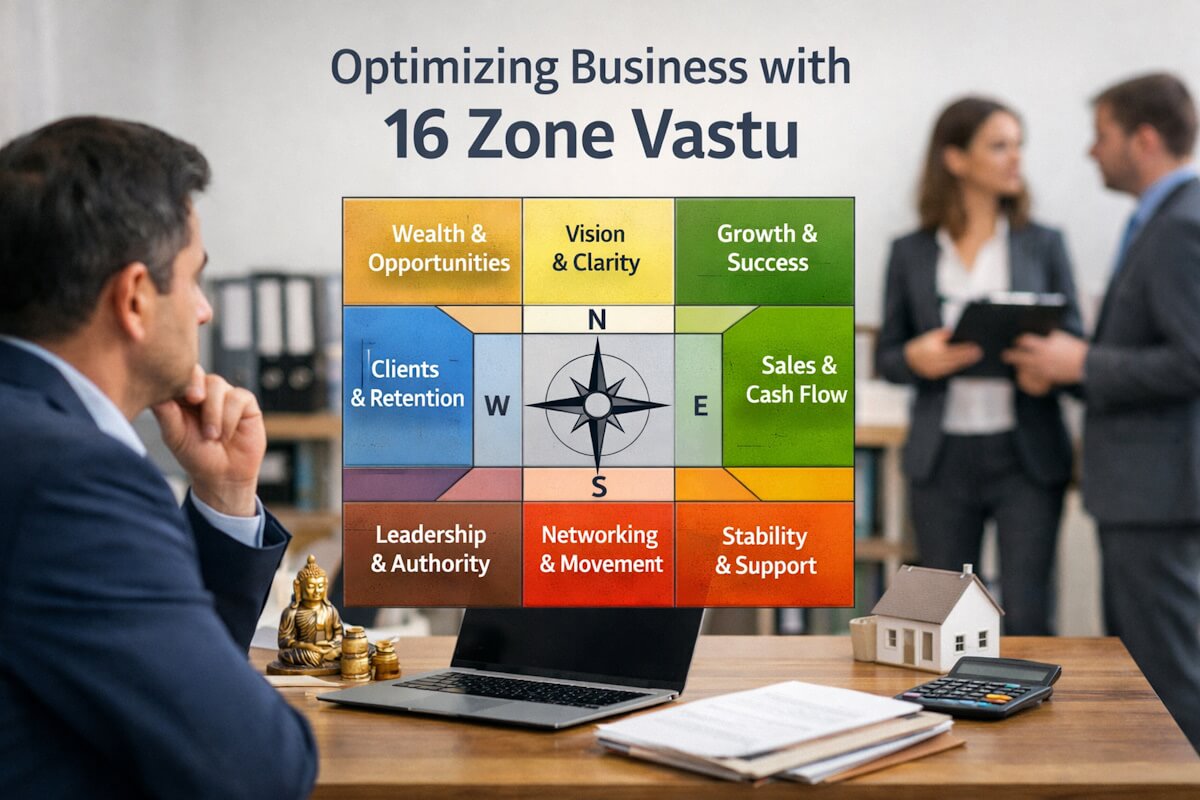
Most people are familiar with eight directions. North, South, East, West, and the corners. The 16 Zone system goes deeper. Each direction is further divided into micro zones. These zones are not symbolic. They are functional.
In commercial properties, each zone connects with a specific business activity like leadership, finance, marketing, legal matters, inventory, networking, staff discipline, or innovation.
This matters because modern buildings do not allow complete freedom. You might not be able to move a staircase or shift a lift shaft. The 16 Zone method works within these limits. Instead of redesigning everything, you correct what is possible inside each zone.
Think of it as tuning a machine instead of replacing it.
Why Direction-Based Vastu Alone Often Fails in Commercial Properties
Many business owners try basic fixes. Place the owner in the southwest. Keep cash in the north. Avoid toilets in the northeast. These ideas are useful but incomplete.
Here is the real issue. Large offices and commercial buildings have multiple activities happening at once. Sales teams, accounts, IT, storage, legal, HR, customer handling, and leadership all sit under one roof. One direction cannot support everything.
That is why two businesses in the same building can perform very differently.
The 16 Zone approach separates overlapping energies. It explains why a north-facing office can still suffer financial instability. Or why a well-located shop sees heavy footfall but poor conversions.
How Each Zone Impacts Key Business Functions
Let us break this down in a way that connects directly to real commercial situations.
North Zone – Income Flow and Opportunities
This zone governs cash inflow, new clients, and daily revenue movement. In many offices, this area is blocked by heavy storage, server rooms, or dead files. That slows money cycles.
In retail stores, clutter or dark lighting here often results in steady walk-ins but inconsistent billing.
Simple corrections like reducing weight, improving lighting, and keeping this zone active can make collections smoother.
North East Zone – Vision, Trust, and Brand Perception
This zone shapes how people perceive your business. Reputation, credibility, and long-term vision come from here.
In clinics, law offices, and consulting firms, disturbance in this zone often shows up as trust issues, legal troubles, or confused branding.
Avoid heavy cabins, toilets, or electrical panels here. Open space, clarity, and calm work best.
East Zone – Growth, Marketing, and Expansion
This area fuels growth ideas and outward expansion. Marketing teams placed here often perform better.
If your business feels stagnant despite effort, check whether this zone is blocked or overloaded. Even small things like unused furniture or broken equipment can dull momentum.
South East Zone – Sales, Cash Handling, and Energy
This zone drives sales, billing, and transaction energy. It is ideal for accounts teams, cash counters, and sales operations.
In restaurants and retail, incorrect use of this zone often leads to high expenses or unstable profits. Fire-related elements belong here. Water elements do not.
South Zone – Stability and Process Discipline
This zone controls discipline, compliance, and workflow structure. Factories and process-driven businesses benefit from proper usage here.
When misused, staff become careless, timelines stretch, and systems feel chaotic even if software and SOPs exist.
South West Zone – Leadership and Control
This is one of the most critical zones for business owners, directors, and decision-makers.
If this zone is weak, leadership feels unstable. Owners feel overworked, control slips, and staff dominance increases.
In many commercial spaces, this zone is mistakenly used for storage or left unused. That quietly weakens authority.
West Zone – Client Retention and Market Hold
The west governs retention, repeat business, and long-term contracts.
Businesses that get clients but struggle to keep them often have issues here. Service-based companies feel this sharply.
Correct use supports sustainability rather than quick wins.
North West Zone – Movement, Networking, and Staff Turnover
This zone handles movement. Sales travel, logistics, networking, and staff changes.
When balanced, it supports flexible growth. When disturbed, staff attrition rises and partnerships fail.
This zone suits meeting rooms and dynamic teams rather than fixed leadership cabins.
Applying 16 Zone Vastu in Offices and Corporate Spaces
Most offices today operate inside glass boxes, shared floors, and leased spaces. Structural changes are limited. This is where the 16 Zone system shines.
Instead of relocating walls, focus on:
- Cabin placement within zones
- Desk orientation
- Storage load distribution
- Lighting balance
- Electronic equipment positioning
For example, placing senior leadership cabins slightly shifted into the southwest sub-zone can improve decision control without breaking lease rules.
Accounts teams positioned closer to the southeast sub-zone often see better coordination and fewer errors.
Meeting rooms in the northwest zone support negotiations without dragging decisions endlessly.
These are subtle shifts, yet the impact is noticeable over months.
Retail Stores and Showrooms – Turning Footfall into Revenue
Many shops have great locations but poor closure rates. Owners blame pricing or staff skills. Sometimes the problem is simpler.
Retail stores rely heavily on:
- Entrance zone activation
- Cash counter placement
- Product display flow
- Storage weight balance
The 16 Zone method helps align these without altering the shopfront.
For instance, placing the billing counter in the southeast sub-zone improves transaction flow. Keeping the northeast light and open improves customer comfort and trust. Avoiding dead stock in the north keeps revenue cycles active.
This matters more in malls where every store competes visually.
Factories, Warehouses, and Industrial Units
Industrial spaces deal with machinery, raw materials, finished goods, and staff movement. Basic Vastu advice often fails here.
The 16 Zone approach separates:
- Raw material storage zones
- Production zones
- Quality control zones
- Finished goods holding areas
- Admin and leadership sections
Improper placement often causes machine breakdowns, wastage, labor disputes, or compliance issues.
Balancing heavy loads in southwest sub-zones and keeping movement zones clear reduces friction. Offices placed carelessly inside factories often suffer burnout. Proper zoning changes that.
Commercial Buildings and Mixed-Use Properties
Builders and investors often overlook Vastu beyond entrance direction. That is risky.
In mixed-use buildings with shops, offices, and services stacked vertically, internal zoning matters more than orientation.
The 16 Zone method can be applied floor-wise and unit-wise. Even when entrances vary, internal layouts can be corrected.
This is useful for:
- Rental income stability
- Tenant retention
- Legal peace
- Maintenance cost control
Buildings with poor zone balance often see frequent tenant changes and disputes.
Why 16 Zone Vastu Works Better Than Surface-Level Remedies
Crystals, symbols, and color changes get attention. They rarely solve structural imbalance.
16 Zone Vastu works because it is logic-based. Each zone supports a specific activity. When that activity sits elsewhere, friction appears.
This method does not promise miracles. It removes invisible resistance.
Businesses already doing well often use it to stabilize growth. Struggling businesses use it to identify blind spots they never considered.
Common Mistakes Business Owners Make with Vastu
One major mistake is copying someone else’s layout. Another is treating Vastu as decoration.
Some assume one correction fixes everything. Business spaces are complex. They need layered adjustments.
Ignoring unused zones is another error. Empty corners still carry influence.
The 16 Zone approach forces you to look at the entire space honestly.
When Should You Consider a 16 Zone Vastu Review
If any of these sound familiar, it may be time:
- Revenue is inconsistent despite effort
- Staff turnover feels unusually high
- Legal or compliance issues repeat
- Expansion plans stall
- Leadership feels overwhelmed
- Expenses rise without clarity
These are not always market problems. Often the space is working against you.
Practical Takeaway for Business Owners and Investors
You do not need blind belief. Treat 16 Zone Vastu like a diagnostic tool.
Start by understanding what activity sits in which zone. Observe patterns over time. Make corrections that fit your operational reality.
Commercial success is not only about strategy and execution. The space supporting that effort matters more than most people realize.
If you want your business property to support growth instead of draining energy, the 16 Zone approach gives structure to that process. Quietly. Practically. Without drama.
The space you work in every day should help you think clearly, act decisively, and grow steadily. If it does not, the zones deserve a closer look.